

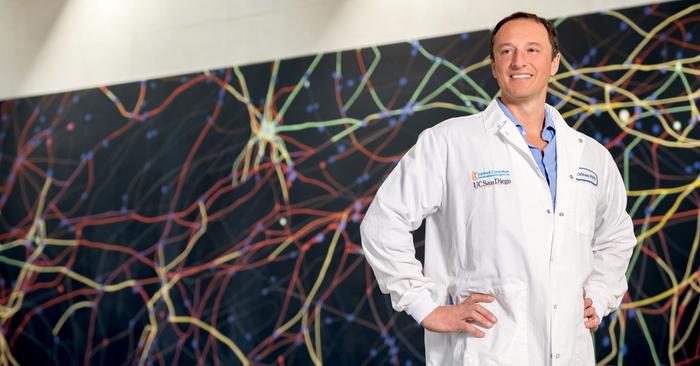
Researchers worldwide can now create highly realistic brain cortical organoids — essentially miniature artificial brains with functioning neural networks — thanks to a proprietary protocol released this month by researchers at the University of California San Diego.

Credit: UC San Diego Health Sciences
Researchers worldwide can now create highly realistic brain cortical organoids — essentially miniature artificial brains with functioning neural networks — thanks to a proprietary protocol released this month by researchers at the University of California San Diego.
The new technique, published in Nature Protocols, paves the way for scientists to perform more advanced research regarding autism, schizophrenia and other neurological disorders in which the brain’s structure is usually typical, but electrical activity is altered. That’s according to Alysson Muotri, Ph.D., corresponding author and director of the UC San Diego Sanford Stem Cell Institute (SSCI) Integrated Space Stem Cell Orbital Research Center. The SSCI is directed by Dr. Catriona Jamieson, a leading physician-scientist in cancer stem cell biology whose research explores the fundamental question of how space alters cancer progression.
The newly detailed method allows for the creation of tiny replicas of the human brain so realistic that they rival “the complexity of the fetal brain’s neural network,” according to Muotri, who is also a professor in the UC San Diego School of Medicine’s Departments of Pediatrics and Cellular and Molecular Medicine. His brain replicas have already traveled to the International Space Station (ISS), where their activity was studied under conditions of microgravity.
Two other protocols for creating brain organoids are publicly accessible, but neither allow researchers to study the brain’s electrical activity. Muotri’s method, however, allows researchers to study neural networks created from the stem cells of patients with various neurodevelopmental conditions.
“You no longer need to create different regions and assemble them together,” said Muotri, adding that his protocol allows different brain areas — like the cortex and midbrain — “to co-develop, as naturally observed in human development.”
“I believe we will see many derivations of this protocol in the future for the study of different brain circuits,” he added.
Such “mini brains” can be used to test potentially therapeutic drugs and even gene therapies before patient use, as well as to screen for efficacy and side effects, according to Muotri.
A plan to do so is already in the works. Muotri and researchers at the Federal University of Amazonas in Manaus, Amazonas, Brazil, are teaming up to record and investigate Amazonian tribal remedies for Alzheimer’s disease — not on Earth-based mouse models, but on diseased human brain organoids in space.
A recent Humans in Space grant — awarded by Boryung, a leading health care investment company based in South Korea — will help fuel the research project, which spans multiple continents and habitats, from the depths of the Amazon rainforest to Muotri’s lab on the coast of California — and, eventually, to the International Space Station.
Other research possibilities for the brain organoids include disease modeling, understanding human consciousness and additional space-based experiments. In March, Muotri — in partnership with NASA — sent to space a number of brain organoids made from the stem cells of patients with Alzheimer’s disease and ALS (amyotrophic lateral sclerosis, also known as Lou Gehrig’s disease). The payload returned in May and results, which will eventually be published, are being reviewed.
Because microgravity mimics an accelerated version of Earth-based aging, Muotri should be able to witness the effects of several years of disease progression while studying the month-long mission’s payload, including potential changes in protein production, signaling pathways, oxidative stress and epigenetics.
“We’re hoping for novel findings — things researchers haven’t discovered before,” he said. “Nobody has sent such a model into space, until now.”
Co-authors of the study include Michael Q. Fitzgerald, Tiffany Chu, Francesca Puppo, Rebeca Blanch and Shankar Subramaniam, all of UC San Diego, and Miguel Chillón, of the Universitat Autònoma de Barcelona and the Institució Catalana de Recerca i Estudis Avançats, both in Barcelona, Spain. Blanch is also affiliated with the Universitat Autònoma de Barcelona.
This work was supported by the National Institutes of Health R01MH100175, R01NS105969, MH123828, R01NS123642, R01MH127077, R01ES033636, R21MH128827, R01AG078959, R01DA056908, R01HD107788, R01HG012351, R21HD109616, R01MH107367, California Institute for Regenerative Medicine (CIRM) DISC2-13515 and a grant from the Department of Defense W81XWH2110306.
About the Sanford Stem Cell Institute
The UC San Diego Sanford Stem Cell Institute (SSCI) is a global leader in regenerative medicine and a hub for stem cell science and innovation in space. SSCI aims to catalyze critical basic research discoveries, translational advances and clinical progress — terrestrially and in space — to develop and deliver novel therapeutics to patients.
# # #
Journal
Nature Protocols
COI Statement
Muotri is a cofounder and has equity interest in TISMOO, a company dedicated to genetic analysis and brain organoid modeling focusing on therapeutic applications customized for autism spectrum disorder (ASD) and other neurological disorders with genetic origins. He is also the inventor of several patents related to human functional brain organogenesis, including the protocol described in the new publication.

