


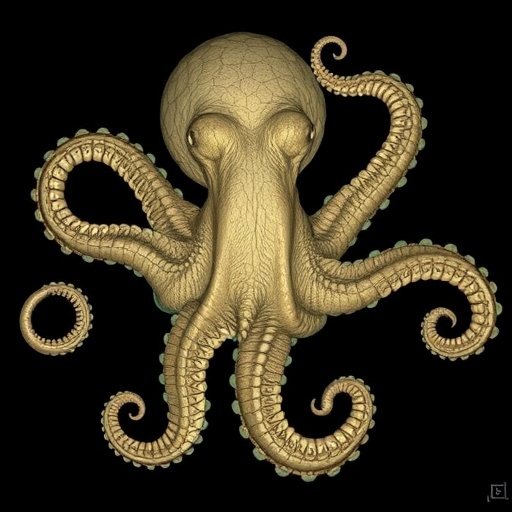
A 300-million-year-old fossil, long hailed as the world’s oldest octopus, has been revealed to be an entirely different creature thanks to cutting-edge imaging techniques. This discovery not only overturns decades of scientific consensus but also rewrites a critical chapter in the evolutionary history of cephalopods. Once included in the Guinness Book of Records, the fossil known as Pohlsepia mazonensis has now been firmly excluded from the octopus lineage. Instead, researchers have identified it as a relative of the modern Nautilus, an ancient marine mollusc renowned for its external shell and distinctive tentacles.
The original identification of Pohlsepia mazonensis as an octopus was based on external morphology and surface characteristics observable in the fossilized remains. These included apparent arm-like structures and body shapes reminiscent of octopuses, leading scientists in 2000 to postulate that this specimen represented a major pushback in the timeline of octopus evolution by roughly 150 million years. However, this interpretation always faced scrutiny, primarily because the fossil did not exhibit the complete defining features of true octopuses, such as the absence of external shells.
Recent advances in synchrotron imaging, which involves the use of extremely bright and focused beams of X-rays, permitted researchers to peer within the fossil matrix in unprecedented detail. This non-destructive technique allowed the team to detect minute internal structures hidden beneath the fossil’s surface. The new analyses revealed the presence of radular teeth, a specialized molluscan feeding apparatus comprised of rows of small teeth arranged in a ribbon-like configuration. This radical anatomical insight undermined the previous octopus attribution.
Crucially, the tooth count and morphology in the radula differed significantly from what is observed in octopuses. Octopuses typically exhibit radulae with seven to nine teeth per row, whereas the newly discovered fossil bore at least eleven teeth per row. Such characteristics are consistent with nautiloids—a group that includes the modern Nautilus—known for having up to thirteen teeth per radular row. This pattern closely matched that of another fossil species, Paleocadmus pohli, previously discovered in the same Mazon Creek deposits in Illinois.
The fossilization process had long obscured the true identity of Pohlsepia mazonensis, with post-mortem decay contributing to its octopus-like appearance. Detailed forensic examination using synchrotron light effectively conducted a “cold case” investigation of this ancient specimen, revealing that decomposition prior to fossilization altered the external morphology. These findings definitively place Pohlsepia within the nautiloid lineage, highlighting the challenges of interpreting soft-bodied fossil preservation.
This reassignment substantially impacts our understanding of cephalopod evolution and biogeographic timelines. As nautiloids are considered “living fossils” due to their conserved morphology over hundreds of millions of years, the discovery of the oldest known soft tissue of a nautiloid challenges assumptions about when soft-bodied cephalopods diversified. Pohlsepia now represents the earliest known example of soft tissue preservation in nautiloids—surpassing previous records by approximately 220 million years.
With Pohlsepia’s reevaluation, the timeline for the emergence of octopuses, scientifically known as octobrachians, shifts forward dramatically. The data now support the hypothesis that modern octopuses did not appear until the Jurassic Period, some 150 million years later than Pohlsepia’s age. Furthermore, the divergence between octopuses and their ten-armed cephalopod relatives, such as squids, likely occurred during the Mesozoic Era, overturning the idea of a Palaeozoic origin for these groups.
This discovery underscores the importance of integrating novel imaging technologies in paleontological research, particularly when evaluating enigmatic and controversial fossils. By uncovering tiny but critical anatomical features, researchers can challenge and refine long-held scientific narratives. The Pohlsepia case exemplifies how modern scientific tools can redefine evolutionary milestones and reshape textbook depictions of life’s history.
Dr. Thomas Clements, the study’s lead author and a lecturer specializing in invertebrate zoology at the University of Reading, articulated the revolutionary nature of this finding. He emphasized that this was more than just a taxonomic correction; the tiny radular teeth, preserved for 300 million years, allowed scientists to peel back the layers of history and understand cephalopod evolution with newfound clarity. Such breakthroughs demonstrate that fossil reinterpretations, driven by modern methodologies, can yield transformative insights.
The research was published on April 8, 2026, in the journal Proceedings of the Royal Society B Biological Sciences. The article, titled “Synchrotron data reveal nautiloid-characters in Pohlsepia mazonensis, refuting a Palaeozoic origin for octobrachians,” presents detailed synchrotron imaging analyses combined with comparative anatomical studies. These data collectively affirm the fossil’s placement within the Nautiloidea rather than the Octobrachia clade.
Pohlsepia’s discovery site, Mazon Creek in Illinois, is known for its exceptional fossil preservation, where soft tissues are often fossilized alongside hard parts. This makes it a crucial window into Cambrian and later faunas, shedding light on the ecology and morphology of soft-bodied and lightly sclerotized organisms. The identification of nautiloid features in this specimen enhances the paleontological significance of the Mazon Creek Lagerstätte and encourages renewed examination of existing collections under modern imaging technologies.
In summary, redefining Pohlsepia mazonensis as a nautiloid relative realigns evolutionary timelines and alters interpretations of early cephalopod diversity. It dispels the myth of the “oldest octopus” and highlights the nuanced processes by which fossils can be misinterpreted due to taphonomic effects. This milestone discovery not only reconfigures scientific understanding but also demonstrates the power of advanced imaging techniques in unlocking Earth’s deepest biological mysteries.
News Publication Date: 8 April 2026
Cite Scienmag News
Drew Townsend. (April 7, 2026). Scans Reveal ‘Oldest Octopus’ Fossil Is Not an Octopus After All. Scienmag. https://scienmag.com/scans-reveal-oldest-octopus-fossil-is-not-an-octopus-after-all/
Drew Townsend. "Scans Reveal ‘Oldest Octopus’ Fossil Is Not an Octopus After All." Scienmag, 7 April 2026, https://scienmag.com/scans-reveal-oldest-octopus-fossil-is-not-an-octopus-after-all/. Accessed 3 September 2026.
Drew Townsend. "Scans Reveal ‘Oldest Octopus’ Fossil Is Not an Octopus After All." Scienmag. April 7, 2026. https://scienmag.com/scans-reveal-oldest-octopus-fossil-is-not-an-octopus-after-all/


