


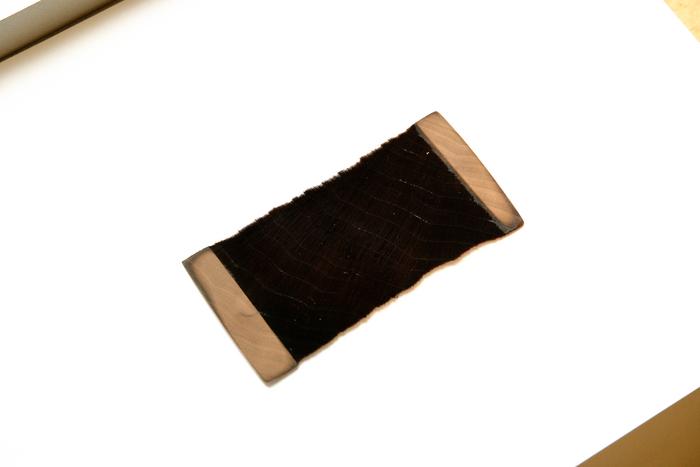
Thanks to an accidental discovery, researchers at the University of British Columbia have created a new super-black material that absorbs almost all light, opening potential applications in fine jewelry, solar cells and precision optical devices.

Credit: Photo credit: UBC Forestry/Ally Penders
Thanks to an accidental discovery, researchers at the University of British Columbia have created a new super-black material that absorbs almost all light, opening potential applications in fine jewelry, solar cells and precision optical devices.
Professor Philip Evans and PhD student Kenny Cheng were experimenting with high-energy plasma to make wood more water-repellent. However, when they applied the technique to the cut ends of wood cells, the surfaces turned extremely black.
Measurements by Texas A&M University’s department of physics and astronomy confirmed that the material reflected less than one per cent of visible light, absorbing almost all the light that struck it.
Instead of discarding this accidental finding, the team decided to shift their focus to designing super-black materials, contributing a new approach to the search for the darkest materials on Earth.
“Ultra-black or super-black material can absorb more than 99 per cent of the light that strikes it – significantly more so than normal black paint, which absorbs about 97.5 per cent of light,” explained Dr. Evans, a professor in the faculty of forestry and BC Leadership Chair in Advanced Forest Products Manufacturing Technology.
Super-black materials are increasingly sought after in astronomy, where ultra-black coatings on devices help reduce stray light and improve image clarity. Super-black coatings can enhance the efficiency of solar cells. They are also used in making art pieces and luxury consumer items like watches.
The researchers have developed prototype commercial products using their super-black wood, initially focusing on watches and jewelry, with plans to explore other commercial applications in the future.
Wonder wood
The team named and trademarked their discovery Nxylon (niks-uh-lon), after Nyx, the Greek goddess of the night, and xylon, the Greek word for wood.
Most surprisingly, Nxylon remains black even when coated with an alloy, such as the gold coating applied to the wood to make it electrically conductive enough to be viewed and studied using an electron microscope. This is because Nxylon’s structure inherently prevents light from escaping rather than depending on black pigments.
The UBC team have demonstrated that Nxylon can replace expensive and rare black woods like ebony and rosewood for watch faces, and it can be used in jewelry to replace the black gemstone onyx.
“Nxylon’s composition combines the benefits of natural materials with unique structural features, making it lightweight, stiff and easy to cut into intricate shapes,” said Dr. Evans.
Made from basswood, a tree widely found in North America and valued for hand carving, boxes, shutters and musical instruments, Nxylon can also use other types of wood such as European lime wood.
Breathing new life into forestry
Dr. Evans and his colleagues plan to launch a startup, Nxylon Corporation of Canada, to scale up applications of Nxylon in collaboration with jewellers, artists and tech product designers. They also plan to develop a commercial-scale plasma reactor to produce larger super-black wood samples suitable for non-reflective ceiling and wall tiles.
“Nxylon can be made from sustainable and renewable materials widely found in North America and Europe, leading to new applications for wood. The wood industry in B.C. is often seen as a sunset industry focused on commodity products—our research demonstrates its great untapped potential,” said Dr. Evans.
Other researchers who contributed to this work include Vickie Ma, Dengcheng Feng and Sara Xu (all from UBC’s faculty of forestry); Luke Schmidt (Texas A&M); and Mick Turner (The Australian National University).
To schedule interviews with the researchers or to access b-roll and additional images, please contact lou.bosshart@ubc.ca
Journal
Advanced Sustainable Systems
Method of Research
Experimental study
Subject of Research
Not applicable
Article Title
Super-Black Material Created by Plasma Etching Wood
Article Publication Date
16-Jun-2024
Cite Scienmag News
Bethany Barker. (July 30, 2024). UBC super-black wood can improve telescopes, optical devices and consumer goods. Scienmag. https://scienmag.com/ubc-super-black-wood-can-improve-telescopes-optical-devices-and-consumer-goods/
Bethany Barker. "UBC super-black wood can improve telescopes, optical devices and consumer goods." Scienmag, 30 July 2024, https://scienmag.com/ubc-super-black-wood-can-improve-telescopes-optical-devices-and-consumer-goods/. Accessed 5 September 2026.
Bethany Barker. "UBC super-black wood can improve telescopes, optical devices and consumer goods." Scienmag. July 30, 2024. https://scienmag.com/ubc-super-black-wood-can-improve-telescopes-optical-devices-and-consumer-goods/

