

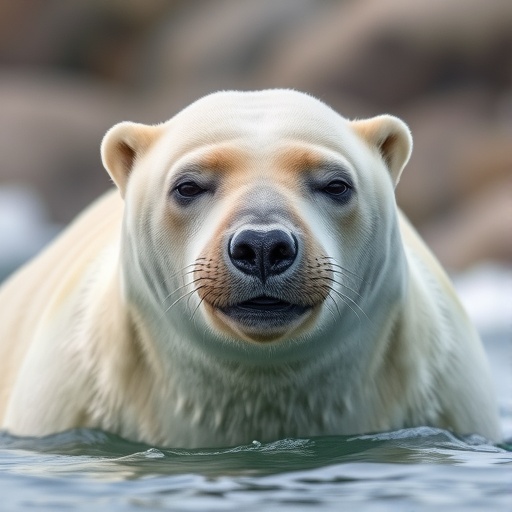
As the Arctic undergoes rapid transformation due to climate change, the dynamic between predators and prey is being fundamentally reshaped. A groundbreaking study conducted by researchers from the University of British Columbia (UBC), York University, and government bodies provides new insight into how ringed seals in eastern Hudson Bay adjust their behavior in response to both the threat of polar bears and the availability of diverse prey. Employing cutting-edge GPS tracking and ecological modeling methods, the study reveals a complex balance of risk and reward that challenges conventional assumptions about predator-prey interactions in evolving Arctic ecosystems.
The Arctic’s changing ice landscapes dramatically influence the survival tactics of species that depend on this environment. The research team, led by Dr. Katie Florko during her doctoral work at UBC’s Institute for the Oceans and Fisheries (IOF), equipped 26 ringed seals and 39 polar bears with GPS collars capable of recording spatial movements and diving behavior. By integrating this high-resolution telemetry data with daily sea-ice maps and temporal models depicting fish biodiversity beneath the ice, the scientists constructed a detailed picture of how predator presence and prey composition jointly govern seal foraging strategies.
Results highlight that seals are not merely avoiding areas heavily frequented by polar bears but are instead displaying remarkable behavioral plasticity. Seals transiently pass through zones of intense bear activity but extend their underwater foraging durations when encountering a particularly varied fish assemblage, even within these dangerous predation hotspots. Conversely, in regions safer from bears, seals tend to dive for shorter intervals when prey diversity is high, indicating an opportunistic adjustment to food abundance. This nuanced response suggests that the cost-benefit calculus governing anti-predator behavior is significantly influenced by the diversity and availability of prey resources.
The concept underpinning these findings relates to the ecological “portfolio effect,” an analogy borrowed from financial diversification. Just as investors mitigate economic risk by spreading capital across multiple assets, seals seemingly diversify their diet to buffer against fluctuations in prey availability caused by climate-induced environmental instability. This strategy enhances their likelihood of successful feeding despite the presence of apex predators like polar bears, whose hunting ranges are simultaneously being compressed due to shrinking sea ice.
Methodologically, capturing polar bears for GPS collaring posed significant logistical challenges, demanding the use of helicopters and tranquilizer darts deployed by skilled rangers—a vivid illustration of the complexities involved in field-based Arctic ecological research. Such efforts underscore the importance of precise spatial data to comprehend behavioral patterns that are otherwise invisible but critical for refining conservation planning.
Intriguingly, the research also probed the possibility that seals might acoustically detect polar bears traversing ice surfaces, potentially delaying surfacing to avoid detection. While the study did not establish a definitive relationship, limitations in temporal resolution and the micro-scale nature of such interactions mean this possibility remains open for future investigation with more sensitive equipment or methodologies fine-tuned to capture ephemeral underwater acoustic cues.
The potential shift in predator assemblages prompted by climate change presents further challenges. Killer whales, which are superior swimmers compared to polar bears, are increasingly penetrating Arctic waters. Unlike the relatively slower terrestrial predators that seals can evade by diving, the presence of killer whales introduces a novel predation risk that might outpace seals’ existing anti-predator adaptations, suggesting an urgent need for monitoring how these emerging threats reshape predator-prey dynamics.
Moreover, declining sea ice coverage compresses the polar bears’ usable habitat, likely escalating their local density in shrinking patches of ice. This increased spatial overlap with seals may temporarily heighten predation pressure before polar bear populations themselves decline, indicating complex temporal dynamics in predator-prey risks that managers must anticipate when drafting conservation measures and population models.
The research also delivers a cautionary message to ecologists and wildlife managers about the necessity of holistic habitat modeling. Traditional models that map critical areas based solely on species distributions or prey density risk overlooking how predator presence shapes habitat use, especially under rapidly changing climatic conditions. Incorporating the “landscape of fear”—a conceptual model describing spatial variation in predation risk—enables the design of conservation strategies that more accurately reflect the real-world choices animals make to survive.
Food security and ecosystem health are inextricably tied to these ecological insights. Northern communities rely on seals and fish populations for sustenance and cultural heritage. By refining habitat maps to include both food availability and predation risk, wildlife management can better support sustainable harvesting, biodiversity conservation, and the resilience of Arctic food webs amid unprecedented environmental change.
This study, published in the prestigious journal Ecology Letters, represents a significant advancement in understanding the subtleties of Arctic marine ecology and underscores the importance of multidimensional data integration in wildlife research. It serves as a resounding call to reconsider simplistic assumptions about spatial ecology and to embrace complex interactive models that account for shifting predator-prey relationships shaped by climate change.
By merging innovative telemetry technology with ecological theory, the research illuminates mechanisms by which ringed seals navigate an increasingly treacherous seascape. Their strategic diversity in foraging decisions epitomizes adaptive resilience but also signals the fragility of these systems in the face of accelerating environmental transformations. As the Arctic ice continues to recede, ongoing scientific efforts must unravel these intertwined ecological puzzles to guide effective stewardship for future generations.
Subject of Research: Arctic predator-prey interactions, specifically ringed seal foraging behavior and polar bear predation dynamics under climate change.
Article Title: Not explicitly provided in the content.
News Publication Date: Not explicitly specified.
Web References:
References:
- Florko, K. et al. (Year). Ecology Letters. DOI: 10.1111/ele.70364
Image Credits: Katie Florko
Keywords: Foraging behavior, Behavioral ecology, Ecology, Bears, Pinnipeds, Marine mammals, Climate change, Range shifts


