


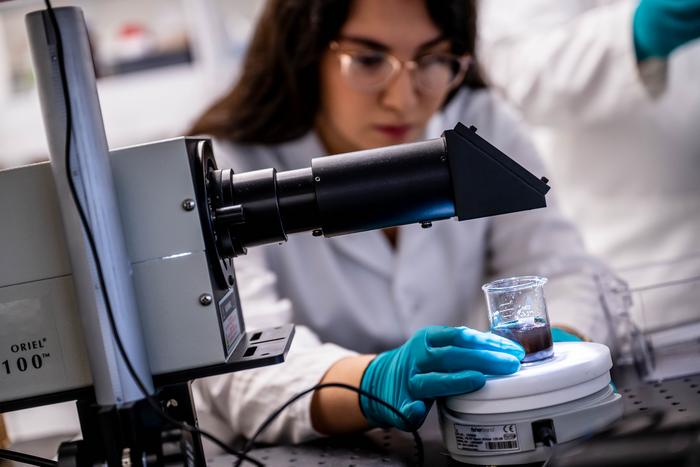
Chemical engineers at the University of British Columbia have developed a new treatment that traps and treats PFAS substances—widely known as “forever chemicals”—in a single, integrated system.

Credit: UBC Applied Science/Paul Joseph
Chemical engineers at the University of British Columbia have developed a new treatment that traps and treats PFAS substances—widely known as “forever chemicals”—in a single, integrated system.
Per- and polyfluoroalkyl substances (PFAS) are widely used in manufacturing consumer goods like waterproof clothing due to their resistance to heat, water and stains. However, they are also pollutants, often ending up in surface and groundwater worldwide, where they have been linked to cancer, liver damage and other health issues.
“PFAS are notoriously difficult to break down, whether they’re in the environment or in the human body,” explained lead researcher Dr. Johan Foster, an associate professor of chemical and biological engineering in the faculty of applied science. “Our system will make it possible to remove and destroy these substances in the water supply before they can harm our health.”
Catch and destroy
The UBC system combines an activated carbon filter with a special, patented catalyst that traps harmful chemicals and breaks them down into harmless components on the filter material. Scientists refer to this trapping of chemical components as adsorption.
“The whole process is fairly quick, depending on how much water you’re treating,” said Dr. Foster. “We can put huge volumes of water through this catalyst, and it will adsorb the PFAS and destroy it in a quick two-step process. Many existing solutions can only adsorb while others are designed to destroy the chemicals. Our catalyst system can do both, making it a long-term solution to the PFAS problem instead of just kicking the can down the road.”
No light? No problem
Like other water treatments, the UBC system requires ultraviolet light to work, but it does not need as much UV light as other methods.
During testing, the UBC catalyst consistently removed more than 85 per cent of PFOA (perfluorooctanoic acid, a type of forever chemical) even under low light conditions.
“Our catalyst is not limited by ideal conditions. Its effectiveness under varying UV light intensities ensures its applicability in diverse settings, including regions with limited sunlight exposure,” said Dr. Raphaell Moreira, a professor at Universität Bremen who conducted the research while working at UBC.
For example, a northern municipality that gets little sun could still benefit from this type of PFAS solution.
“While the initial experiments focused on PFAS compounds, the catalyst’s versatility suggests its potential for removing other types of persistent contaminants, offering a promising solution to the pressing issues of water pollution,” explained Dr. Moreira.
From municipal water to industry cleanups
The team believes the catalyst could be a low-cost, effective solution for municipal water systems as well as specialized industrial projects like waste stream cleanup.
They have set up a company, ReAct Materials, to explore commercial options for their technology.
“Our catalyst can eliminate up to 90 per cent of forever chemicals in water in as little as three hours—significantly faster than comparable solutions on the market. And because it can be produced from forest or farm waste, it’s more economical and sustainable compared to the more complex and costly methods currently in use,” said Dr. Foster.
The research was supported by an NSERC Discovery grant and was recently published in Nature Communications Engineering.
Journal
Communications Engineering
Cite Scienmag News
Bethany Barker. (August 28, 2024). UBC engineers develop all-in-one solution to catch and destroy ‘forever chemicals’. Scienmag. https://scienmag.com/ubc-engineers-develop-all-in-one-solution-to-catch-and-destroy-forever-chemicals/
Bethany Barker. "UBC engineers develop all-in-one solution to catch and destroy ‘forever chemicals’." Scienmag, 28 August 2024, https://scienmag.com/ubc-engineers-develop-all-in-one-solution-to-catch-and-destroy-forever-chemicals/. Accessed 6 September 2026.
Bethany Barker. "UBC engineers develop all-in-one solution to catch and destroy ‘forever chemicals’." Scienmag. August 28, 2024. https://scienmag.com/ubc-engineers-develop-all-in-one-solution-to-catch-and-destroy-forever-chemicals/

