


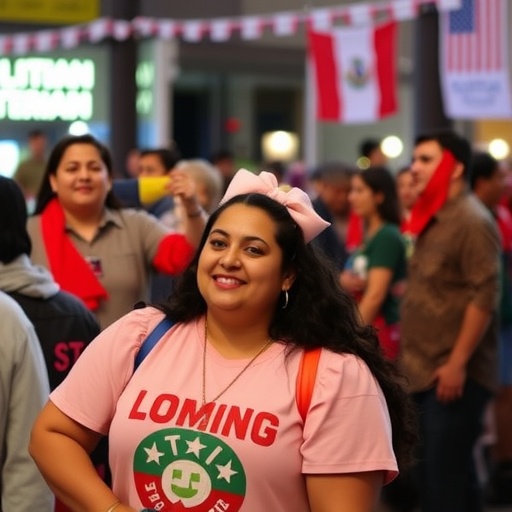
For the first time in the history of the United States, Latinos constitute one out of every five people in the country, marking a historic demographic milestone. Recent comprehensive analysis by the Latino GDP Project, a collaborative initiative between UCLA and California Lutheran University, has unveiled this remarkable growth based on data from the 2024 U.S. Census Bureau. This population expansion reflects an increase of approximately two million individuals since 2023, bringing the total estimated U.S. Latino population to over 68 million. This milestone has profound implications for the socioeconomic landscape of the nation.
This unprecedented growth in the Latino population is not merely a reflection of increasing numbers but signifies a transformative force within the labor market. The Latino labor force has demonstrated remarkable dynamism, experiencing a 5.5% increase in size in 2024 alone, reaching 35.1 million workers. This rate of labor force expansion notably surpasses that of the non-Latino population by 4.2 percentage points, underscoring the accelerating contribution of Latino workers to the U.S. economy. Since 2010, the Latino labor force’s growth rate has been 7.2 times faster than that of their non-Latino counterparts, indicating a fundamental shift in workforce demographics.
Labor force participation among Latinos has reached an all-time high, with a current rate of 69%. This participation rate exceeds that of the non-Latino population by a premium of 6.2 percentage points in 2024, the highest recorded differential. Labor force participation rate, a critical metric often influenced by a population’s age structure, education, and economic opportunities, reflects the high engagement of Latinos in economic activity. This rise in participation is linked to a cultural ethos emphasizing perseverance, optimism, and self-sufficiency, which the researchers suggest as underpinning factors driving labor market resilience and economic contribution.
The implications of this labor force expansion on the national economy are profound. The Latino GDP, a measure aggregating the economic output generated by Latino workers and businesses, has surged to $4.1 trillion, positioning it as the world’s fifth-largest economy, outpacing India. Since 2019, the Latino GDP has outperformed other major geopolitical economies, including China, signifying one of the fastest economic growth trajectories globally. This correlation between population growth, workforce expansion, and economic output underscores the Latino population’s pivotal role in sustaining and expanding U.S. economic vitality.
Examining natural population changes further elucidates the demographic momentum driving Latino growth. Despite experiencing disproportionate mortality rates during the COVID-19 pandemic, Latinos have sustained a positive natural increase—defined as births minus deaths—throughout the period from 2020 to 2024. This natural increase totaled an additional 3.2 million Latinos, contrasting sharply with a cumulative non-Latino natural decline of 1.3 million during the same period. This demographic resilience amidst crisis highlights the younger age profile and higher fertility rates characteristic of the Latino population, factors that will continue to shape future demographic trends and economic participation.
This comprehensive demographic and economic analysis challenges previous projections from the late 1980s, which had estimated Latino population growth to 58.8 million by this time, underscoring the conservative nature of earlier models. The unexpected acceleration in growth rates demonstrates the dynamism of population changes and the necessity for continuous methodological refinement in demographic forecasting. Modern data collection and analytic methodologies have enabled these insights, harnessing detailed census data paired with economic modeling to better capture the evolving realities of demographic transitions.
The Latino labor force’s rapid growth and elevated participation reflect broader structural shifts in the U.S. economy, including increased educational attainment, entrepreneurial activity, and integration into diverse sectors. This labor force vitality is critical in the context of an aging general population and declining birth rates among non-Latino groups, factors that pose challenges to sustained economic growth and social security systems. Latino workers, therefore, represent an increasingly essential component of the national productive capacity, innovation ecosystem, and consumer market.
Economic analysts highlight that these labor and population dynamics will have ripple effects across various sectors, from technology and manufacturing to services and education. The infusion of a growing and engaged Latino workforce contributes to increased consumer demand, higher earnings, and entrepreneurial ventures. These factors cumulatively generate a multiplicative effect on GDP growth, local economies, and tax bases. Policymakers and business leaders are thus urged to recognize and support Latino populations to sustain this positive trajectory.
The Latino GDP Project, which disseminates annual reports documenting these trends, underscores the reciprocal relationship between Latino population growth and the overall economic health of the United States. It emphasizes that Latino economic vibrancy is not ancillary but central to the country’s economic future. This perspective challenges economic and social narratives, advocating for inclusive policies that leverage the strengths of the Latino workforce and population for broader national benefit.
Moreover, the detailed analysis reveals a persistent “Latino labor force participation premium,” which is indicative of relative robustness compared to the general population. This premium quantifies the extent to which Latinos are more actively engaged in the labor market, a phenomenon driven by demographic factors such as younger median age and immigration dynamics, as well as social and cultural determinants. The sustained premium suggests that interventions to enhance labor market access, skills development, and fair employment practices can yield outsized benefits for the U.S. economy.
Underlying these macroeconomic findings is a narrative that transcends numbers. It is a story of resilience, adaptation, and contribution by Latino communities across the country. These communities embody core values of hard work and self-reliance, which have been foundational to their rapid economic integration and growing influence. Recognizing and supporting this demographic shift through targeted investments in education, healthcare, and housing infrastructure will be crucial to cementing the role of the Latino population as a cornerstone of America’s future prosperity.
In conclusion, the current demographic and economic data clearly establish Latinos as a demographic and economic powerhouse within the United States. The historic milestone of one in five Americans being Latino, coupled with record-breaking rates of labor force participation and economic output, signals a reshaping of the country’s demographic and economic trajectory. As the nation continues to navigate post-pandemic recovery and global economic challenges, the growing Latino population stands out as a beacon of growth, innovation, and resilience, driving not just community progress but the collective advancement of the entire country.
Cite Scienmag News
Courtney Benton. (October 8, 2025). U.S. Latino Population and Workforce Reach Historic Highs. Scienmag. https://scienmag.com/u-s-latino-population-and-workforce-reach-historic-highs/
Courtney Benton. "U.S. Latino Population and Workforce Reach Historic Highs." Scienmag, 8 October 2025, https://scienmag.com/u-s-latino-population-and-workforce-reach-historic-highs/. Accessed 4 September 2026.
Courtney Benton. "U.S. Latino Population and Workforce Reach Historic Highs." Scienmag. October 8, 2025. https://scienmag.com/u-s-latino-population-and-workforce-reach-historic-highs/


