


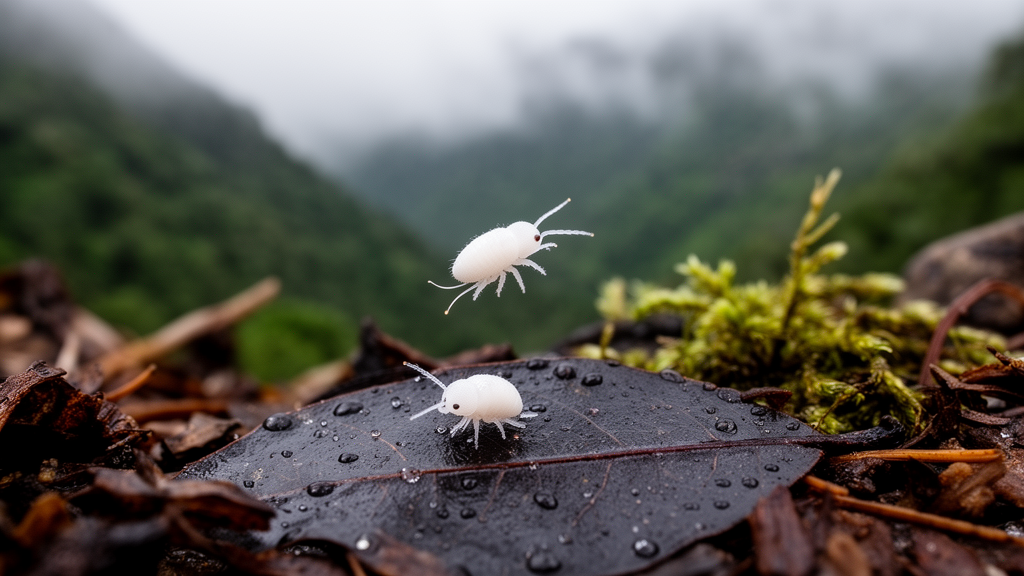
Deep in the leaf litter of Colombia’s eastern Andes, two animals smaller than a grain of rice have been carrying secrets for years. Scientists have now formally introduced them to the world: Lepidocyrtus (Setogaster) deiverandersoni and Lepidocyrtus rosanae, two brand-new species of springtails, the tiny six-legged soil dwellers that belong to the class Collembola. The discovery, published in the Biodiversity Data Journal, is more than a routine addition to a catalog. It opens a window onto one of the planet’s least appreciated bursts of biodiversity and hints at ancient evolutionary connections stretching from the tropical Andes to Europe, Asia, and the islands of the Pacific.
Springtails are everywhere, yet almost nobody notices them. They live in soil, leaf litter, moss, and rotting wood by the billions, munching on fungal hyphae, decaying plant matter, and microbes. They get their common name from a spring-loaded appendage called a furcula, folded under the abdomen like a chitin mousetrap, that snaps them astonishing distances when danger threatens. They do not have the charisma of jaguars or the bright colors of poison frogs, but ecologically they are indispensable: by shredding organic material and grazing fungi, they drive nutrient cycling in nearly every terrestrial ecosystem on Earth. The genus Lepidocyrtus, first established in 1839 by the French naturalist Bourlet, is one of the giants of this hidden fauna, with roughly 289 described species worldwide, most of them distinguished not by what they look like at a glance but by intricate patterns of bristles on their bodies.
Those bristle patterns, known to specialists as chaetotaxy, are the key to the new study. To the untrained eye, a springtail is a speck; under a phase-contrast microscope, it is a map of hundreds of chaetae, bristles of different sizes and shapes, each with a name and a position on the body. Macrochaetae are the long ones, mesochaetae and microchaetae the shorter ones, and S-chaetae, or sensilla, serve as sensory organs. The presence or absence of a single bristle on one abdominal segment can separate two otherwise nearly identical species. The researcher behind the discovery, L. A. González-Montaña, mapped these patterns in painstaking detail for the new species, following standardized nomenclature systems for the head, labium, postlabium, and thoracic and abdominal segments, and even anchoring the anatomical vocabulary in the Collembola Anatomy Ontology, a structured database of terms designed to make descriptions of these animals consistent and machine-readable.
The specimens themselves were collected the old-fashioned way: with pitfall traps buried flush with the soil surface and malaise traps that intercept flying and drifting insects, set at two localities in Colombia’s Eastern Andes. The animals were then cleared in Nesbitt’s solution and mounted on slides in Hoyer’s medium, a classic aqueous mounting medium that renders soft tissues transparent and lets light pass through the cuticle so that every bristle, scale, and tooth can be drawn with a camera lucida attached to Nikon E400 and Eclipse E600 microscopes. It is slow, exacting work, closer to cartography than to most modern biology, and it is the only way to reliably separate species whose bodies may differ by a fraction of a millimeter.
The first new species, Lepidocyrtus (Setogaster) deiverandersoni, came from Santana in the department of Boyacá, at 2,200 meters elevation, where a single female holotype and fifteen paratypes were gathered in April 2018. The animals measure about 1.37 millimeters long on average, barely visible to the naked eye, and wear a striking livery: dark blue pigment on the antennae and the rear part of the body, with whitish, blue-flecked patches elsewhere. What makes it scientifically distinct is a constellation of bristle characters: the absence of a supplementary chaeta called ml on the second abdominal segment, the presence of p7 as a microchaeta on the third abdominal segment, a dorsal macrochaeta formula of A0/00/0100+3, the absence of a particular sensory chaeta on the fourth abdominal segment, and the presence of a mucronal spinelet, a tiny spine at the tip of the jumping organ. Its assignment to the subgenus Setogaster rests on the absence of an apical bulb on the fourth antennal segment together with that spinelet.
The name carries a deeply personal weight. Deiverandersoni is dedicated to the memory of the author’s brother, Deiver Anderson González Montaña, who lived from 1975 to 2021. It is a quiet reminder that behind every species description stands a human being, and that taxonomy, often caricatured as dry stamp-collecting, is in practice a labor of love carried out by people with families, histories, and losses of their own. The second species carries a similar dedication: rosanae honors the author’s mother, María Rosana Montaña Lemus.
Lepidocyrtus rosanae, the second newcomer, was found much lower down, at 321 meters in Sabanalarga, in the department of Casanare, with a holotype and eleven paratypes collected in December 2016. It is slightly larger, at a mean of 1.86 millimeters, and anatomically more enigmatic. Its labral chaeta a1 is branched at the tip, bi- or trifurcate, an unusual feature; the sublobal plate of the maxillary outer lobe lacks appendages; particular sensory chaetae are missing from the second and third abdominal segments; and scales decorate the front face of the ventral tube, the collophore, a moisture-managing organ on the underside of the body. Its dorsal macrochaeta formula is 00/0100+2, and unlike its mountain cousin, it does show the apical bulb on the fourth antennal segment. That combination of traits has left its subgeneric placement genuinely uncertain: the mucronal spinelet points toward Setogaster, but the antennal bulb and the scaled collophore are features otherwise associated with the genus Acrocyrtus. The authors are candid about this ambiguity, a welcome dose of honesty in a field where tidy answers are often tempting.
Distinguishing the new species from their closest relatives required exactly the kind of bristle-by-bristle comparison that defines modern springtail taxonomy. Deiverandersoni resembles L. marimutti and L. asensillatus in the arrangement of inner macrochaetae on the fourth abdominal segment but differs from the former in the state of chaeta m7 and supplementary bristles on the third abdominal segment, and from the latter in the loss of a labial chaeta and the shape of the third abdominal bristles. Rosanae, meanwhile, recalls L. caprilesi and L. paracaprilesi in the way the mesothorax projects forward over the head and in the scaled collophore, but lacks the labial chaetae M1 and M3 found in those species. It also shares its color pattern with L. dispar and L. biphasis, yet parts company with each on the antennal bulb and on the same missing sensory chaetae. In a group where whole species can be told apart by one missing bristle, these details are not pedantry; they are the species’ fingerprints.
Perhaps the most provocative part of the study reaches far beyond Colombia. The new species belong to a group characterized by the absence of the labial chaeta M1, a group that includes most Neotropical Lepidocyrtus but also species from the Nearctic, such as L. floridensis and the recently described L. bobwoodruffi, from Europe, including L. bicoloris and L. lanuginosus, and from Asia, such as L. filamentosus and L. gumgum from the Indo-Malay region. In several of those northern species, the same labial chaeta is variable or absent. Related characters, such as the lack of dorsal cephalic macrochaetae and the presence of a dental tubercle, have already been used to argue a kinship between the Florida species L. floridensis and Neotropical lineages, and the resemblance between the European L. fimetarius and several Neotropical species, including the Colombian L. nilatus described in 1987, suggests connections across the Holarctic. Even more tantalizing, an Asian species from southern China and another from the Pacific islands resemble the Neotropical L. nigrosetosus, hinting at a transpacific story that has never been systematically explored.
What emerges from this single paper is a research agenda. The authors argue that the subgenera of Lepidocyrtus rest on characters whose reliability remains in conflict, particularly for Neotropical species, and that the next step is phylogenetic: testing, for example, whether labial chaetae actually support natural evolutionary groups rather than superficial similarities. They also point to the Andean region as a probable hotbed of undiscovered Lepidocyrtus diversity, a place where every additional survey is likely to yield more novelties. For a genus that has been known to science since 1839, the fact that two entirely new species could be plucked from Colombian mountain traps and described only now says something humbling about how much of life remains undocumented. The smallest citizens of the soil are still being counted, and the census has barely begun. As springtails go, these two Colombian newcomers are unglamorous, invisible, and utterly essential, and they now have, at last, their names.
Subject of Research: Taxonomic description of two new Neotropical springtail species of the genus Lepidocyrtus from Colombia
Article Title: Two new species of Neotropical Lepidocyrtus Bourlet, 1839 ( Collembola , Entomobryidae , Lepidocyrtinae ) from Colombia
Article References: Two new species of Neotropical Lepidocyrtus Bourlet, 1839 ( Collembola , Entomobryidae , Lepidocyrtinae ) from Colombia. (n.d.). https://doi.org/10.3897/BDJ.14.e207059
Image Credits: AI Generated
Keywords: Collembola, springtails, Lepidocyrtus, taxonomy, Colombia, Andes, biodiversity, chaetotaxy, new species, Entomobryidae, soil fauna, Neotropical
Cite Scienmag News
Gavin Prescott. (October 15, 2026). Two New Springtail Species Hidden in Colombia’s Andes Rewrite a Tiny World. Scienmag. https://scienmag.com/two-new-springtail-species-hidden-in-colombias-andes-rewrite-a-tiny-world/
Gavin Prescott. "Two New Springtail Species Hidden in Colombia’s Andes Rewrite a Tiny World." Scienmag, 15 October 2026, https://scienmag.com/two-new-springtail-species-hidden-in-colombias-andes-rewrite-a-tiny-world/. Accessed 15 October 2026.
Gavin Prescott. "Two New Springtail Species Hidden in Colombia’s Andes Rewrite a Tiny World." Scienmag. October 15, 2026. https://scienmag.com/two-new-springtail-species-hidden-in-colombias-andes-rewrite-a-tiny-world/


