


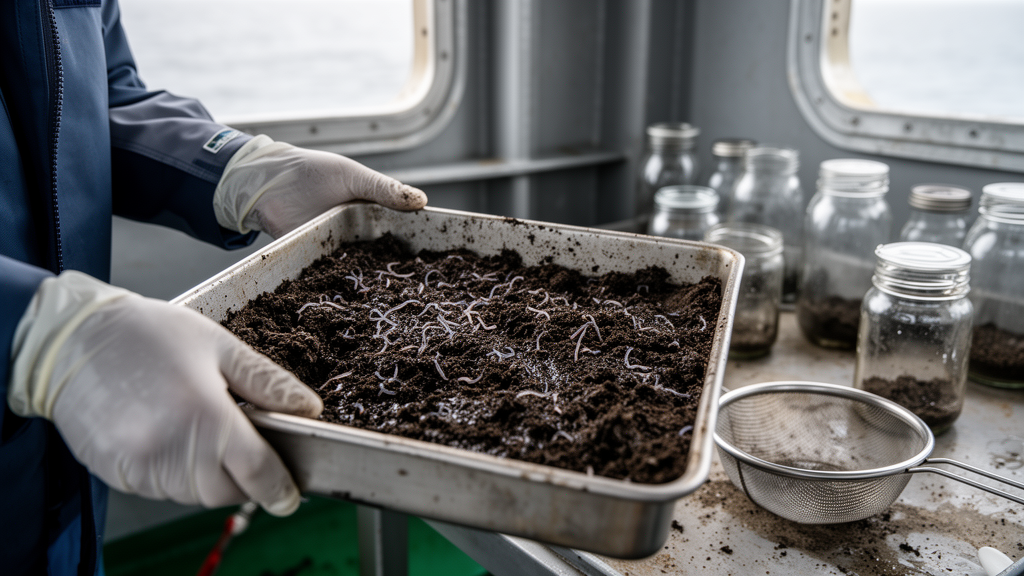
Two previously unknown species of free-living marine nematodes have been described from intertidal sediments on the coast of Huidong County, Guangdong Province, along the northern South China Sea. The worms, named Comesoma gracilis sp. nov. and Paracomesoma sinica sp. nov., belong to the family Comesomatidae and were recovered from silty sediment collected in October 2021 from the top 0 to 8 centimeters of the beach at Chishaqiao. With the addition of the new Comesoma, fifteen valid species had previously been accepted worldwide; twenty valid Paracomesoma species had been recorded. The discovery underscores how much microscopic biodiversity remains undocumented in the region’s sediments.
Free-living marine nematodes are the most dominant and diverse meiofaunal group in marine benthic habitats. Yet a large number of nematode species are still undescribed. In the seas of China, approximately 600 species of free-living marine nematodes have been recorded so far, a figure that researchers estimate represents less than half of the actual species diversity, a gap attributed to insufficient sampling. The South China Sea alone, which covers roughly 3.5 million square kilometers, has an average depth of 1,212 meters and a maximum depth of 5,559 meters, and only about 500 nematode species have been identified there to date, leaving a large number of species unknown.
The new species were isolated using standard meiofauna extraction techniques. Sediment samples were fixed in an equal volume of 10 percent formalin, then stained with 0.1 percent Rose Bengal solution for about six hours to make the worms visible. The material was passed through a pair of sieves with mesh sizes of 500 micrometers and 42 micrometers to separate macrofauna from meiofauna, and the residue on the finer mesh was centrifuged three times in Ludox-TM, a 50 percent colloidal silica suspension with a specific gravity of 1.15 grams per milliliter, to isolate the animals from heavier sediment particles. Specimens were then transferred through a glycerol-ethanol solution and mounted in glycerin on permanent slides for examination.
Detailed descriptions were made with a Leica DM 2500 differential interference contrast microscope, photographs were taken with a Leica DMC 5400 digital camera, and line drawings were prepared with a camera lucida. All measurements were made using Leica LAS X software, with curved structures measured along the midline of the curve. The type specimens have been deposited at the Marine Biological Museum of the Chinese Academy of Sciences in Qingdao, ensuring that future researchers can re-examine the physical standards against which the new species are defined.
Comesoma gracilis, whose name derives from a Latin adjective referring to its relatively slender body, is known from a single male holotype and a single female paratype collected from the 0 to 2 centimeter surface silty sediment layer. The male measures 2,585 micrometers in total body length with a maximum diameter of just 24 micrometers, giving an exceptionally high slenderness ratio of 107.7, while the female is 2,775 micrometers long with a ratio of 111. The head carries the characteristic 6+6+4 arrangement of anterior sensilla: six papilliform inner labial sensilla, six setiform outer labial sensilla about 4 micrometers long, and four very long and thick cephalic setae reaching 24 micrometers in the male and 28 micrometers in the female, more than twice the head diameter.
Several features distinguish the new Comesoma from its congeners. The amphideal fovea, a sense organ on the head, is multispiral with three turns in the male and 2.5 turns in the female and spans 86 to 88 percent of the corresponding body diameter. The male spicules, the copulatory structures, are slender and arcuate, roughly 4.5 times as long as the cloacal body diameter, with distinct transverse striations and a cephalate capitulum, and the gubernaculum is a simple plate-like structure without an apophysis. The male bears seven small papilliform precloacal supplements, spaced increasingly far apart toward the anterior. Compared with its closest relatives, C. zhangi and C. macramphida, the new species differs in body slenderness, the form of the outer labial sensilla, the position of the subcephalic setae, amphid turns, spicule proportions, and supplement count. The authors note that only one male and one female were found, suggesting this is a rare species, though they argue the morphological characteristics are distinct enough to allow clear separation from congeners despite the limited material.
Paracomesoma sinica, named for China, is represented by more material: one male holotype and three paratypes, two females and one additional male, from the same beach. The males are larger, 3,570 and 3,290 micrometers long, with females reaching 3,995 and 3,832 micrometers, and the species is again strikingly slender, with slenderness ratios of 123 to 148. The head sensilla follow the same 6+6+4 pattern, but here the six outer labial sensilla are unequal in length, with the two lateral ones at 10 to 12 micrometers and the remaining four at 5 micrometers. The buccal cavity is cylindrical, 13 micrometers deep and 2 micrometers wide, and armed with one dorsal and two subventral small teeth, a hallmark of the genus Paracomesoma, which was proposed in 1950 on the basis of a buccal cavity with distinct teeth.
The reproductive and tail morphology of Paracomesoma sinica further sets it apart. Males have two opposed, outstretched testes, paired equal arcuate spicules 3.4 to 3.5 times the cloacal body diameter in length with slightly swollen proximal ends but no distinct capitulum, a plate-like gubernaculum of 15 micrometers, and 28 to 30 nearly equidistant papilliform precloacal supplements. Females possess two opposed outstretched ovaries, two spermathecae positioned anterior and posterior to the vulva, and large elongate-oblong eggs up to 250 micrometers long and 18 micrometers wide, with the vulva located at mid-body, at 50 to 53 percent of total body length. The amphideal fovea is spiral with 2.5 turns and occupies about 76 percent of the corresponding body diameter. Against its closest relatives, the new species differs from P. heterosetosum in having fewer amphid turns and much shorter spicules of 79 to 84 micrometers versus 188 to 205 micrometers, from P. inaequale in shorter cephalic setae and spicules, and from P. longissimum in far shorter spicules and a greater slenderness ratio.
The taxonomic context of both genera reflects a long history. The genus Comesoma was established by Bastian in 1865 with C. vulgare as the type species, and two of its species, C. heterosetosum and C. simile, remain known only from female specimens, having never been described with males. Five Comesoma species had previously been reported from Chinese seas, two of them from the South China Sea. Paracomesoma, proposed by Schuurmans Stekhoven in 1950, was reinstated by Hopper in 1967 and validated by Hope and Murphy in 1972 with P. coronata, a synonym of Comesoma dubium, as its type species. Five Paracomesoma species had been described in Chinese sea areas before this study, only one of them, P. longissimum, from the South China Sea. The new descriptions were accompanied by comprehensive comparative tables compiling body length, cephalic setae length, amphid turns, slenderness ratios, spicule lengths, and supplement counts for every valid species in both genera, providing a benchmark for future identifications.
Beyond the novelty of the species themselves, the work highlights the state of knowledge of meiofauna in Chinese waters, where survey sampling remains insufficient and the research foundation comparatively weak. Each formally described species, complete with measurements, drawings, micrographs, and permanently archived type slides, adds a fixed point of reference for future surveys. With roughly 500 nematode species identified in the South China Sea and the true total expected to be far higher, the two slender worms from a Guangdong beach are a reminder that hidden fauna can be revealed by a cut-off syringe, a pair of sieves, and a careful look through the microscope.
Subject of Research: Description of two new species of comesomatid nematodes from intertidal sediments of the South China Sea
Article Title: Two new species of the family Comesomatidae ( Nematoda , Chromadorea , Araeolaimida ) from the South China Sea
Article References: Li, S., Liu, L., & Huang, M. (2026). Two new species of the family Comesomatidae (Nematoda, Chromadorea, Araeolaimida) from the South China Sea. ZooKeys, 1295, 239-254. https://doi.org/10.3897/zookeys.1295.204242
Image Credits: AI Generated
DOI: 10.3897/zookeys.1295.204242
Keywords: nematodes, meiofauna, South China Sea, taxonomy, new species, Comesomatidae, Comesoma, Paracomesoma, marine biodiversity, intertidal sediment, ZooKeys, species
Cite Scienmag News
Drew Townsend. (October 23, 2026). Two New Nematode Species Unearthed From South China Sea Mud. Scienmag. https://scienmag.com/two-new-nematode-species-unearthed-from-south-china-sea-mud/
Drew Townsend. "Two New Nematode Species Unearthed From South China Sea Mud." Scienmag, 23 October 2026, https://scienmag.com/two-new-nematode-species-unearthed-from-south-china-sea-mud/. Accessed 23 October 2026.
Drew Townsend. "Two New Nematode Species Unearthed From South China Sea Mud." Scienmag. October 23, 2026. https://scienmag.com/two-new-nematode-species-unearthed-from-south-china-sea-mud/


