


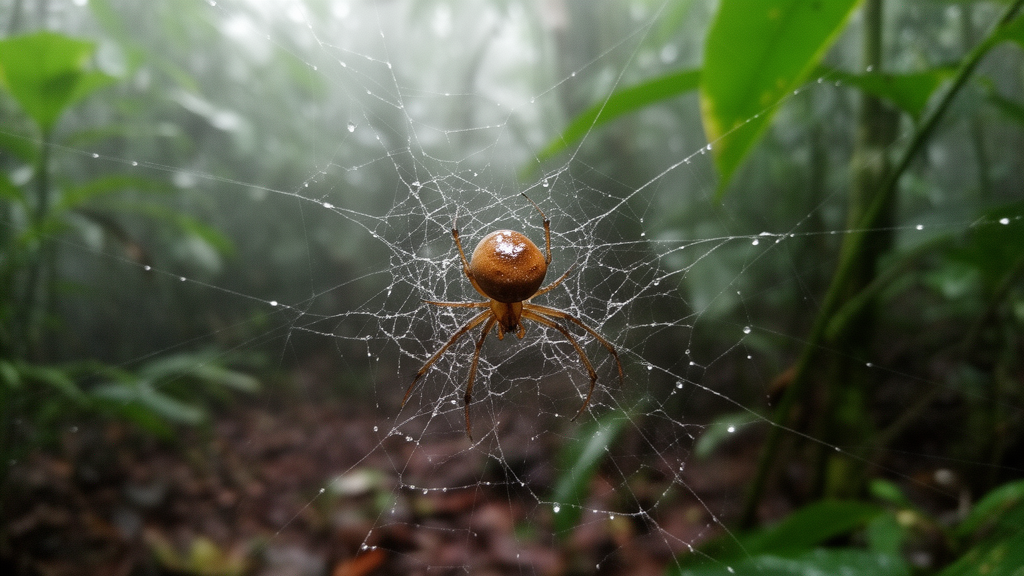
Deep in the lowland rainforests and agricultural plots of Jambi Province, Sumatra, spiders smaller than a grain of rice have been quietly spinning their tangled cobwebs, unnoticed by science. Now, a team examining more than half a million canopy arthropods has identified five species of the cobweb spider genus Platnickina, including two entirely new to science and three recorded for the first time in Indonesia. The discovery, published in the journal Evolutionary Systematics, marks the first time any Platnickina species has been documented in the country, and it hints that the archipelago’s spider diversity may be far richer than current catalogs suggest.
The genus Platnickina belongs to the family Theridiidae, the cobweb spiders, a group famous for including the black widow and the common house spiders. These tiny predators build irregular, three-dimensional webs in which prey is entangled before being wrapped in silk. Platnickina was first recognized as a distinct group by the legendary spider taxonomist Herbert Levi in 1957, who noted the exposed base of the embolus, a key structure of the male copulatory organ, as its defining character. The genus name itself has a curious history: it was originally erected as Keijia in 2001, but that name turned out to be preoccupied by a crustacean genus described in 1995, so it was replaced with Platnickina in 2008, honoring the influential arachnologist Norman Platnick. Today, the genus contains 11 species worldwide, none of which had ever been recorded from Indonesia.
The specimens at the heart of the study were collected in 2013 as part of the EFForTS project, a large-scale ecological research initiative in Jambi that sampled 32 permanent research plots evenly distributed across four land-use systems: lowland rainforest, extensively managed jungle rubber agroforestry, and smallholder monoculture plantations of rubber and oil palm. Using canopy fogging, a technique that releases a fine insecticidal mist into the treetops to knock down the arthropods living there, the researchers gathered an enormous collection of canopy spiders. When the team, led by spider taxonomist Dhiya’ulhaq, sorted through the material, they found five Platnickina species, two of which were undescribed.
The two new species, Platnickina harapan and Platnickina debu, were each described from both males and females, with detailed diagnoses, high-quality photographs, and line drawings of their copulatory organs. The name harapan refers to the type locality, the Harapan Rainforest, and is also an Indonesian word meaning hope, reflecting the authors’ aspiration for the advancement of spider taxonomy in Indonesia. The name debu is an Indonesian word meaning dust, referring to the dark specks scattered across the opisthosoma, the rear body segment, of that species. Both species are tiny: the males measure around 1.6 to 1.9 millimeters in total length, while females reach up to about 2.6 millimeters.
Distinguishing such closely related species requires careful examination of the genitalia, which in spiders are species-specific and often the most reliable diagnostic characters. In males, the researchers studied the palpal bulb, the structure that stores and delivers sperm, focusing on the shape of the conductor, the embolus, and the theridiid tegular apophysis, a sclerotized outgrowth unique to this family. In females, the epigynum, the external genital plate, was excised and cleared with potassium hydroxide to reveal the internal copulatory ducts and spermathecae, the sperm storage organs. Platnickina harapan, for instance, belongs to the sterninotata-group and is distinguished from the closely related Platnickina adamsoni by its spatulate conductor with a rounded tip and notched tegular apophysis, as well as by looser copulatory ducts whose initial part is arc-shaped rather than rectangular. Platnickina debu, placed in the maculata-group based on its cow-horn-shaped embolus and wide tegular apophysis, differs from Platnickina maculata by the obtuse tip of its conductor, and from Platnickina xianfengensis by having an atrium distinctly smaller than its spermathecae.
The three newly recorded species, Platnickina adamsoni, Platnickina fritilla, and Platnickina xianfengensis, were previously known from other parts of Asia and beyond. Platnickina adamsoni is cosmopolitan, having been reported from numerous countries, but its actual region of origin has never been investigated. The authors note that Levi remarked in 1967 that the species was likely introduced to the Americas given the apparent lack of closely related species there, and that the fact that other members of the sterninotata-group, including the new Platnickina harapan, are found in Asia suggests that this region may be the native distribution of Platnickina adamsoni. Platnickina fritilla was previously known only from China, while Platnickina xianfengensis, recently transferred from the genus Theridion, was known from China and Taiwan.
The findings carry broader implications for how scientists understand spider biogeography in Southeast Asia. Sumatra, one of the largest islands in the Indonesian archipelago, sits within the Indomalayan region, a biodiversity hotspot where rapid deforestation and the expansion of monoculture plantations threaten countless species before they are even described. That five Platnickina species, including two new ones, emerged from a single canopy fogging campaign across 32 plots suggests that the island’s spider fauna, particularly in the canopy layer, remains substantially underexplored. The researchers emphasize that their study represents the first published records of the genus in Indonesia, and they hope it will encourage further taxonomic work in the country, which hosts one of the richest yet least documented spider faunas on Earth.
Methodologically, the study followed established descriptive conventions, with specimens examined under a ZEISS Stemi 2000 microscope and imaged with a Keyence VHX-7000 digital microscope system. Coloration descriptions were based on specimens preserved in ethanol, and all measurements were recorded in millimeters, with leg lengths given as the sum of individual segments. The type specimens, the holotypes and paratypes that anchor each species name, are held in the Museum Zoologicum Bogoriense in Bogor, Indonesia, and in German repositories including the University of Göttingen, the Naturmuseum Senckenberg in Frankfurt, and the Zoologisches Museum Hamburg, with plans to transfer the Indonesian material to the Bogor museum. This arrangement ensures that the reference specimens are accessible to future researchers in both the country of origin and the international taxonomic community.
For the researchers, the discovery is more than a checklist update. It is a signal that the canopy of Sumatra’s forests and even its agricultural plantations harbor lineages that science has yet to fully catalog, and that meticulous morphological work, combined with large-scale ecological sampling, can still yield surprises in one of the most biologically intensively studied landscapes in the tropics. As the authors put it in their etymological choice, the name harapan, hope, captures their aspiration that this study will be a stepping stone toward a far more complete understanding of Indonesia’s spider diversity, a diversity that, like the tiny cobweb builders of Jambi, has been hiding in plain sight.
Subject of Research: Two new species and three new records of the cobweb spider Platnickina (Araneae, Theridiidae) from Sumatra
Article Title: Two new species and three new records of the cobweb spider Platnickina ( Araneae , Theridiidae ) from Sumatra
Article References: Dhiya’ulhaq, N. U., Buchori, D., Hidayat, P., Scheu, S., & Drescher, J. (2025). Two new species and three new records of the cobweb spider Platnickina (Araneae, Theridiidae) from Sumatra. Evolutionary Systematics, 9(2), 203-220. https://doi.org/10.3897/evolsyst.9.162623
Image Credits: AI Generated
DOI: 10.3897/evolsyst.9.162623
Keywords: species, three, records, cobweb, spider, Platnickina, Araneae, Theridiidae, Sumatra, scientific research
Cite Scienmag News
Drew Townsend. (October 18, 2026). Two new cobweb spider species and three first records from Sumatra. Scienmag. https://scienmag.com/two-new-cobweb-spider-species-and-three-first-records-from-sumatra/
Drew Townsend. "Two new cobweb spider species and three first records from Sumatra." Scienmag, 18 October 2026, https://scienmag.com/two-new-cobweb-spider-species-and-three-first-records-from-sumatra/. Accessed 18 October 2026.
Drew Townsend. "Two new cobweb spider species and three first records from Sumatra." Scienmag. October 18, 2026. https://scienmag.com/two-new-cobweb-spider-species-and-three-first-records-from-sumatra/


