


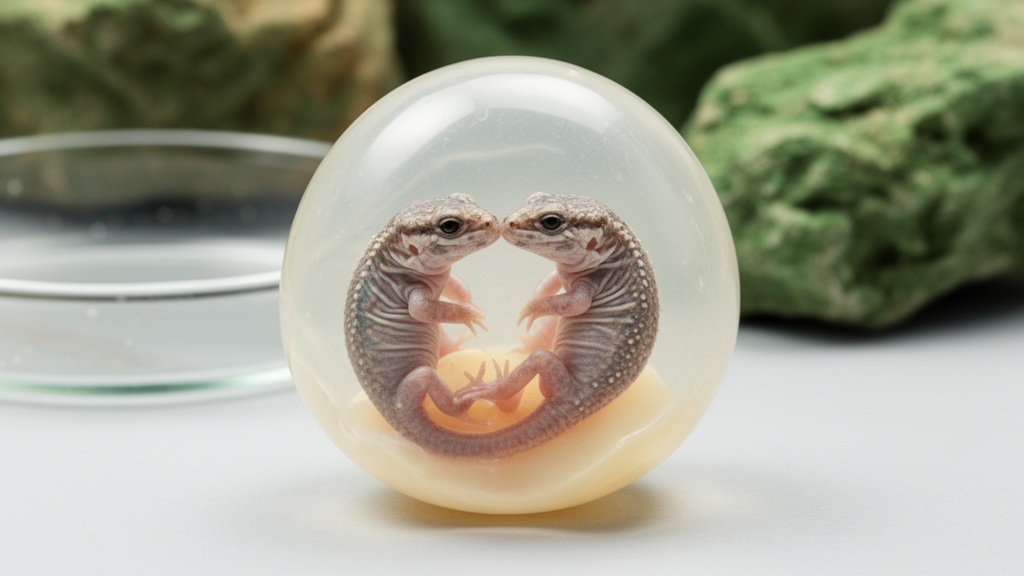
Deep in the mountain steppe of southern Georgia, near Saghamo Lake at an elevation of just over 2,000 meters, a team of herpetologists captured sixteen females of the parthenogenetic rock lizard Darevskia armeniaca during the reproductive season of July 2023 and brought their eggs into the laboratory. What they found when they examined the developing embryos under a stereo microscope was startling: one embryo, fixed seventeen days after the egg was deposited, had two heads, two long necks, and two pairs of forelimb buds, yet a single body and a single tail. The embryo was at the stage of pigmented eyes and plate-like limb buds with distinct borders at their edges, and it represents the third recorded case of axial bifurcation in this species, a finding now described in detail in the journal Caucasiana.
Axial bifurcation, the developmental anomaly that produces two-headed organisms, is an extreme case of developmental instability, which may in turn stem from genetic disorders or environmental effects. It can result from the incomplete separation of identical twins or from the duplication of the notochord, the rod-like structure that defines the vertebrate body axis. Although the phenomenon remains reasonably rare, hundreds of bicephalic organisms have been recorded since ancient times, and bicephalic individuals are known from every vertebrate group, including lampreys, sharks, bony fish, salamanders, frogs, turtles, crocodilians, lizards, and mammals. Snakes, however, are the clear champions of bicephaly, with records of two-headed individuals stretching back centuries and surviving animals documented repeatedly.
The prevalence of bicephaly within the squamate reptiles, the group that includes lizards and snakes, is strongly taxon-specific. A comprehensive summary of bicephaly in snakes accounted for 1,850 records of axial duplication, including 542 cases in colubrids, 335 in natricids, 266 in viperids, and only 13 in elapids. In lizards, by contrast, axial bifurcation is relatively uncommon. A recent review lists just 49 reports of conjoined twins across all lizard families, including 14 cases in the lacertids, the family of wall lizards and rock lizards to which Darevskia belongs. Two of those lacertid cases belong to the parthenogenetic form Darevskia armeniaca, described in 1966 and 1995, and the new embryo now adds a third.
The bicephalic embryo belonged to the category termed proarchodichotomous, a classification developed for snakes with axial bifurcation but apparently applicable to other squamates. In this category, the duplication affects the anterior end of the animal, producing two heads and two necks on a single body. In snakes, this category of axial bifurcation is itself rare, comprising only 4.2 percent of studied cases. Comparable information for lacertids is scarce, but a newborn Italian wall lizard with two pairs of forelimbs and two heads has been described, as has a hatched prodichotomous viviparous lizard, showing that similar patterns occur across the family.
The overall morphology of the two-headed embryo displayed clear signs of degradation. Its eyes were poorly differentiated and oedematous, with patchy pigmentation, and the surface ectoderm was abnormal. The limb features matched stage 30 of the standard staging scheme for lizard embryos, with an autopodium bearing an apical ectodermal ridge, whereas normally developing siblings fixed from day thirteen after egg deposition already showed three distinct limb segments with the beginning of digit condensation, corresponding to stages 32 to 34. In plain terms, the two-headed embryo was developing more slowly than its normally developing counterparts, and the authors conclude that it obviously would have died before hatching.
Such a finding in a lizard egg is a genuinely rare event. Only 49 conjoined twins of lizards have been found in total, including 11 bicephalic or conjoined twins in lacertids, a figure strikingly lower than the records for bicephalic snakes. The authors suggest an explanation for this disparity: different from bicephalic snakes, which survive for years in 16 percent of recorded cases, there are no documented cases of survived conjoined twins in lizards, including lacertids. Two-headed lizards presumably die before or at hatching, so the anomaly is recorded far less often than in snakes, where living two-headed individuals can be observed and documented by keepers and researchers over long periods.
What makes the new discovery even more interesting is that this is the third recorded bicephaly in the parthenogenetic species Darevskia armeniaca. Although this species is relatively common in its natural habitats, it has a very limited range and is observed by scientists and amateur herpetologists far less often than widespread European species such as the sand lizard or the viviparous lizard. The repeated appearance of two-headed individuals in a form that is rarely encountered drives the authors to the hypothesis that some specific features of D. armeniaca tend to produce twins, including conjoined twins, more commonly than most other lizard species. The open question is whether this is a common feature of all Caucasian rock lizards of the genus Darevskia, of all hybridogenous parthenogens from this genus, or specifically of D. armeniaca itself.
To gain insight, the researchers summarized the recorded data on captive breeding of different rock lizard species, which are relatively commonly bred in captivity for research purposes and kept in terraria. Most breeders do not report the number of hatched juveniles, but the published and unpublished records together account for 517 cases of captive hatching, and the authors suppose the true total is several times higher. More than one-third of the recorded hatchlings are Darevskia armeniaca, and only for this parthenogenetic form have three cases of bicephalism, including the embryo described in the new paper, been reported. That amounts to 1.6 percent of all described juveniles hatched or developed in captivity, a substantial proportion that might be related to the specific developmental features of this species. The authors caution, however, that all tabulated cases concern hatched juveniles, and the proportion of embryos with axial bifurcation may be substantially higher, since such embryos that reach the hatching stage are presumably only a fraction of those that develop the anomaly. Remarkably, the two other cases of bicephaly in D. armeniaca were described for hatched juveniles, which is also notable given that no conjoined lacertid twins are otherwise known to survive.
Among the potential reasons for axial bifurcation, researchers list inbreeding depression from small population gene pools, hybridization, and various environmental impacts. The natural habitats of D. armeniaca, including the location from which the mother of the two-headed embryo was collected, lie in a natural mountain steppe setting at an elevation over 2,000 meters and are not densely populated. Potential environmental causes such as excessive pollution or radiation should therefore rather be ruled out, leaving genetic factors specific to this species as the most likely explanation. Hybridization is a significant candidate, since crossing between two species of milk snakes has been shown to produce offspring with axial bifurcation, and the backcross of a hybrid elapid snake also produced a two-headed offspring.
Here the story of the Caucasian rock lizards becomes particularly compelling. All Darevskia parthenogens have hybrid origins and represent hybrid clones, which may be a potential reason for the relatively common axial bifurcation in these species. Most strikingly, D. armeniaca most likely combines in its genome parts of the genomes of three rather than two bisexual parental species, namely D. mixta, D. valentini, and D. portschinskii. This might cause the presence of multiple incompatible fragments in the genome, producing not only the loss of sexual reproduction but also other potential developmental problems. Notably, the parthenogens gradually return to a homozygous state at individual loci, including those where deleterious alleles may be present, through a process of gene conversion. At the moment this remains a hypothesis, because bicephalic embryos may be more common in all lacertid species than the successful hatching of two-headed individuals suggests. To validate it, representative samples of developing pre-hatched embryos should be analyzed in different species of sexually reproducing and parthenogenetic lizards, which is the matter of the ensuing study. If the pattern holds, the two-headed embryo from southern Georgia may reveal that the price of a life without males, paid in the genome of a hybrid clone, is written in the earliest stages of development.
Subject of Research: Two-headed parthenogenetic lizard embryo from southern Georgia
Article Title: Two-headed parthenogenetic lizard embryo from southern Georgia
Article References: Iankoshvili, G., Tsikolia, N., Barateli, N., Gabelaia, M., Seropian, A., & Tarkhnishvili, D. (2023). Two-headed parthenogenetic lizard embryo from southern Georgia. Caucasiana, 2, 199-203. https://doi.org/10.3897/caucasiana.2.e111452
Image Credits: AI Generated
DOI: 10.3897/caucasiana.2.e111452
Keywords: Two-headed, parthenogenetic, lizard, embryo, southern, Georgia, scientific research
Cite Scienmag News
Juliet Wilcox. (October 18, 2026). Two-headed lizard embryo discovered in parthenogenetic rock lizards. Scienmag. https://scienmag.com/two-headed-lizard-embryo-discovered-in-parthenogenetic-rock-lizards/
Juliet Wilcox. "Two-headed lizard embryo discovered in parthenogenetic rock lizards." Scienmag, 18 October 2026, https://scienmag.com/two-headed-lizard-embryo-discovered-in-parthenogenetic-rock-lizards/. Accessed 18 October 2026.
Juliet Wilcox. "Two-headed lizard embryo discovered in parthenogenetic rock lizards." Scienmag. October 18, 2026. https://scienmag.com/two-headed-lizard-embryo-discovered-in-parthenogenetic-rock-lizards/


