


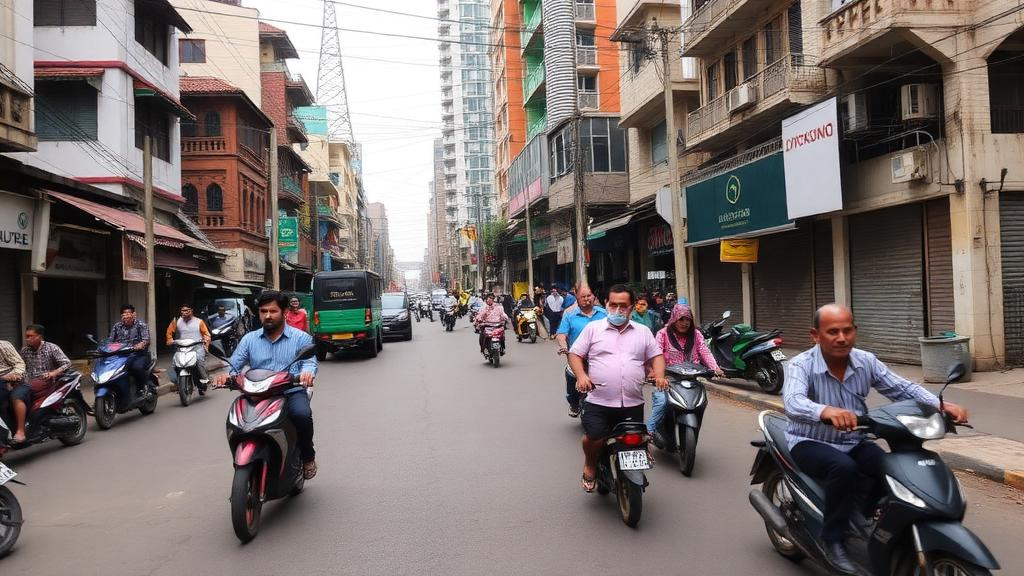
In the sprawling megacity of Dhaka, where more than twenty million people navigate some of the world’s most congested streets, the daily journey to work is never just a commute. For the owners and employees of the small businesses that form the backbone of Bangladesh’s economy, it is a negotiation between housing affordability, customer networks, transport costs and the unforgiving geometry of the city itself. A new study published in Discover Cities has now quantified that negotiation with unusual precision, revealing that two commercial districts only a few kilometres apart can produce radically different mobility lives for the people who work in them.
The research, led by Md. Salman Syed Sani of Shahjalal University of Science and Technology together with colleagues at the University of Dhaka, focused on Gulistan and Gulshan-2, two commercial hubs that could hardly be more different. Gulistan, under Dhaka South City Corporation, is a dense, chaotic transport node packed with roadside stalls and small-scale enterprises heavily dependent on public transport. Gulshan-2, under Dhaka North City Corporation, is a more planned commercial-residential district with better infrastructure and a more established business class. The stakes of the comparison are enormous: micro, small and medium-sized enterprises contribute roughly a quarter of Bangladesh’s GDP and employ close to eighty percent of its workforce, yet their owners’ and workers’ mobility has been almost entirely invisible in urban transport research.
To capture that hidden population, the team surveyed 384 respondents, split evenly between the two districts, using a sample size calculated with Cochran’s formula at a ninety-five percent confidence level. Between April and October 2024, researchers approached business owners and employees directly at their workplaces during business hours, gathering data on education, income, business structure, residential location, commuting distance, travel time, transport mode and expenditure. Two focus group discussions, one in each district, added qualitative depth. The analysis combined descriptive statistics, multiple regression, Principal Component Analysis and geospatial mapping in SPSS, MS Excel and ArcGIS, an integrated toolkit designed to connect individual circumstances with the spatial structure of the city.
The demographic contrasts were stark from the outset. Gulistan’s workforce is young, with forty-eight percent of respondents aged between twenty and thirty, and education concentrated at primary and secondary levels. Gulshan’s workers are older, more educated and far more settled: thirty percent reported more than ten years in the same business, and thirty-seven percent had never changed jobs, compared with just twenty percent in Gulistan. Gulistan workers, by contrast, are chronic movers, with seventy-two percent reporting job changes within the same zone and half reporting three job changes in the past decade. In Gulistan, relocation decisions were driven mainly by business location, financial improvement and workplace relationships; in Gulshan, business location dominated, but residential location and better job preferences played larger supporting roles.
Residential patterns told a similar story of divergence. Ninety percent of Gulshan workers live in central city locations close to their workplaces, clustered in neighbourhoods such as Natun Bazar, Badda, Banasree and Shahjadpur, and typically within five to ten kilometres of work. Gulistan workers are far more dispersed: fourteen percent live in outer suburban areas, and some commute from districts as distant as Narayanganj and Munshiganj. Fifteen percent of Gulistan workers travel more than thirty kilometres to work, and thirty percent commute between ten and twenty kilometres. The consequence is a transport profile dominated by buses, which carry fifty-six percent of Gulistan commuters, followed by informal leguna minibuses at eighteen percent and rickshaws at fifteen percent. Gulshan workers, living closer, rely far more on walking and non-motorized transport.
The financial burden follows the same gradient. Nearly a third of Gulistan workers spend between 1,000 and 1,500 taka per month on commuting, and a quarter spend between 2,000 and 3,000 taka, significant sums for low-income earners. Focus group participants described the trade-offs in blunt terms. One Gulistan employee explained that affordable housing near the commercial area is nearly impossible to find, forcing a daily long-distance commute. Another reported choosing slower, cheaper transport options to keep expenses down, while a third said peak-hour congestion often doubles travel time and makes a regular work schedule difficult to maintain. Gulshan participants, by contrast, described commutes that, while not congestion-free, are at least predictable, and some said paying more for reliable transport is a worthwhile investment in efficiency.
The statistical core of the study delivered its most striking finding. Principal Component Analysis extracted five components explaining ninety-two percent of the total variance in the data, and when those components were fed into a logistic regression classifier, the model distinguished Gulistan from Gulshan respondents with ninety-four percent accuracy. The first component, dominated by business scale and economic capacity, separated smaller, informal, foot-traffic-dependent enterprises in Gulistan from larger, more formal and better-connected businesses in Gulshan. In effect, the analysis showed that mobility inequality in Dhaka is not randomly distributed but structurally embedded in the geography of the two districts, so much so that a worker’s commuting and business profile alone can identify which district they work in.
Yet the regression models delivered a humbling lesson about what actually determines commuting time. Education, age, income and transport mode all failed to reach statistical significance once other factors were controlled. Only two variables mattered: sex, at the ten percent significance level, and commuting distance, which was highly significant at the one percent level. The models explained roughly eighteen and twenty-three percent of the variance in commuting time for Gulistan and Gulshan respectively. The authors interpret this through the lens of Hägerstrand’s time-geography and the Alonso-Muth urban location model: in a city as congested as Dhaka, congestion, road conditions and residential-workplace mismatch impose constraints that cut across socio-economic groups, while lower educational attainment can indirectly restrict housing choices, pushing workers to the periphery and lengthening their journeys. The researchers are careful to note that only the direct effects of distance and sex are statistically supported; the wider causal chain remains a theoretically informed interpretation.
Perhaps the most distinctive insight concerns entrepreneurs themselves. Business owners, especially those managing multiple premises, consistently prioritized commercial accessibility over residential convenience. Participants explained that they choose business locations based on customer demand and established supplier relationships, even when that means travelling farther from home, and that changing residence is easier than relocating a business whose customers and suppliers are already anchored in place. This inverts the assumptions of conventional commuting studies, which treat the workplace as fixed and the residence as the adjustable variable. For small business owners, the reverse is often true, and any transport policy that ignores the gravitational pull of customer networks will misread the mobility behaviour of a huge share of Dhaka’s workforce.
The policy implications are correspondingly place-specific. In Gulistan, the authors argue, priority should go to improving the reliability, affordability and coordination of buses, legunas and rickshaws, along with safer boarding areas and better connections from peripheral districts. In Gulshan, the challenge is protective: preserving continuous footpaths, safe crossings and first- and last-mile connections against the encroachment of parking and construction. At the metropolitan scale, the study calls for mixed-use development paired with affordable rental housing near commercial centres, since proximity alone helps no one who cannot afford to live there. Gender-disaggregated transport data, delivery access for multi-location businesses, and coordinated monitoring by the two city corporations round out the recommendations. What the study ultimately demonstrates is that mobility inequality is not only a problem between cities or social classes; it can be manufactured, block by block, within a single metropolis, and fixing it requires reading the fine grain of the urban fabric itself.
Subject of Research: Intra-urban mobility and commuting patterns of small business owners and employees in Dhaka's commercial districts
Article Title: Assessing the influence of intra-urban mobility on small business dynamics in Gulistan and Gulshan commercial areas of Dhaka
Article References: Sani, M. S. S., Rahman, M. M., & Labib, M. I. H. (2026). Assessing the influence of intra-urban mobility on small business dynamics in Gulistan and Gulshan commercial areas of Dhaka. Discover Cities, 3(1), Article 196. https://doi.org/10.1007/s44327-026-00375-0
Image Credits: AI Generated
DOI: 10.1007/s44327-026-00375-0
Keywords: Dhaka, intra-urban mobility, small business, MSMEs, commuting behavior, urban planning, transport geography, residential location, principal component analysis, spatial inequality, public transport, Bangladesh
Cite Scienmag News
Courtney Benton. (October 1, 2026). Two Districts, Two Cities: How Dhaka’s Urban Form Splits Small-Business Commuters. Scienmag. https://scienmag.com/two-districts-two-cities-how-dhakas-urban-form-splits-small-business-commuters/
Courtney Benton. "Two Districts, Two Cities: How Dhaka’s Urban Form Splits Small-Business Commuters." Scienmag, 1 October 2026, https://scienmag.com/two-districts-two-cities-how-dhakas-urban-form-splits-small-business-commuters/. Accessed 4 October 2026.
Courtney Benton. "Two Districts, Two Cities: How Dhaka’s Urban Form Splits Small-Business Commuters." Scienmag. October 1, 2026. https://scienmag.com/two-districts-two-cities-how-dhakas-urban-form-splits-small-business-commuters/


