

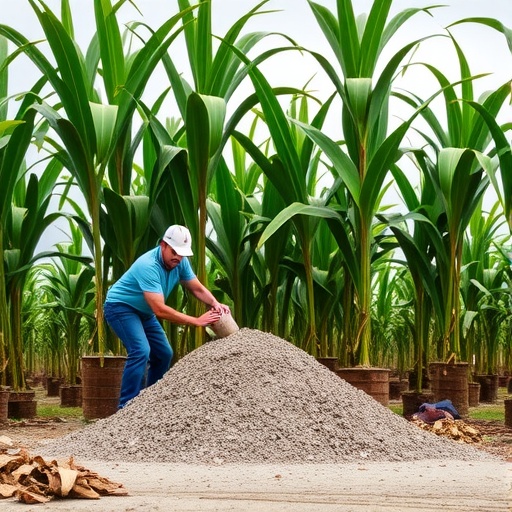
In a groundbreaking study, researchers have unveiled a remarkable approach that marries the principles of circular economy with environmental sustainability. The focus of their investigation centers on the utilization of fly ash derived from sugarcane bagasse as a substitute for traditional cement. This novel strategy not only addresses the pressing issue of solid waste management but also opens up new avenues for enhancing the adsorption capabilities of amoxicillin, a widely used antibiotic. The urgency of finding sustainable solutions in the construction industry and pharmaceutical sectors has never been more critical, and this study promises significant contributions to both fields.
Fly ash, a byproduct of combustion processes, is often viewed as just waste material. However, the current research led by Saldarriaga and colleagues presents compelling evidence of its transformative potential when sourced from sugarcane bagasse combustion. This byproduct, abundant in agricultural regions densely populated with sugarcane farming, holds the key to mitigating environmental issues related to cement production, which is notorious for contributing to greenhouse gas emissions. By replacing up to a certain percentage of cement with fly ash, they aim to reduce the carbon footprint while providing a sustainable alternative to traditional building materials.
The methodology undertaken in this research is thorough and multifaceted, combining materials science with environmental chemistry. The team conducted a series of experiments to assess the physical and chemical properties of the fly ash in question. This included examining the ash’s particle size distribution, specific surface area, and chemical composition. Such detailed analysis is crucial as it directly influences the performance of the fly ash when utilized as a cement replacement. The findings depict that the fly ash possesses desirable characteristics, making it suitable for integration into sustainable construction practices.
Moreover, the research delves into the adsorption capacities of the fly ash concerning amoxicillin. This aspect of the study is particularly significant considering the increasing prevalence of antibiotic residues in the environment, which pose serious risks to ecosystems and human health. The adsorption tests performed show that sugarcane bagasse-derived fly ash effectively captures amoxicillin from aqueous solutions, offering a dual benefit of not only aiding in cement replacement but also contributing to the remediation of water bodies contaminated with pharmaceuticals. Here lies a prime example of how waste can be transformed into a resource, reinforcing the cycle of sustainability.
Another important dimension of this investigation is its implications for the circular economy. By converting agricultural waste into valuable materials for construction and environmental applications, the study exemplifies a holistic approach to waste management. Such practices not only foster resource efficiency but also reduce reliance on virgin materials, which are often associated with extensive environmental degradation. The researchers highlight that a transition towards more circular economic models is essential for sustainable development, making this research timely and impactful.
The potential applications of this technology extend beyond construction. As cities increasingly grapple with pollution and waste management, the integration of fly ash from sugarcane bagasse could revolutionize how we think about building materials. Urban planners and developers may find that utilizing this byproduct can lead to not only more sustainable buildings but also improved air quality and reduced urban heat island effects. Such advancements can significantly enhance the quality of life in densely populated areas while promoting environmental health.
In the context of global trends, the findings align with the increasing shift towards sustainability and environmental awareness within industries. Governments and private sectors are incentivizing research and development focusing on eco-friendly practices, signaling a growing recognition of the need for sustainable solutions. The communication of these research outcomes is vital as it raises awareness about alternative materials that can lessen our environmental impact without sacrificing performance or safety in construction.
Furthermore, the broader impacts of this research can also be felt in the agricultural sector. By creating a demand for sugarcane bagasse fly ash, farmers may find additional economic opportunities in waste valorization. This innovation could lead to increased revenue streams for agricultural communities, thereby encouraging practices that are both environmentally and economically sustainable. The circular economy, as highlighted in this study, is not merely academic; it is a pathway for socio-economic improvement, providing comprehensive benefits for society as a whole.
Public engagement and understanding of these concepts are paramount for fostering a collective movement toward sustainability. Educational initiatives that incorporate findings such as those presented by Saldarriaga and his team are crucial for empowering communities to participate actively in environmental solutions. By disseminating knowledge about the importance of circular economy practices, we can cultivate a culture that values resourcefulness and innovation in tackling pressing environmental challenges.
The implications for future research are significant. The exploration of other agricultural wastes as potential substitutes for cement and their roles in pollutant adsorption could broaden the scope of sustainable materials further. Additionally, long-term studies assessing the durability and performance of such novel concrete mixes will be necessary to inform standards and guidelines within the construction industry. The pursuit of building materials that are not only strong and durable but also eco-friendly is an ongoing challenge that demands continuous innovation.
In conclusion, this research sheds light on a crucial intersection of materials science, environmental chemistry, and sustainability. By utilizing fly ash from sugarcane bagasse, the study exemplifies a comprehensive approach to tackling environmental stresses associated with cement production and pharmaceutical pollution. The commitment to a circular economy framework is evident throughout the study, positioning it as a beacon of hope in the relentless pursuit of sustainable development. As we move towards a future where the impacts of climate change are more pronounced, the lessons learned from such research will be instrumental in shaping resilient communities and industries.
Subject of Research: Utilization of fly ash from sugarcane bagasse as a cement replacement and its application in amoxicillin adsorption.
Article Title: Incorporation of fly ash from sugarcane bagasse for cement replacement and amoxicillin adsorption: a circular economy approach.
Article References: Saldarriaga, J.F., López, J.E., Freire, F. et al. Incorporation of fly ash from sugarcane bagasse for cement replacement and amoxicillin adsorption: a circular economy approach. Environ Sci Pollut Res (2026). https://doi.org/10.1007/s11356-026-37438-z
Image Credits: AI Generated
DOI: https://doi.org/10.1007/s11356-026-37438-z
Keywords: Circular economy, fly ash, sugarcane bagasse, sustainable construction, amoxicillin adsorption, environmental sustainability, resource efficiency, waste management.


