


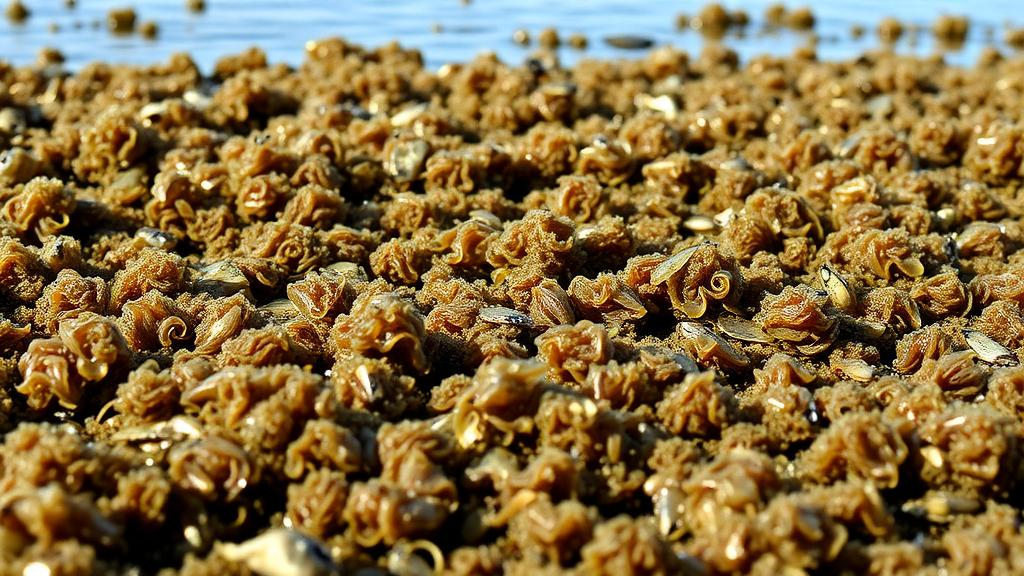
Every oyster farm fights a quiet, constant battle against seaweed. Fouling algae settle on longlines, baskets, and gear, competing with the cultivated crop for space, light, and nutrients. The cleanup is not optional: biofouling has been estimated to cost shellfish producers between 5 and 10 percent of total production, and sometimes more, through shell erosion, stock loss, and smothering. A new study published in Frontiers in Aquaculture argues that this unwanted biomass could be reframed as a second, unplanned crop — and it lays out, with unusual quantitative precision, exactly when harvesting it would actually make money.
The research team, led by Halley E. Froehlich of the University of California, Santa Barbara, together with colleagues at UC Santa Cruz, UC Berkeley, Cal Poly San Luis Obispo, California Sea Grant, and the Hog Island Oyster Company, introduces and formalizes a concept they call secondary extensive aquaculture, or SEA. The idea is deceptively simple: seaweeds such as Ulva, Gracilaria, and Pyropia naturally recruit and grow on infrastructure built for a different primary species, typically oysters or clams. Instead of treating that growth purely as a maintenance problem, farmers could cultivate, harvest, and sell it as a co-product. Because the seaweed arrives on its own, the approach requires no seeding, no hatcheries, and no additional gear beyond what the farm already deploys.
The authors are careful to argue that SEA genuinely qualifies as aquaculture under the definitions used by the Food and Agriculture Organization of the United Nations and the European Union, both of which require some intervention in the rearing process and ownership of the stock. The placement and maintenance of longlines and bags, they contend, constitute the intervention: the infrastructure provides artificial hard substrate and alters local water flow, structuring where and how much seaweed recruits compared with an unmanaged wild population. Ownership is satisfied because the recruiting seaweed spends its entire rearing period on privately leased and actively managed infrastructure. The researchers draw an analogy to traditional Hawaiian fishponds, or loko i’a, which have long been recognized as aquaculture despite relying on tidal recruitment of wild fish through sluice gates rather than active stocking.
To test whether the concept could survive contact with economic reality, the team built a scenario-based bioeconomic model coupling logistic seaweed growth and sustainable harvest with a simple profit function. The framework borrows from fisheries science: because extensive aquaculture resembles harvesting from the wild, the researchers applied a surplus-production model of the kind routinely used to estimate maximum sustainable yield. Biomass dynamics were simulated at a daily time step over a 20-year horizon, with harvest rates linked to a profit function accounting for market price, variable costs, labor inputs, and fixed operating costs. Oyster production was treated as a fixed baseline — roughly $100,000 in revenue and $80,000 in costs per hectare per year — so that seaweed profitability could be read as an incremental gain or loss from diversification. Crucially, the model assumes that the labor once spent clearing biofouling is redirected into harvesting it, rather than disappearing.
The model was parameterized with literature-derived ranges for seaweed growth rates and carrying capacities, and grounded in real-world data from a pilot harvest conducted in April 2025 on the roughly 65-hectare Hog Island Oyster farm in Tomales Bay, Northern California. During two harvest events, crews pulled Gracilaria, known commercially as ogo, from bottom bags and Pyropia, the nori used in sushi restaurants, from suspended gear and lines. The first harvest, performed by three people, produced about 22.7 kilograms of wet nori in 19 minutes; the second, with six people, yielded roughly 104 kilograms of total wet biomass. The material was processed for Hog Island’s restaurant operations, giving the team an unusually direct measure of what SEA actually costs in labor.
The simulations revealed a clear hierarchy of what matters. Profitability increased with farm size, growing season length, and the intrinsic growth rate of the seaweed, with viable scenarios typically requiring more than 50 to 100 hectares and more than 60 growing days under conservative market assumptions of $400 per ton of wet weight. Strikingly, the intrinsic growth rate exerted a stronger influence on profitability than carrying capacity: the maximum possible profit under the fastest growth scenario was more than 500 percent higher than under the highest carrying capacity. That finding has practical consequences, because it points to fast-growing fouling species — Ulva, Gracilaria, and Pyropia among them — as the most suitable SEA candidates, and it means a farmer’s first diagnostic step is simply identifying which algae are colonizing the farm. Under very slow growth and low carrying capacity, profits were negative regardless of farm size, showing that some ecological conditions preclude feasibility altogether.
Labor emerged as the decisive bottleneck. The pilot harvests required roughly 50 to 60 labor-hours per ton for harvesting and between roughly 140 and 200 labor-hours per ton once processing was included — figures that dwarf the approximately 10 labor-hours per ton needed to break even at California’s minimum wage of $16.90 per hour. Doubling the crew from three to six people cut labor hours by about 30 percent, but that was nowhere near enough. The team’s modeling of efficiency improvements showed that technological and knowledge-driven gains matter far more than adding workers: with an 80 percent reduction in labor-hours per ton, breakeven became achievable with a crew of roughly eight people, while a 50 percent improvement required around 15. Those improvement targets are conservative by historical standards — Maine’s seaweed sector documented a roughly 14-fold increase in labor efficiency between 2017 and 2022, equivalent to about a 41 percent annual reduction in labor-hours per unit harvested.
Despite the labor challenge, the yield numbers were encouraging. The pilot SEA harvests produced between roughly 0.66 and 1.10 tons per hectare per year, and the model’s estimated maximum sustainable yield came in at about 0.94 tons per hectare per year — figures that sit near the lower bound of global seaweed aquaculture production but remain within plausible commercial ranges. The pilot yields were two to three times higher than the single lowest yield documented in a global systematic review of dedicated seaweed producers, a Gracilaria monoculture in China. Under modal ecological conditions on a 65-hectare farm, or at a higher seaweed price of $1,200 per ton typical of restaurant-grade nori, SEA could account for 4 to 11 percent of total farm profit — enough to recoup the 5 to 10 percent losses that unharvested biofouling typically inflicts.
The authors are candid about the caveats. Many parameters rest on limited pilot observations and model assumptions; seaweed markets remain emerging and volatile; and the analysis treated SEA as a standalone revenue stream, leaving out indirect benefits such as improved primary crop production from more thorough fouling removal. Because SEA depends on natural recruitment rather than seeding, farmers have limited control over which species colonize their gear, meaning farm suitability rather than species selection is the relevant management lever — and species composition may shift over time, complicating market strategy. A biostimulant market, where marine soil additives sell for roughly $0.22 to $0.66 per kilogram, may be more resilient to that variation than a nori-only market, and the researchers suggest smaller-scale, local-regional supply chains may be the ideal pathway for SEA harvests.
What emerges is a concept that is ecologically feasible but economically constrained — a promising complementary strategy for diversifying revenue and enhancing circularity in aquaculture systems, contingent on sufficient scale, favorable biological productivity, labor efficiency gains, and supportive policy frameworks that clarify permitting for co-harvested species. For the small farms that dominate the U.S. seaweed landscape, the message is sobering but precise: simply removing the fouling seaweed is likely the better financial option, unless family or voluntary labor changes the calculus. For larger operations in productive waters, the nuisance growing on the oyster lines may be quietly waiting to become a second harvest — provided the industry can learn to pick it fast enough to make the arithmetic work.
Subject of Research: Bioeconomic viability of harvesting naturally recruiting seaweed as a secondary crop on shellfish aquaculture farms
Article Title: Defining and finding the profit for seaweed secondary extensive aquaculture
Article References: Defining and finding the profit for seaweed secondary extensive aquaculture. (n.d.). https://doi.org/10.3389/faquc.2026.1844314
Image Credits: AI Generated
DOI: 10.3389/faquc.2026.1844314
Keywords: seaweed aquaculture, secondary extensive aquaculture, biofouling, oyster farming, bioeconomic modeling, maximum sustainable yield, Ulva, Gracilaria, Pyropia, labor efficiency, blue economy, California
Cite Scienmag News
Alan Morgan. (October 15, 2026). Turning Oyster Farm Nuisance Seaweed Into Profit: New Model Defines When It Pays Off. Scienmag. https://scienmag.com/turning-oyster-farm-nuisance-seaweed-into-profit-new-model-defines-when-it-pays-off/
Alan Morgan. "Turning Oyster Farm Nuisance Seaweed Into Profit: New Model Defines When It Pays Off." Scienmag, 15 October 2026, https://scienmag.com/turning-oyster-farm-nuisance-seaweed-into-profit-new-model-defines-when-it-pays-off/. Accessed 15 October 2026.
Alan Morgan. "Turning Oyster Farm Nuisance Seaweed Into Profit: New Model Defines When It Pays Off." Scienmag. October 15, 2026. https://scienmag.com/turning-oyster-farm-nuisance-seaweed-into-profit-new-model-defines-when-it-pays-off/


