


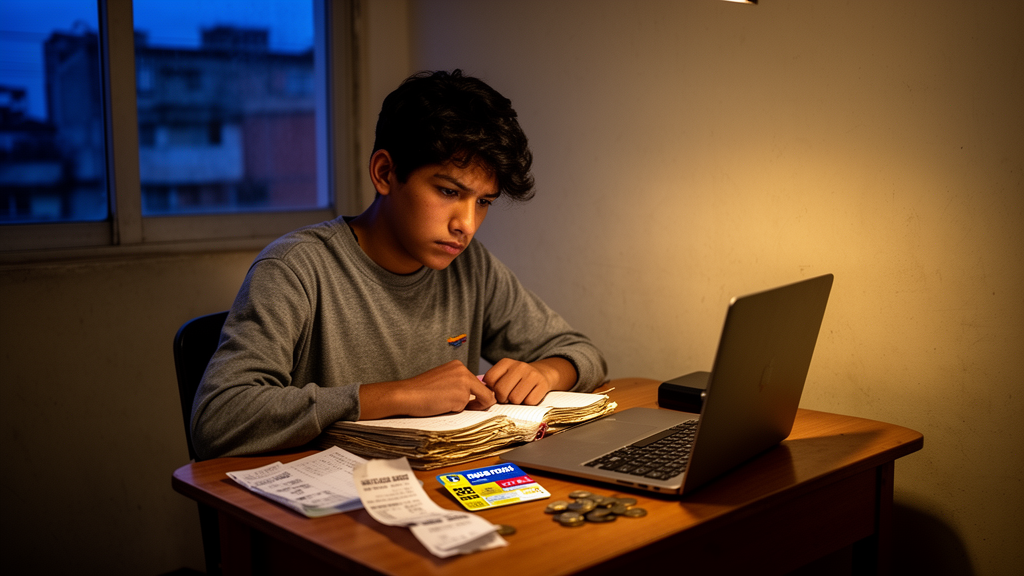
Tuition-free higher education removes one of the largest barriers to entering university, but it does not remove the money students need to stay there. A new Perspective article published in Frontiers in Education on 20 October 2026 argues that Ecuador’s constitutionally tuition-free public undergraduate system still leaves students exposed to transportation, food, connectivity, materials, and employment pressures that can quietly undermine their academic trajectories. The article, authored by researchers at the Faculty of Agricultural Economics, Universidad Agraria del Ecuador in Guayaquil, introduces a concept the authors call student sustainability: the capacity to maintain an academically viable university trajectory under sufficiently stable financial-material, temporal, family-social, and institutional conditions.
The central premise of the paper is that tuition-free provision and cost-free participation are not equivalent. In Ecuador, prior work has identified food, housing, transportation, internet, health, and other expenditures as hidden costs of public higher education, and other studies report that insufficient income, employment demands, transportation, limited digital access, and geographic distance can constrain university continuity. These pressures influence whether students can reach campus, access course materials, remain connected, eat adequately, and allocate sufficient time to study. The financial burden of higher education, the authors argue, is distributed across multiple recurring expenditures and opportunity costs rather than concentrated only in tuition.
Food insecurity offers a concrete illustration. Among 730 university students in Quito, almost half experienced food insecurity related to economic restrictions and food prices, and multicountry evidence from public universities in Argentina, Brazil, Colombia, and Peru shows that food insecurity remained common and was associated with diet quality and living arrangements. Ecuadorian evidence also indicates that low-income students in Quito skipped meals in some cases. Employment and mobility create a similar tension: students who work to finance routine expenses may protect their short-term capacity to remain enrolled while simultaneously reducing the time and cognitive resources available for academic work, and long travel times from peripheral or rural areas can generate comparable trade-offs.
Financial support mechanisms exist, but their existence does not guarantee effective protection. Evidence from Cuenca indicates that scholarships and educational-credit alternatives may be insufficient relative to student demand and may be poorly communicated to potential beneficiaries. The authors therefore argue that student vulnerability should not be reduced to household income alone; what matters is the interaction between resources, recurring expenses, unexpected shocks, employment obligations, and the accessibility of institutional support. Existing research already links financial pressure among university students with reduced study time, difficulty obtaining learning resources, concentration problems, and reduced wellbeing.
To contextualize this argument, the authors conducted an anonymous online survey using Google Forms from July 26 to July 28, 2026. All 98 submissions received during that period were considered, and eligibility required electronic informed consent, age 18 or older, and current enrollment in an undergraduate program. Ninety-five respondents provided consent, and 89 of these were currently enrolled and formed the eligible sample; all eligible participants were adults. Records without consent or current enrollment were excluded before analysis. The authors state transparently that no prior ethics-committee review or formal exemption was obtained, a circumstance they report for editorial assessment.
The questionnaire was developed by the authors and was not a validated scale; it was used only for exploratory contextualization. Items were grouped conceptually into perceived financial stress, associated academic impact, and interruption/dropout-related self-reported risk, with two items reverse-coded and ambiguous responses treated as missing without imputation. To avoid scores based on substantially incomplete item sets, an 80 percent minimum valid-item requirement was applied. Under these criteria, 87 of the 89 eligible participants had a calculable financial-stress score, 86 had a calculable academic-impact score, and 81 had a calculable interruption/dropout-related risk score.
The descriptive results showed financial stress with the highest mean score (M = 2.93, SD = 0.83), followed by academic impact (M = 2.59, SD = 0.97) and interruption/dropout-related risk (M = 2.07, SD = 0.87). Spearman correlations with 10,000-resample bootstrap confidence intervals showed a strong association between financial stress and academic impact (ρ = 0.77, n = 84, 95% CI [.63, .86]), a weaker association between financial stress and interruption/dropout-related risk (ρ = 0.33, n = 80, 95% CI [.11, .53]), and a moderate association between academic impact and interruption/dropout-related risk (ρ = 0.43, n = 78, 95% CI [.22, .61]). A stricter sensitivity analysis restricted to participants with complete responses across all 15 index items (n = 66) yielded ρ = 0.74, 0.37, and 0.45 respectively, preserving the same relative pattern.
The authors are careful about what these numbers mean. The findings indicate cross-sectional covariation among the three dimensions but do not establish temporal ordering, prediction, or causality. Financial stress, in their framework, refers to recurring concern about meeting university and daily expenses; academic vulnerability refers to difficulties visible while the student remains enrolled, such as reduced study time, concentration problems, postponed activities, limited access to materials, or occasional absence; and persistence-related vulnerability refers to self-reported concern about temporary interruption or withdrawal if financial conditions worsen. These constructs organize the proposed framework but are not treated as empirically established stages, and the survey did not observe actual reenrollment, credit progression, interruption, withdrawal, or degree completion.
The distinction the authors draw is between retention and sustainability. Retention describes continued enrollment from an institutional perspective, while persistence generally refers to continuation toward an educational goal; neither concept necessarily indicates whether the student’s financial, material, temporal, family-social, and institutional conditions remain sufficiently stable to sustain that trajectory. A student may be enrolled, intend to graduate, and still experience an increasingly fragile academic path. The survey pattern, in which financial stress was more strongly associated with academic impact than with interruption-related concerns, is compatible with the proposition that material strain may be visible in the academic experience while students remain enrolled, though the cross-sectional design cannot demonstrate that any proposed sequence occurs temporally.
On the institutional side, the authors propose a sustainability-oriented response that identifies material pressures early and links students with proportionate support rather than classifying financially stressed students as future dropouts. Depending on institutional capacity, this may include emergency assistance, scholarships, food or transportation support, connectivity and equipment, academic tutoring, flexible referral pathways, and coordination with student-welfare services. Support must also be visible and usable, since limited awareness can reduce the practical reach of scholarships and educational-credit alternatives even when programs exist. The authors stress that any screening should be voluntary, proportionate, and designed to connect students with support rather than label them, and that financial information should not be interpreted in isolation. The survey did not test the effectiveness of any of these interventions.
The limitations are substantial and are stated plainly. The sample was small, non-probabilistic, and recruited through convenience and participant referral, and institutional affiliation was not recorded, so the findings cannot be generalized to any specific university, to Guayaquil, or to Ecuadorian higher education as a whole. The questionnaire did not undergo formal expert review, cognitive interviewing, factor analysis, or prior content and construct validation, and the interruption/dropout-related index showed only modest internal consistency (α = 0.68), reinforcing its use as a descriptive exploratory indicator rather than a validated risk scale. All variables were self-reported at one point in time, permitting shared-method effects, recall error, and subjective interpretation, and measurement uncertainty arose from ambiguous exported responses treated as missing.
The authors propose a research agenda in two directions: formal content validation, cognitive testing, and factor-analytic evaluation of the questionnaire in larger samples, and longitudinal multi-institutional studies that record institutional affiliation and socioeconomic context while following reenrollment, credit progression, interruption, withdrawal, and degree completion. Combining self-reports with administrative academic indicators and objective financial measures would permit stronger tests of temporal ordering and predictive relevance. Until such evidence is available, the authors argue, student sustainability should remain a conceptual framework for asking not only whether students stay, but whether the conditions that allow them to stay remain viable.
Subject of Research: Financial stress and the material conditions of student persistence in tuition-free Ecuadorian higher education
Article Title: Beyond tuition-free higher education: financial stress, student sustainability, and persistence-related vulnerability in Ecuador
Article References: Tenelanda Mora, D., Mejia Cervantes, L. E., Del Cioppo Morstadt, F., & Delgado Delgado, D. (2026). Beyond tuition-free higher education: financial stress, student sustainability, and persistence-related vulnerability in Ecuador. Frontiers in Education, 11, Article 1957556. https://doi.org/10.3389/feduc.2026.1957556
Image Credits: AI Generated
DOI: 10.3389/feduc.2026.1957556
Keywords: higher education, Ecuador, tuition-free, financial stress, student sustainability, academic vulnerability, persistence, dropout risk, food insecurity, cross-sectional survey, Frontiers in Education, student welfare
Cite Scienmag News
Courtney Benton. (October 27, 2026). Tuition-free university is not cost-free: Ecuadorian students report hidden financial strain. Scienmag. https://scienmag.com/tuition-free-university-is-not-cost-free-ecuadorian-students-report-hidden-financial-strain/
Courtney Benton. "Tuition-free university is not cost-free: Ecuadorian students report hidden financial strain." Scienmag, 27 October 2026, https://scienmag.com/tuition-free-university-is-not-cost-free-ecuadorian-students-report-hidden-financial-strain/. Accessed 27 October 2026.
Courtney Benton. "Tuition-free university is not cost-free: Ecuadorian students report hidden financial strain." Scienmag. October 27, 2026. https://scienmag.com/tuition-free-university-is-not-cost-free-ecuadorian-students-report-hidden-financial-strain/


