

Tuberculosis drug discovery gets smarter with AI at Texas A&M AgriLife
New tools help researchers move faster against a global disease
July 16, 2026 – by Olga Kuchment
When researchers screen potential tuberculosis drugs, they often end up with too many options. Some look promising but later prove to be costly dead ends.
“We might get thousands of compounds from a screen and then have to decide, which one are we going to work on?” said James Sacchettini, Ph.D., the Rodger J. Wolfe-Welch Foundation Chair in Science, Texas A&M AgriLife Research scientist and professor in the Texas A&M College of Agriculture and Life Sciences Department of Biochemistry and Biophysics and College of Arts and Sciences Department of Chemistry.
His lab recently built an artificial intelligence tool to help scientists focus their efforts after initial screening. The team is also using AI to organize years of collaborative data into a searchable form.
“What information can we get that really helps us make decisions?” Sacchettini said. “If we can use AI to shorten the time it takes to go from an idea to a real treatment, that would be wonderful.”
A persistent enemy
The lab’s work with AI carries added weight because of the problem it aims to solve. According to the World Health Organization, tuberculosis is the world’s deadliest infectious disease. It has been with humanity for thousands of years. Standard therapies take months, while cases involving drug-resistant strains or co-infection with HIV take much longer.
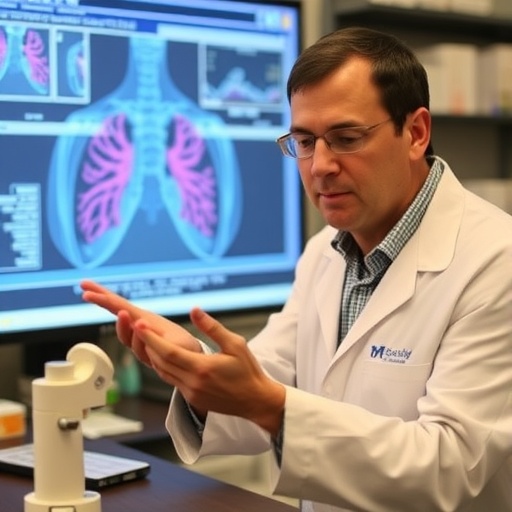
James Sacchettini, Ph.D. (center) and researchers Saswati Panda (left) and Siddhant Rath (right) are creating new AI tools for tuberculosis drug discovery.
Most of those affected live in lower-income regions, where long treatment times and limited care make the disease especially hard to control.
In the U.S., an outbreak in New York in the 1990s served as a wake-up call.
“People had thought, ‘oh, we cured that many years ago, right?’” he said. “Then it turned out that Rikers Island was completely covered with tuberculosis. People were getting out of prison and getting in an elevator with six other people, and by the time they got to the sixth floor, five other people were infected.”
Finding better treatments poses many challenges. The bacteria are covered in a thick, waxy coating that keeps most drugs from reaching their targets inside the cells. The bacteria also grow slowly, so experiments take longer.
“To do a tuberculosis experiment takes months sometimes, where it can take a week with staph or strep,” Sacchettini said. “That’s part of the reason why drug discovery pipeline has been relatively slow. It’s a perfect area to work with AI.”
Building a foundation first
Before the AI tools came a simpler problem. Research data in academic labs often lives on network drives, in slide decks and in the memory of whoever ran the experiment.
Sacchettini’s lab built DAIKON, an open-source platform published in 2023, to track a drug target from gene to years of chemistry work in one place. The Gates Foundation-supported Tuberculosis Drug Accelerator, or TBDA, uses DAIKON across its whole partnership of labs and companies. New tools plug directly into it, including both the Sacchettini lab’s recent AI systems.
“We’re not hoping for AI to give us the exact right answer. But it can tell us what not to work on, which then informs us what we should be working on. And it really is a big time saver.”
James Sacchettini, Ph.D.
Texas A&M AgriLife Research scientist and professor, Department of Biochemistry and Biophysics
Reducing false positives in early screening
Early in drug development, researchers test large numbers of compounds against a protein of interest. Some only appear to work. Some interfere with the test itself.
“These ‘nuisance molecules’ cost us so much time,” Sacchettini said. “One goal is to identify them so we don’t spend months, years or hundreds of thousands of dollars working on them.”
To fix this, Sacchettini’s team developed an AI model to identify those false signals.
The team’s model, called CAGE-Fusion, learns from published screening data to sort compounds into four kinds of trouble: compounds that clump together, compounds that trick the test’s chemical signal, compounds that react instead of binding and compounds that stick to many targets instead of just one. The published study was funded by the Gates Foundation and the Welch Foundation.
Given one nuisance compound and one clean compound, the model ranks the nuisance compound as the more suspicious about 94% of the time. It is better at some categories than others: compounds that react are the easiest to catch, and compounds that stick to many targets are the hardest. Inside DAIKON, the model runs automatically on incoming test data, flagging likely problems before a compound reaches further, expensive stages.
Chemists do not need to take results at face value.
“The model can walk you through the process and show you which regions of the molecules it thought were problematic,” said Siddhant Rath, an AgriLife Research scientist in Sacchettini’s lab who led the effort.
Identifying misleading compounds early is only one piece of the puzzle. Drug discovery spans many stages across multiple institutions. The Sacchettini lab is also using AI to help TBDA make better use of its shared knowledge.
Turning mountains of results into shared knowledge
Rath and colleague Saswati Panda, also in Sacchettini’s lab, developed an AI system to sort through TBDA’s data to ease its use. The project received funding from the Gates Foundation, National Institutes of Health and the Welch Foundation.
The consortium’s years of documentation includes many molecular structures.
“In my research, I might come across a molecule and think, ‘I know I’ve seen this before,’ but there was no easy way to find it,” Sacchettini said.
The system pulls together TBDA data across the drug discovery pipeline. A molecule can now be traced visually across projects, including where work has hit a dead end. Researchers can query the data through a chat interface.
“It will tell me in a matter of seconds who presented something, what they said about it, and give me the presentation so I can see the slides,” Sacchettini said.
New tools vs. an old ailment
In 2026, scientists have access to processing power not available before. This has helped AI play a bigger role in research, Rath and Panda said.
Scientists around the world are introducing AI tools into different stages of drug design, Sacchettini said. The models his lab created are already helping make the process easier.
“We’re not hoping for AI to give us the exact right answer,” he said. “But it can tell us what not to work on, which then informs us what we should be working on. And it really is a big time saver.”
Journal
Journal of Cheminformatics
Article Title
Deep learning for assay nuisance compound detection using a gated co-attention graph embedding model (CAGE-Fusion)
Article Publication Date
15-May-2026
Laura Muntean
Texas A&M AgriLife Communications
gabe.saldana@ag.tamu.edu
Office: 601-2481891
Journal
Journal of Cheminformatics
Article Title
Deep learning for assay nuisance compound detection using a gated co-attention graph embedding model (CAGE-Fusion)
Article Publication Date
15-May-2026
Tags
Cite Scienmag News
Louis Brooks. (July 30, 2026). Tuberculosis drug discovery gets smarter with AI at Texas A&M AgriLife. Scienmag. https://scienmag.com/tuberculosis-drug-discovery-gets-smarter-with-ai-at-texas-am-agrilife/
Louis Brooks. "Tuberculosis drug discovery gets smarter with AI at Texas A&M AgriLife." Scienmag, 30 July 2026, https://scienmag.com/tuberculosis-drug-discovery-gets-smarter-with-ai-at-texas-am-agrilife/. Accessed 4 September 2026.
Louis Brooks. "Tuberculosis drug discovery gets smarter with AI at Texas A&M AgriLife." Scienmag. July 30, 2026. https://scienmag.com/tuberculosis-drug-discovery-gets-smarter-with-ai-at-texas-am-agrilife/


