


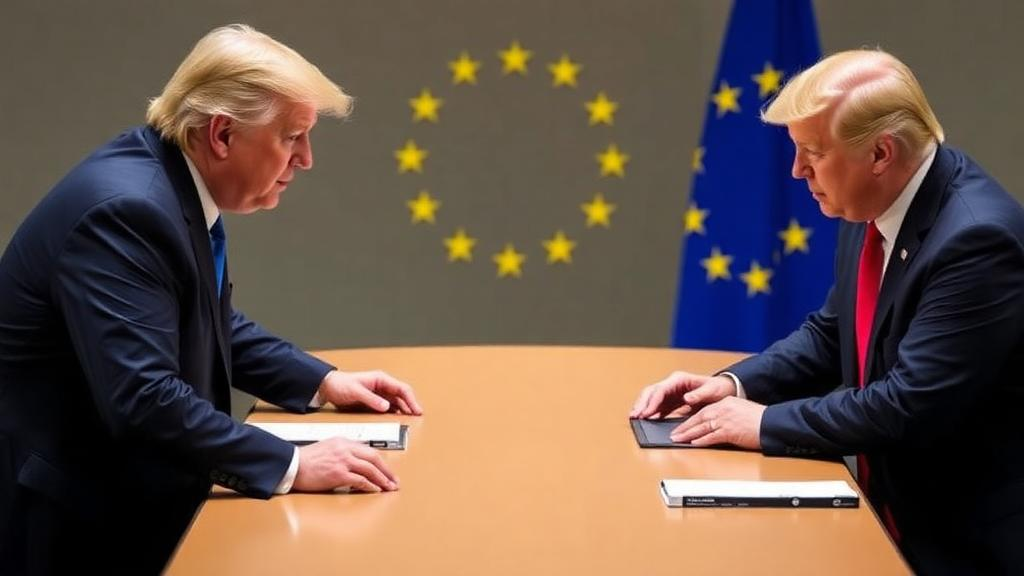
A new analysis published in the journal Global Public Policy and Governance argues that Donald Trump’s presidency should be understood not as a temporary aberration in transatlantic relations but as a catalyst that is accelerating a structural transformation of European Union governance. The study, authored by Matteo Scotto of Villa Vigoni, the German-Italian Centre for the European Dialogue, examines how the broader repositioning of the United States in global affairs has forced Europe to confront long-deferred questions about defense, foreign policy, and political coordination. According to the paper, the pressures generated by Washington’s conditional security commitments are producing institutional and industrial responses that may mark the beginning of what the author calls a post-American phase of European integration, even if that phase remains incomplete and its endpoint uncertain.
The analytical core of the paper rests on a distinction between disruption and catalysis. Where much commentary has treated Trump’s approach to alliances as an anomaly to be waited out, Scotto contends that the phenomenon functions instead as an accelerant for dynamics that were already latent in the European project. The European Union has long possessed economic weight and regulatory power, often described through the notion of the Brussels Effect, in which EU standards shape global markets, but it has historically lacked the capacity for collective action in the domains of hard security and high politics. Scholars have described the EU as a regulatory polity, strong at setting rules for trade and product standards yet weak at integrating what are called core state powers: defense, policing, taxation, and the other instruments through which states ultimately guarantee their own survival. Trump’s return to the presidency, the paper argues, has exposed this asymmetry with unusual force.
The first of three interrelated dynamics identified in the study concerns the rebalancing of the transatlantic relationship itself. Since the founding decades of the Cold War, European security has rested on what the historian Geir Lundestad famously described as an empire by invitation, in which Western European states welcomed an American security umbrella in exchange for alignment. That bargain assumed a durable American commitment to European territorial integrity. Trump’s public skepticism toward NATO, his demands that European allies dramatically increase defense spending, and his framing of alliances as transactions in which the United States pays and everybody else benefits have converted that assumption into a conditional one. The paper traces this rhetorical lineage from Trump’s 2016 campaign statements, when he called NATO obsolete and suggested the alliance might be allowed to break up, through his 2024 Republican National Convention speech, showing how the conditional character of American protection has become an explicit feature of the strategic environment rather than a background assumption.
This conditionality has spurred a cascade of EU-level and national initiatives. The study points to the Strategic Compass adopted by the Council of the European Union in 2022, which set out an ambitious framework for the Union to act as a security provider, and to the 2016 EU Global Strategy, which had already urged the Union to learn what the then High Representative Josep Borrell later called the language of power. More concretely, the European Council established the Security Action for Europe, known as SAFE, in May 2025, reinforcing the European Defence Industry Instrument in order to expand joint procurement and strengthen the continent’s defense industrial base. These measures, the paper suggests, represent more than incremental policy adjustments. They signal an emerging recognition that the governance architecture of the EU, historically optimized for market integration and regulation, must now extend into domains that member states have jealously guarded as symbols of sovereignty.
The second dynamic examined in the study concerns Germany’s evolving role in European defense, a topic the author treats as one of the most consequential and most ambivalent dimensions of the current transformation. For decades, Germany was characterized in the scholarly literature as the EU’s reluctant hegemon, an economic giant whose political culture, historical memory, and constitutional constraints made it unwilling to translate its economic strength into military leadership. The Russian full-scale invasion of Ukraine in 2022 prompted Chancellor Olaf Scholz to declare a Zeitenwende, a historic turning point, announcing a fundamental reorientation of German security policy and a special fund for rearmament. Yet the paper highlights the dilemmas that persist beneath this rhetorical shift. German rearmament raises difficult questions about burden-sharing within the EU, about the appropriate relationship between national capabilities and collective European instruments, and about how a militarily stronger Germany would be embedded in European institutions so as to reassure rather than alarm its neighbors.
The third dynamic identified in the analysis is the emergence of a political nucleus for European defense and foreign policy through intergovernmental and minilateral cooperation. Rather than a grand treaty-based leap toward a federal European army, the paper observes that the most significant developments are occurring in smaller, flexible formats. The Weimar Triangle, bringing together France, Germany, and Poland, is cited as one such grouping with the potential to lead on both security and industrial policy. The Franco-German embedded bilateralism that scholars Ulrich Krotz and Joachim Schild have documented as the historical engine of European integration is being supplemented by wider coalitions of the willing and able. This minilateral pattern reflects what the author, drawing on his earlier work on intergovernmentalism in EU crises, sees as a recurring feature of European integration: progress tends to occur through improvised, crisis-driven arrangements negotiated among a small set of pivotal states, which may later be generalized to the Union as a whole.
The paper situates these contemporary developments within a longer intellectual history of transatlantic asymmetry. Robert Kagan’s influential formulation of Americans being from Mars and Europeans from Venus captured a period in which Europe, sheltered under American protection, could afford to invest in civilian and normative power while the United States exercised hard power. The paper also invokes Francis Fukuyama’s thesis of the end of history, the post-Cold War expectation that liberal democracy and American-led order would face no fundamental challenger, and notes how that expectation has given way to a multipolar international system in which Europe must define its own position. Even Renaissance political thought, the author suggests in a historical aside drawing on Guicciardini’s account of Italy’s state system, offers precedents for how middle powers navigate between larger protectors and their own security imperatives. The point of these references is to underline that the current moment is not without historical parallel, even though its specific configuration is unprecedented.
Among the most sensitive questions the paper surveys is the nuclear dimension of European autonomy. A forum in the journal Survival in 2024 debated the prospects for a European nuclear deterrent, and a subsequent 2025 analysis by Lawrence Freedman examined the here and now of Europe’s nuclear options. The paper treats these debates as emblematic of the deeper transformation underway: if American extended deterrence becomes unreliable, European states must at least consider what strategic autonomy would mean at the highest level of escalation. The author does not present a European bomb as an imminent or settled prospect, but the very fact that such discussions have moved from the margins to the mainstream of strategic commentary illustrates how far the terms of the debate have shifted under the pressure of American retrenchment. Similarly, tensions over technology policy, including American criticism of European digital regulation described by the EU Institute for Security Studies as deepening the EU-US rift, show that the rebalancing extends well beyond defense into economic and regulatory affairs.
The paper’s conclusion is deliberately measured. Europe, Scotto argues, may be entering a post-American phase, but this phase is not defined by rupture with Washington. Rather, it is defined by the potential, still unfulfilled, for a rebalanced partnership with the United States and for a more autonomous European role in a multipolar order. The distinction matters: the analysis does not predict a clean break, nor does it claim that European strategic autonomy is already achieved. Instead, it identifies the institutional, industrial, and political building blocks that are being laid, from SAFE procurement instruments to German rearmament to minilateral defense coalitions, and asks whether they can cohere into durable governance. The answer, the paper suggests, will depend on whether Europe can convert crisis-driven improvisation into permanent capability, a challenge that has defeated earlier generations of European strategists but that the current conjuncture makes unusually urgent.
For observers of European politics, the study offers a framework for interpreting the accelerating stream of defense announcements, procurement deals, and diplomatic realignments emerging from Brussels and national capitals. Its central claim, that Trump operates less as a cause than as a catalyst of European governance change, implies that the transformation will not reverse with a change of administration in Washington. The unresolved questions of European defense, foreign policy coordination, and political integration that the American presidency has thrust into the open are, on this account, structural rather than episodic. Whether Europe seizes the moment to build governance commensurate with its economic weight, or continues to rely on an increasingly conditional American guarantee, remains the defining question of the continent’s security policy for the decade ahead.
Subject of Research: The impact of US repositioning under Trump on European Union defense and governance integration
Article Title: Toward a post-American Europe? Trump as a catalyst for EU governance
Article References: Scotto, M. (2025). Toward a post-American Europe? Trump as a catalyst for EU governance. Global Public Policy and Governance, 5(4), 433-443. https://doi.org/10.1007/s43508-025-00128-6
Image Credits: AI Generated
DOI: 10.1007/s43508-025-00128-6
Keywords: Donald Trump, European Union, EU governance, European defense, NATO, strategic autonomy, transatlantic relations, Germany, intergovernmentalism, multipolarity, foreign policy, defense industry
Cite Scienmag News
Courtney Benton. (October 3, 2026). Trump’s Return Accelerates Europe’s Push for Strategic Autonomy, Study Finds. Scienmag. https://scienmag.com/trumps-return-accelerates-europes-push-for-strategic-autonomy-study-finds/
Courtney Benton. "Trump’s Return Accelerates Europe’s Push for Strategic Autonomy, Study Finds." Scienmag, 3 October 2026, https://scienmag.com/trumps-return-accelerates-europes-push-for-strategic-autonomy-study-finds/. Accessed 4 October 2026.
Courtney Benton. "Trump’s Return Accelerates Europe’s Push for Strategic Autonomy, Study Finds." Scienmag. October 3, 2026. https://scienmag.com/trumps-return-accelerates-europes-push-for-strategic-autonomy-study-finds/


