


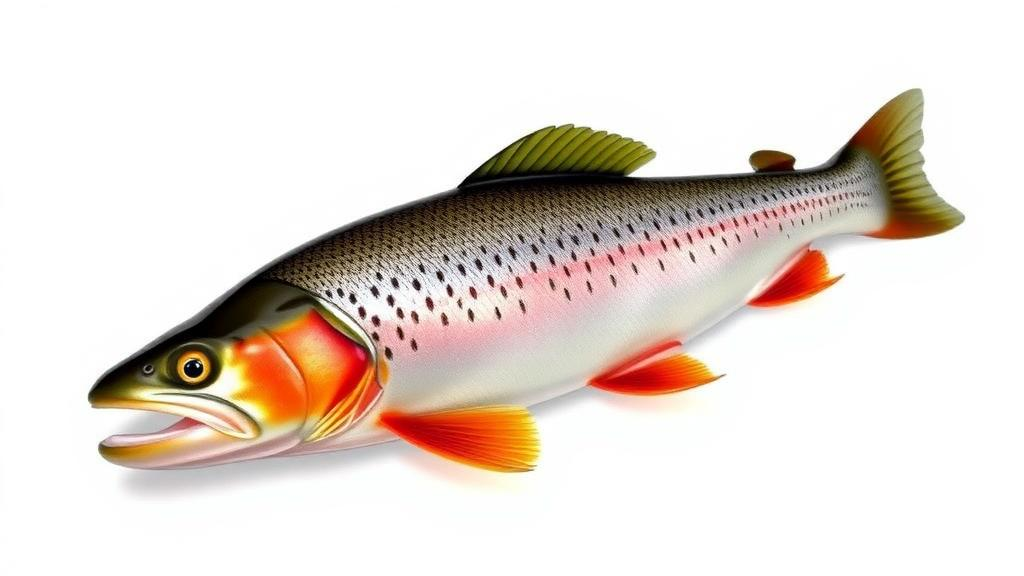
Every rainbow trout swimming in the lakes and hatcheries of southern Chile may already carry its own identity card. A new study published in Acta Ichthyologica et Piscatoria shows that the dark spots scattered along the flanks of Oncorhynchus mykiss are arranged in a pattern so distinctive that a computer can tell one fish from another with perfect accuracy. The finding opens the door to a non-invasive alternative to electronic tagging, one that relies on nothing more than a photograph and freely available pattern-matching software.
The research, conducted on a naturalized population from Calafquén Lake and a farmed Blue Back strain from the Piscícola Huililco fish farm in Chile’s Región de La Araucanía, set out to answer a deceptively simple question: are the flank spot patterns of rainbow trout unique enough to serve as natural identifiers? The team photographed the left flanks of 56 wild-origin adults captured during the spring run and 45 two-year-old farmed fish, then used the Interactive Individual Identification System, known as I3S, to compare each annotated image against every other image stored in a digital database.
The answer was emphatic. When each photograph was cross-matched against the full database, every single annotated image achieved the top ranking score of zero, which indicates a complete match of spot positions between images. This translated into a 100 percent recognition rate in both populations, with 95 percent confidence intervals stretching from 93.1 to 100 percent for the Calafquén Lake sample and 90.9 to 100 percent for the Blue Back strain. In other words, the software never confused one trout with another, and no two fish shared the same flank constellation of dark spots.
Underpinning this success is a striking degree of natural irregularity. Before running the recognition tests, the researchers quantified how evenly the spots were distributed using the coefficient of variation of nearest-neighbor distances, a standard metric for biological pattern analysis. At least half of the fish in both populations showed coefficients of 0.33 or greater, far higher than a control training dataset of deliberately regular patterns, which averaged just 0.12. This haphazard placement of spots, the authors argue, is precisely what makes the pattern so useful for identification: a random, individual-specific layout is far harder to duplicate than an orderly one.
The method also survived the test of time. In a subset of eight farmed fish photographed at age two and again at age three, six individuals were correctly matched to their own earlier images, a 75 percent long-term recognition rate with a wide confidence interval reflecting the small sample. Notably, the average number of flank spots did not change significantly between the two developmental stages, even though the fish grew substantially in length, from a mean of roughly 32 centimeters to more than 43 centimeters. Spot number, it seems, remains stable as the animal grows, while shifts in spot position relative to anatomical landmarks may explain the two fish that were missed.
That caveat points to the method’s boundaries. The researchers found a significant negative correlation between the number of spots in an image and the ranking scores of the second- and third-best matches, meaning that fish with denser spotting produced match scores closer to zero, raising the risk of a false positive. The technique worked best on trout carrying roughly ten to one hundred well-formed flank spots. It is also, by definition, useless for the small fraction of fish that lack spots altogether, which the study found ranged from zero to 8.9 percent depending on the population.
Image quality emerged as a further consideration. Because trout skin is reflective, photographs taken under natural light in different seasons risked specular glare that could obscure spots, and physiological darkening caused by stress, rearing background color, or sexual maturity can reduce contrast. The authors suggest that future studies adopt artificial lighting to standardize conditions, or borrow a trick from Chinook salmon research: photographing fish while submerged in water to suppress reflections. Digital contrast enhancement before the matching step offers another route to cleaner spot extraction.
The implications extend well beyond a single species. Spot-based identification has already proven effective in Atlantic salmon, whose opercular spots yielded an 85 percent match rate over ten months, and in Chinook salmon, where head spot patterns produced 100 percent recognition among 106 smolts. What distinguishes the new work is its use of simple, free software rather than custom-built algorithms, and its explicit quantification of pattern irregularity. For salmonid biologists, this lowers the technical barrier considerably: any laboratory or hatchery with a digital camera and a laptop can build its own identification database.
In Chile, where naturalized rainbow trout populations inhabit rivers and lakes across Patagonia, the technique could help researchers track spring-run spawning migrations, estimate demographic parameters, and study movement between habitats without repeatedly capturing and tagging animals. On fish farms, where rainbow trout carry real commercial weight, the approach could replace PIT tagging in small controlled trials of reproduction, genetics, nutrition, and health, sparing fish the stress of physical marking. The authors acknowledge that scaling up will require a fully automated identification tool and larger long-term validation samples, but their results establish the flank spot pattern as a genuine biological fingerprint for one of the world’s most widely farmed fishes.
Subject of Research: Photo-identification of individual rainbow trout using flank spot patterns
Article Title: Photo-identification of individual rainbow trout, Oncorhynchus mykiss ( Actinopterygii , Salmoniformes , Salmonidae ), using the flank spot pattern
Article References: Colihueque, N., & Estay, F. (2025). Photo-identification of individual rainbow trout, Oncorhynchus mykiss (Actinopterygii, Salmoniformes, Salmonidae), using the flank spot pattern. Acta Ichthyologica et Piscatoria, 55, 181-190. https://doi.org/10.3897/aiep.55.151044
Image Credits: AI Generated
Keywords: rainbow trout, photo-identification, spot pattern, non-invasive tagging, salmonids, aquaculture, Chile, I3S software, fish welfare, pattern recognition, naturalized populations, long-term identification
Cite Scienmag News
Alan Morgan. (October 19, 2026). Trout Spots Serve as Natural Fingerprints for Tag-Free Fish ID. Scienmag. https://scienmag.com/trout-spots-serve-as-natural-fingerprints-for-tag-free-fish-id/
Alan Morgan. "Trout Spots Serve as Natural Fingerprints for Tag-Free Fish ID." Scienmag, 19 October 2026, https://scienmag.com/trout-spots-serve-as-natural-fingerprints-for-tag-free-fish-id/. Accessed 19 October 2026.
Alan Morgan. "Trout Spots Serve as Natural Fingerprints for Tag-Free Fish ID." Scienmag. October 19, 2026. https://scienmag.com/trout-spots-serve-as-natural-fingerprints-for-tag-free-fish-id/


