


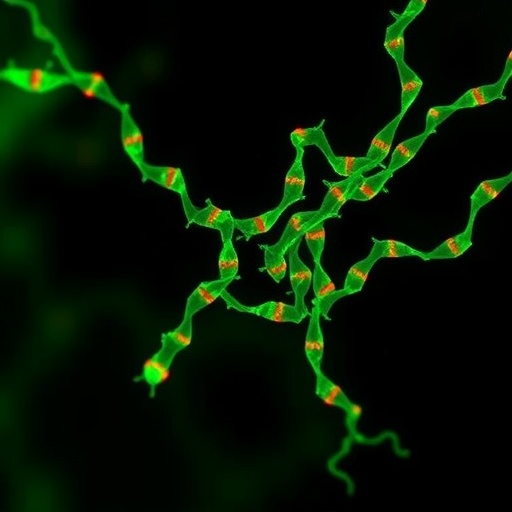
Recent advances in understanding the molecular underpinnings of triple-negative breast cancer (TNBC) have revealed a surprising link between Tropomodulin 1 (TMOD1) expression and chemotherapy responsiveness. TNBC, regarded as the most aggressive and lethal subtype of breast cancer, is characterized by its lack of estrogen, progesterone, and HER2 receptors, posing significant therapeutic challenges. In a groundbreaking study published in BMC Cancer, researchers led by Li et al. have uncovered that TMOD1 holds a paradoxical yet crucial role in the biology and treatment of TNBC, impacting patient prognosis and chemotherapeutic outcomes.
TMOD1 is a pointed-end actin filament capping protein previously implicated as a downstream effector within the NF-κB signaling pathway, which is known to regulate many processes critical to cancer cell survival and proliferation. Although TMOD1’s function in cancer biology had been touched upon, its specific influence on TNBC prognosis and response to chemotherapy had remained largely unexplored until now. Utilizing extensive clinical and laboratory-based methods, this novel investigation sheds light on how TMOD1 expression may serve as a biomarker for better survival and improved therapeutic sensitivity.
The study began with rigorous bioinformatics analyses from the Kaplan–Meier database, revealing that TNBC patients exhibiting high TMOD1 levels experienced significantly longer overall survival (OS) and recurrence-free survival (RFS). This correlation suggested that TMOD1 expression might serve as a favorable prognostic indicator. To further substantiate these findings, immunohistochemical assessments were conducted on tumor samples collected from 190 TNBC patients treated at West China Hospital, confirming that high TMOD1 expression correlated with improved clinical outcomes.
While it might seem counterintuitive, given TMOD1’s role in promoting the cancer cells’ proliferative, migratory, and invasive characteristics, its elevated presence paradoxically sensitizes TNBC cells to chemotherapy agents, particularly doxorubicin (Dox). This dualistic behavior underscores the complex cross-talk within cancer signaling networks, where oncogenic factors may simultaneously render tumor cells more vulnerable to specific treatments. The in vitro experiments used cell counting kit-8 assays to track cell viability following TMOD1 overexpression. These findings were complemented by Transwell migration and Matrigel invasion assays, which confirmed the enhanced malignant phenotypes but also uncovered an increased susceptibility of these aggressive cells to chemotherapeutic drugs.
The research team adopted a comprehensive approach by testing chemotherapy sensitivity with gradient doses of commonly used agents: doxorubicin, paclitaxel, and 5-fluorouracil (5-FU). Strikingly, TNBC cells overexpressing TMOD1 demonstrated a marked increase in sensitivity specifically to doxorubicin, while responses to paclitaxel and 5-FU did not exhibit the same pattern. This selective enhancement of Dox sensitivity could have significant clinical implications, providing rationale for tailored treatment regimens based on TMOD1 expression levels.
Further in vivo validation employed cell line-derived xenograft (CDX) models in immunocompromised mice, where tumors driven by TMOD1-overexpressing TNBC cells exhibited greater reductions in growth when treated with doxorubicin compared to controls. This animal model reinforced the translational potential of the findings, suggesting that TMOD1 expression might be incorporated into diagnostic workflows to predict patient responsiveness to chemotherapy.
The mechanistic basis underlying TMOD1’s role in augmenting doxorubicin sensitivity remains an active avenue for investigation. TMOD1’s effects on actin cytoskeletal dynamics could influence cell cycle regulation, DNA damage repair pathways, or intracellular drug trafficking, ultimately modulating chemotherapeutic efficacy. Future research focusing on elucidating these pathways at a molecular level would provide valuable insight into designing combination therapies that exploit TMOD1-associated vulnerabilities.
This study also challenges the classical paradigm that links tumor aggressiveness unequivocally with poor prognosis. The data introduce a refined perspective where certain oncogenic factors simultaneously drive malignant behaviors and therapeutic susceptibility, illustrating the necessity of nuanced biomarkers rather than one-dimensional prognostic models.
Clinically, the implications are profound. The identification of TMOD1 as a biomarker of chemotherapy sensitivity could enable oncologists to stratify TNBC patients who are most likely to benefit from doxorubicin-based regimens. This stratification could minimize unnecessary exposure to ineffective treatments, reduce toxicity, and optimize personalized medicine approaches in a cancer subtype historically difficult to treat.
Moreover, the discovery that TMOD1 influences both tumor progression and treatment response underscores the importance of integrated therapeutic strategies addressing tumor biology holistically. Modulating TMOD1 activity pharmacologically or leveraging its expression patterns may pave the way toward novel adjuvant therapies that potentiate chemotherapy while managing tumor aggressiveness.
In conclusion, the work by Li and colleagues offers a pioneering contribution to breast cancer research, revealing that TMOD1 stands at a critical intersection between tumor biology and chemotherapy responsiveness in triple-negative breast cancer. These findings may ignite new research directions aimed at exploiting TMOD1’s dual roles for improved patient outcomes and establish TMOD1 as a vital biomarker in the era of precision oncology.
As the scientific community continues to unravel TNBC’s complexity, integrating molecular determinants like TMOD1 into clinical practice promises to transform prognosis prediction and therapeutic decision-making. This study not only expands our understanding of cancer biology but also exemplifies how molecular oncology can directly inform and refine cancer treatment paradigms to benefit patients facing this most challenging breast cancer subtype.
Cite Scienmag News
Nathaniel Bowman. (October 16, 2025). Tropomodulin 1 Boosts Chemo Response in TNBC. Scienmag. https://scienmag.com/tropomodulin-1-boosts-chemo-response-in-tnbc/
Nathaniel Bowman. "Tropomodulin 1 Boosts Chemo Response in TNBC." Scienmag, 16 October 2025, https://scienmag.com/tropomodulin-1-boosts-chemo-response-in-tnbc/. Accessed 4 September 2026.
Nathaniel Bowman. "Tropomodulin 1 Boosts Chemo Response in TNBC." Scienmag. October 16, 2025. https://scienmag.com/tropomodulin-1-boosts-chemo-response-in-tnbc/


