


Bacterial wilt is one of the most feared diseases in eggplant production. Caused by the soil-borne bacterium Ralstonia solanacearum, it can sweep through a field and leave plants wilted beyond recovery, and because the pathogen persists in soil for years, farmers often face the same threat season after season. In Bangladesh, where eggplant ranks second only to potato in acreage, production and consumption, the standard response has been chemical pesticides, which raise concerns about soil pollution, beneficial organisms and human health. A new study from Bangladesh Agricultural University, published in Innovations in Agriculture, reports that a suspension of the fungus Trichoderma asperellum CP (IPM 33) can substantially reduce bacterial wilt severity in eggplants, and that timing, dosage and variety all determine how well the treatment works.
The research team, working between September 2022 and April 2023, combined laboratory trials at the university’s Plant Disease Diagnostic Clinic and IPM Laboratory with a field experiment at the Department of Plant Pathology’s Field Laboratory. They used a Randomized Complete Block Design with three replicates and tested three eggplant varieties: BAU Begun-1, BAU Begun-2 and BARI Begun-5. The pathogen was isolated from naturally wilted eggplants, surface sterilized with 10% sodium hypochlorite and purified through an oozing test. In the field, plants were inoculated once at the flowering stage and again at the fruiting stage using the collar region inoculation method, in which the bacterial suspension is introduced at the collar, the junction between stem and roots.
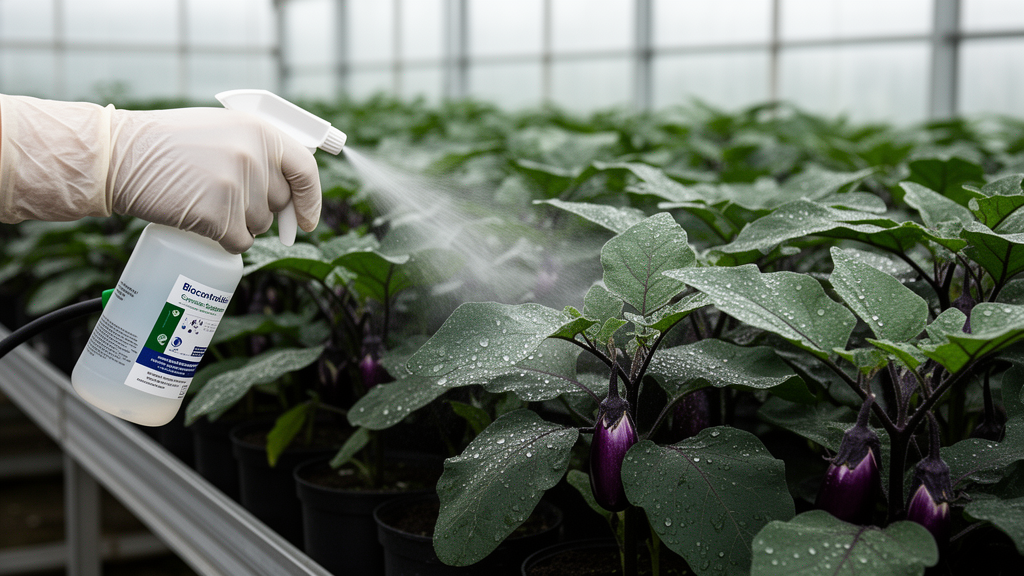
The Trichoderma suspension, prepared at a concentration of 5.8 × 10⁷ colony-forming units per millilitre, was applied to the rhizosphere, the narrow zone of soil surrounding the roots where microbes and plant roots interact. Half of the plants in each plot received the treatment 48 hours before pathogen inoculation and the other half 48 hours after, at rates of either 20 or 40 millilitres per plant. The researchers recorded symptom expression every three days for 21 days after inoculation, counting total, inoculated, wilted and recovered plants per plot. Disease severity was scored on a 0–5 rating scale following the method of Rahman and Haque, and infection levels were expressed as percentages.
In the laboratory, the antagonistic potential of the fungus was evaluated in dual culture on potato dextrose agar. Trichoderma asperellum CP (IPM 33) achieved complete inhibition of Ralstonia solanacearum f. sp. melongenae growth, blocking the bacterium entirely when the two organisms shared a plate. The authors note that colonies of the virulent strain became visible on nutrient agar within 48 to 72 hours, appearing white or cream-colored, irregularly round, fluidal and opaque with a pinkish center. This 100% in vitro inhibition, they argue, supports the fungus’s candidacy as a biological control agent and provides a mechanistic basis for the field results.
The field data revealed striking differences among the three varieties. Percent wilting ranged from 25 to 33.33%. BARI Begun-5 proved the most susceptible at 33.33%, BAU Begun-1 the most resistant at 25%, and BAU Begun-2 fell in between at 29.17%. Notably, recovery of wilted plants was observed only in BAU Begun-2; neither BAU Begun-1 nor BARI Begun-5 recovered from infection under any treatment. During the pathogenicity test, BARI Begun-5 showed symptoms first at the flowering stage, progressing from slow drooping to quick drooping, while BAU Begun-1 took longer to develop symptoms, indicating relative resistance. At the fruiting stage, no symptoms appeared even in control plots, suggesting that susceptibility depends on the plant’s growth stage.
Timing of application emerged as a decisive factor. When no Trichoderma was applied, wilting reached 83.33%. Pre-inoculation application produced the lowest wilting percentage, 22.22%, and the highest recovery rate, 12.50%, both significantly different from other treatments. Post-inoculation application reduced wilting to 36.11% with 7.69% recovery. The authors attribute this preventive effect to thorough colonization of the rhizosphere by Trichoderma before the bacterium can establish itself. When the suspension was applied after inoculation, parts of the rhizosphere had already been colonized by Ralstonia, limiting the biocontrol agent’s ability to intervene. Similar timing effects have been reported previously in tomato.
Dosage also mattered. Wilting percentages ranged from 19.44 to 83.33% across dose treatments. The 40 millilitres per plant rate produced the lowest wilting, 19.44%, and was the only dose at which recovery occurred, reaching 28.57%. The 20 millilitres per plant rate reduced wilting to 38.89% but produced no recovery. The authors suggest that the higher dose reduced the growth rate of Ralstonia in the rhizosphere, and they draw parallels with earlier work showing that Trichoderma harzianum reduces chlamydospore germination in Fusarium oxysporum. These dose-dependent responses, they conclude, indicate that optimizing application rates is crucial for maximizing biocontrol efficacy in the field.
Growth stage shaped the outcome as well. Wilting was significantly lower at the fruiting stage, 19.44%, than at the flowering stage, 27.78%, while untreated controls reached 83.33%. Recovery of wilted plants was possible only at the flowering stage, at a rate of 10%, and was absent at the fruiting stage. The interaction analysis showed that for BAU Begun-1, applying 40 millilitres per plant as a pre-inoculation treatment at both stages produced no disease at all, while the other two varieties wilted at rates between 6.67 and 12.50% across all factor combinations. Recovery was observed only in BAU Begun-2 at the flowering stage with the 40 millilitres per plant dose, for both pre- and post-inoculation treatments. The combined influence of varietal resistance, optimal dosage, growth stage and application timing illustrates the multifactorial nature of effective disease suppression.
The authors frame the findings in the context of growing global demand for safe food and organic farming methods. Chemical pesticides, they note, can harm beneficial organisms and raise human and animal health concerns, whereas Trichoderma is a naturally occurring soil fungus that produces trichodermin, an antagonistic compound, and can also boost plant growth, enhance nutrient uptake and fortify plant resistance. An organic formulation containing the fungus, they argue, has the potential to substitute or minimize chemical pesticide use in managing eggplant wilt while creating a safer environment for growers.
The study also points to future directions. The authors call for research on the field-level consistency of Trichoderma efficacy across diverse agro-ecological zones and cropping systems, and for molecular studies to clarify the mechanisms underlying varietal resistance and rhizosphere colonization. Such work, they suggest, would support the development of more robust biocontrol solutions. For now, the results offer eggplant growers a concrete, evidence-based option: apply Trichoderma asperellum suspension before the pathogen arrives, at the higher dose tested, and pair it with moderately resistant varieties such as BAU Begun-2 to give wilted plants their best chance of recovery.
Subject of Research: Trichoderma asperellum biopesticide reduces bacterial wilt in eggplants in Bangladesh field trials.
Article Title: Trichoderma to the rescue: Overcoming bacterial wilt in eggplants with a natural biopesticide
Article References: Trichoderma to the rescue: Overcoming bacterial wilt in eggplants with a natural biopesticide. (n.d.). https://doi.org/10.3897/ia.2025.145975
Image Credits: AI Generated
Keywords: Trichoderma asperellum, bacterial wilt, eggplant, Ralstonia solanacearum, biopesticide, biological control, Bangladesh, sustainable agriculture, Trichoderma, rescue, Overcoming, bacterial
Cite Scienmag News
Alan Morgan. (October 16, 2026). Trichoderma asperellum suspension curbs bacterial wilt in eggplants, study finds. Scienmag. https://scienmag.com/trichoderma-asperellum-suspension-curbs-bacterial-wilt-in-eggplants-study-finds/
Alan Morgan. "Trichoderma asperellum suspension curbs bacterial wilt in eggplants, study finds." Scienmag, 16 October 2026, https://scienmag.com/trichoderma-asperellum-suspension-curbs-bacterial-wilt-in-eggplants-study-finds/. Accessed 16 October 2026.
Alan Morgan. "Trichoderma asperellum suspension curbs bacterial wilt in eggplants, study finds." Scienmag. October 16, 2026. https://scienmag.com/trichoderma-asperellum-suspension-curbs-bacterial-wilt-in-eggplants-study-finds/


