


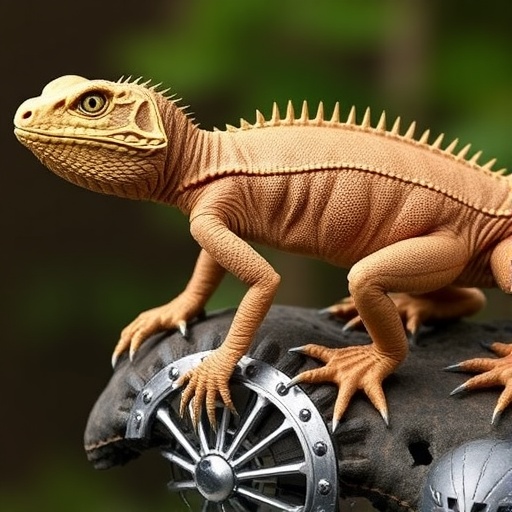
A newly published study elucidates remarkable insights into the evolutionary history of reptilian skin appendages, revealing that complex integumentary structures existed far earlier and in far more diverse forms than previously understood. The research centers on the remarkable discovery of structurally intricate skin appendages in drepanosauromorphs—an enigmatic group of non-saurian diapsid reptiles from the Triassic period—offering compelling evidence that such morphological innovations arose independently and well before the appearance of modern reptiles and avemetatarsalians, the lineage that includes birds and their closest dinosaurian relatives.
The integumentary appendages of the Triassic genera Mirasaura and Longisquama present characteristics that sharply distinguish them from the known skin structures of other amniotes, such as scales, horns, hair, or crests. These appendages exhibit a unique, highly consistent morphology with a proximal segment featuring a wide central band, coupled with a distal expanded portion formed by two laminae separated by a distinctive medial structure. Their extraordinary length relative to overall body size and the low aspect ratio—characterized by a narrow base that gradually expands distally—make them unlike any conventional scale types recognized in reptilian integument.
Further nuance emerges from the microstructural analysis of melanosomes, pigment-containing organelles within the skin appendages. The geometric properties of these melanosomes in Mirasaura differ significantly from those associated with scaly reptilian skin and mammalian hair, allowing researchers to exclude close homology or affinity between these appendages and the integumentary structures typical of other vertebrate lineages. This strongly suggests that the appendages represent a distinct evolutionary experiment in integumentary complexity, separate from both scaly dermal coverings and hair.
Strikingly, the morphology of these appendages superficially resembles pennaceous feathers, particularly in their bilaterally symmetrical, flattened, distal structure and the presence of a medial spine-like feature resembling a rachis. Yet, the analogy to feathers is limited. Unlike pennaceous feathers, which develop through complex branching of barbs that fuse to form a central rachis flanked by vanes, the appendages in Mirasaura and Longisquama lack any evidence of branching barbs. Instead, each lamina constitutes a continuous, sheet-like layer, as confirmed by preserved carbonaceous films on fossil specimens. Consequently, the medial structure, though vane-like in appearance, cannot be considered homologous to the rachis found in true feathers.
Phylogenetic analyses conducted by the research team further reinforce the notion of evolutionary convergence rather than direct homology. These analyses position Mirasaura and its relatives within non-saurian diapsids predating the last common ancestor of avemetatarsalians, suggesting that bilaterally symmetrical integumentary appendages arose independently in drepanosauromorphs and bird-line archosaurs. This divergence implies that complex skin structures like feathers are one of multiple evolutionary trajectories in skin appendage innovation that emerged during the Triassic.
The Triassic period thus emerges as a pivotal epoch for integumentary evolution, witnessing not only the genesis of feathers and hair among archosaurs and mammaliaforms but also entirely novel appendages like those of Mirasaura. The latter group’s appendages were likely not adaptations for thermoregulation or body insulation—a primary function of feathers and hair—but rather visual display structures, underscoring diverse selective pressures acting on skin morphology during this dynamic time in vertebrate evolution.
This discovery reshapes current paradigms about the origins and functional diversity of skin appendages across amniotes, emphasizing that the early evolution of complex integument involved multiple independent innovations rather than a single ancestral lineage. The presence of these elaborate appendages in non-saurian diapsids predating modern reptiles suggests that the capacity for developing such structures traces back to deep branches of the reptilian evolutionary tree, potentially even to ancestors predating the split of major reptile lineages.
Moreover, the study sheds light on the evolutionary arms race during the Triassic, a transformative period marked by dramatic climatic shifts and biotic interactions that catalyzed leaps in metabolic and neurological sophistication in vertebrates. Whereas feathers and hair contributed critically to the rise of endothermy and enhanced cognitive capacity through insulation and thermoregulation, the appendages on Mirasaura exemplify an alternative evolutionary pathway, emphasizing display and perhaps species recognition as drivers of morphological complexity.
The technological advances allowing detailed melanosome analysis, including comparisons of preserved pigmentation structures, have proven instrumental in differentiating these unique integumentary features. Such investigations transcend mere morphology, tapping into cellular and molecular evidence to refine our understanding of evolutionary relationships and homologies among skin appendages. These methods are setting new standards for paleontological inquiry into the soft tissue anatomy of extinct taxa hitherto known predominantly from skeletal remains.
This compelling evidence from Mirasaura and Longisquama also underscores the remarkable diversity of integumentary forms accommodated by diapsids during the Triassic, marking this interval as a hotspot for morphological experimentation. The eventual extinction of drepanosauromorphs before the Jurassic further highlights that the evolutionary success of complex skin appendages was not uniformly guaranteed and that different lineages took divergent evolutionary paths with distinct outcomes.
The study’s findings open fresh avenues of research into the developmental biology underpinning integumentary appendage formation, prompting reassessment of the genetic and epigenetic mechanisms that could have facilitated such independent elaborations. Understanding how these skin structures emerged without the hallmark branching seen in feathers raises important questions about the evolutionary plasticity of integumentary systems and the selective contexts driving their diversification.
In sum, this groundbreaking research published in Nature punctuates the Triassic as a formative era for skin appendage evolution, revealing that the origins of complex integument are far more ancient, diverse, and intricate than classical models have proposed. It revolutionizes our comprehension of reptile evolution, emphasizing that what modern reptiles and birds exhibit today is the legacy of a rich tapestry of evolutionary experiments, some of which unfolded along now-extinct lineages like the drepanosauromorphs.
As we continue to unravel the paleobiology of these enigmatic creatures through cutting-edge microscopy and phylogenetics, we stand poised to redefine how we perceive the early evolution of vertebrate integument. The discovery of these early complex appendages not only fills critical gaps in the fossil record but also challenges entrenched views on how appearance, physiology, and behavior evolved in tandem over hundreds of millions of years.
This research ultimately underscores the dynamic and innovative character of life’s history, revealing how anatomical complexities can arise multiple times across distant evolutionary branches. The evolution of integumentary appendages was no linear progression but rather a multifaceted saga of convergence, adaptation, and experimentation unfolding against the backdrop of Earth’s ever-changing ecosystems.
Cite Scienmag News
Gavin Prescott. (July 23, 2025). Triassic Diapsid Reveals Early Reptile Skin Diversity. Scienmag. https://scienmag.com/triassic-diapsid-reveals-early-reptile-skin-diversity/
Gavin Prescott. "Triassic Diapsid Reveals Early Reptile Skin Diversity." Scienmag, 23 July 2025, https://scienmag.com/triassic-diapsid-reveals-early-reptile-skin-diversity/. Accessed 7 September 2026.
Gavin Prescott. "Triassic Diapsid Reveals Early Reptile Skin Diversity." Scienmag. July 23, 2025. https://scienmag.com/triassic-diapsid-reveals-early-reptile-skin-diversity/


