


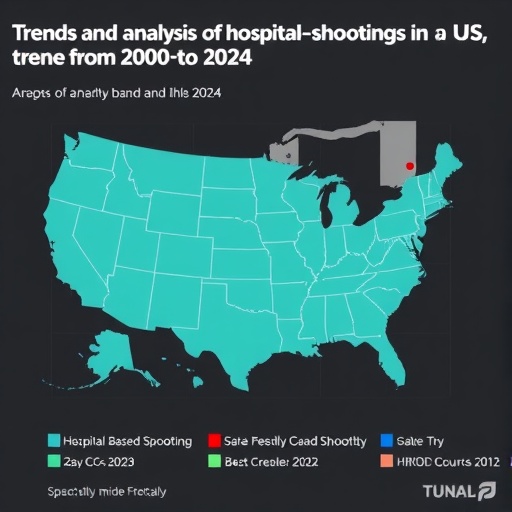
Over the past quarter-century, hospital-based shootings in the United States have escalated with a steady and concerning trajectory, highlighting an urgent intersection between expanding trends in workplace violence and firearm-related incidents nationwide. This systematic review offers a comprehensive analysis of documented incidents, revealing that healthcare environments—traditionally viewed as sanctuaries of safety and care—are increasingly becoming battlegrounds that mirror the greater societal crisis of gun violence.
Hospitals face unique vulnerabilities amid this rise in violence due to several compounding factors. Large healthcare institutions, often located in metropolitan regions and within southern states, bear a disproportionate burden of these shootings. These facilities, characterized by high patient volume, dense and diverse populations, and complex operational dynamics, serve as focal points for the manifestation of broader social tensions, including economic disparities, mental health crises, and systemic inequities in access to care.
The study delves into the underlying mechanisms of this phenomenon by examining urban population dynamics, regional cultural contexts, and hospital size as critical modifiers of risk. Urban hospitals are situated within communities often grappling with elevated baseline levels of violence and social instability. Consequently, the hospital setting may inadvertently become an extension of those external environments, susceptible to the spillover effects of community-based firearm confrontations and interpersonal conflicts.
This pattern has been further contextualized through systems analysis, which frames the hospital as an interconnected node within an intricate social and physical ecosystem. Considerations include not only the internal security infrastructure but also the layered social interactions among staff, patients, visitors, and external actors. Weaponry enters the equation as a potent disruptor, with firearms serving as both instruments and symbols of power that exacerbate the risk profile in these settings.
Central to the review’s findings is the acknowledgment that traditional workplace violence prevention strategies are insufficient when isolated from comprehensive, hospital-specific approaches. Emerging proposals advocate for the implementation of advanced weapons screening technologies at entry points, including metal detection systems and biometric access controls, aimed at intercepting firearms before entry. These technologies, however, raise ongoing debates regarding privacy, operational throughput, and cost-effectiveness, necessitating tailored, context-sensitive deployment.
Furthermore, the study highlights the imperative for integrated risk assessment models that not only factor in immediate threats but also anticipate potential escalation pathways within hospital environments. The incorporation of behavioral psychology insights reveals patterns of human behavior that precipitate violent episodes, enabling proactive intervention strategies by trained personnel. Such multidisciplinary approaches extend beyond physical barriers to include enhanced staff training in de-escalation techniques and mental health support frameworks.
Crucially, the review underscores the symbiotic relationship between hospital shootings and broader societal firearm violence trends. The healthcare system does not operate in a vacuum; thus, effective mitigation requires alignment with national firearm policy reforms, community outreach programs, and societal initiatives aimed at reducing gun access among high-risk individuals. These comprehensive measures must intersect with localized strategies that account for demographic variations and regional cultural factors.
The research also spotlights the nuanced challenges faced by hospitals in the Southern United States, regions with historically higher rates of firearm ownership and cultural normalization of guns. These local contexts complicate prevention strategies, demanding bespoke solutions that respect community values while prioritizing safety imperatives. Engagement with community leaders and law enforcement agencies becomes essential for fostering cooperative frameworks that support violence prevention within these settings.
From a technical perspective, the study employs robust epidemiological methodologies, aggregating data across multiple reporting systems and validating incident reports through cross-references with media accounts and law enforcement documentation. This rigorous approach enhances the reliability of the findings, illuminating patterns that might otherwise remain obscured in fragmented data landscapes.
In sum, the growing menace of hospital-based shootings in the United States represents a multifaceted challenge. Hospitals must evolve beyond traditional security paradigms to incorporate innovative technological, behavioral, and community-informed strategies. As society grapples with mounting firearm violence, healthcare institutions stand at a critical nexus, requiring simultaneous internal transformation and broader societal change to safeguard the sanctity of medical environments.
Addressing this complex crisis demands an urgent, multidisciplinary mobilization that integrates policy reform, technological innovation, and human-centered care principles. Only through such comprehensive and systemic efforts can the trend of escalating hospital shootings be reversed, restoring hospitals as safe havens for healing and hope in an increasingly volatile world.
News Publication Date: Not specified.
Web References: Not specified.
References: (doi:10.1001/jamanetworkopen.2026.10552)
Keywords
Gun violence, Hospitals, United States population, Weaponry, Risk assessment, Community stability, Urban populations, Systems analysis, Technology
Cite Scienmag News
Glenn Wilkins. (May 4, 2026). Trends and Analysis of Hospital-Based Shootings in the US from 2000 to 2024. Scienmag. https://scienmag.com/trends-and-analysis-of-hospital-based-shootings-in-the-us-from-2000-to-2024/
Glenn Wilkins. "Trends and Analysis of Hospital-Based Shootings in the US from 2000 to 2024." Scienmag, 4 May 2026, https://scienmag.com/trends-and-analysis-of-hospital-based-shootings-in-the-us-from-2000-to-2024/. Accessed 3 September 2026.
Glenn Wilkins. "Trends and Analysis of Hospital-Based Shootings in the US from 2000 to 2024." Scienmag. May 4, 2026. https://scienmag.com/trends-and-analysis-of-hospital-based-shootings-in-the-us-from-2000-to-2024/


