

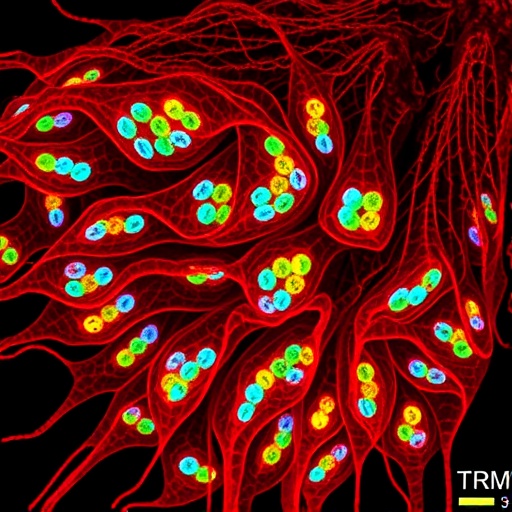
In the ever-evolving landscape of neuroscience, new studies continuously unravel the intricate mechanisms that underlie neurological disorders, providing fresh insights and potential therapeutic avenues. A groundbreaking study recently published in Cell Death & Discovery in 2026 has illuminated a novel cellular mechanism contributing to epileptogenesis—the process by which a normal brain becomes epileptic. This study, spearheaded by Wang, Zhou, Zhai, and their colleagues, advances our understanding of how microglial cells, traditionally known as the brain’s resident immune cells, engage in synaptic remodeling in a manner that prolongs seizure susceptibility following febrile seizures (FS). Central to this mechanism is TREM2, a microglial receptor mediating phagocytic activity—pointing to an intricate interplay between immune signaling and neural circuit stability in epilepsy.
Febrile seizures, seizures associated with fever in young children, have long been recognized as a critical risk factor for the later onset of epilepsy. However, the precise mechanisms by which these early-life insults trigger long-term predisposition to epileptic activity have remained elusive. The study brings microglia, often considered the brain’s housekeepers, into the spotlight, showing that their phagocytic activity goes beyond debris clearance to actively reshaping synaptic connectivity. Wang and colleagues demonstrate that microglia target inhibitory synapses following FS episodes, reducing inhibitory tone and thus contributing to a hyperexcitable neural network primed for epileptic activity.
At the heart of this process is the triggering receptor expressed on myeloid cells 2 (TREM2), a receptor well-documented for its role in microglial activation and phagocytosis in neurodegenerative diseases. Its role in epilepsy, however, has been less characterized until now. By employing a combination of cutting-edge in vivo models and molecular techniques, the researchers revealed that TREM2-mediated signaling prompts microglia to selectively engulf inhibitory synaptic terminals. This selective pruning attenuates GABAergic inhibition, causing an imbalance in excitatory/inhibitory signaling that fosters epileptogenesis.
The research team utilized optogenetic and electrophysiological approaches to confirm that post-FS microglial activity leads to a significant reduction of inhibitory synaptic input in critical brain regions implicated in seizure generation. This disruption destabilizes neural networks by tipping the balance toward excessive excitatory neuron firing. Intriguingly, blocking TREM2 signaling pharmacologically or genetically attenuated microglial phagocytosis of inhibitory synapses, consequently reducing seizure susceptibility in experimental animals. Such findings underscore the receptor’s potential as a therapeutic target for preventing epilepsy following febrile seizures.
Delving deeper into the molecular cascade, the study delineates that TREM2 activation enhances microglial motility and the expression of phagocytic markers, which facilitate synapse engulfment. Microglia exhibit morphological changes characteristic of activated states, including enlarged soma and increased process motility, which enable them to survey and target synaptic structures more efficiently. The specificity for inhibitory synapses appears to involve SAP102 and gephyrin interactions, synaptic scaffold proteins integral to inhibitory synapse stability, which may serve as ‘eat-me’ signals recognized by microglia.
The findings challenge traditional notions of epilepsy as a solely neuronal disorder by emphasizing the interdisciplinary intersections between neuroimmunology and synaptic physiology. Microglial-mediated synapse remodeling represents a paradigm shift, suggesting that immune responses intricately weave into the fabric of neural plasticity and seizure genesis. These insights could recalibrate therapeutic strategies, shifting from neuron-centric to glia-inclusive approaches in epilepsy care.
Further ramifications of this study extend to understanding the chronic nature of epilepsy, particularly how initial insults lead to lasting neural network dysfunction. The prolonged presence of TREM2-activated microglia and persistent pruning of inhibitory synapses might explain the enduring hyperexcitability that defines epileptic foci. This persistent microglial activity may therefore be a critical driver of epileptogenesis beyond the acute injury phase, offering a window for intervention before chronic epilepsy establishes.
Importantly, the work adds to accumulating evidence linking impaired inhibitory circuits with epilepsy, reinforcing GABAergic dysfunction as a hallmark of seizure disorders. By pinpointing microglial phagocytosis as a novel mechanism for inhibitory synapse loss, the study opens avenues for targeted manipulation of microglial receptors and signaling pathways to restore synaptic balance and prevent seizure progression.
The use of advanced imaging techniques, including two-photon microscopy, allowed real-time visualization of microglial movements and their interactions with synapses in living brain tissue. Such observations provided direct evidence for microglial engulfment of inhibitory terminals and highlighted dynamic cellular responses post-FS. This methodological innovation strengthens the causal link between microglial activity and synaptic pathology.
The translational potential of targeting TREM2 in epilepsy is significant. Therapeutic interventions aimed at modulating microglial activation—whether through small molecules, antibodies, or gene editing—could offer novel disease-modifying treatments. Given TREM2’s established involvement in other CNS disorders like Alzheimer’s disease, existing drug development pipelines could be leveraged, accelerating clinical progress.
Wang et al. also discuss implications for pediatric epilepsy, where early identification of children at risk following febrile seizures could prompt TREM2-based therapeutic strategies to mitigate long-term outcomes. Such prophylactic approaches could revolutionize the management of epilepsy, transforming it from reactive treatment to risk prevention.
While the study profoundly enhances our understanding, several questions remain. The precise molecular signals mediating selective recognition of inhibitory synapses by microglia need further elucidation. Additionally, the broader impact of TREM2 modulation on microglia-neuron interactions and overall brain homeostasis warrants careful investigation to avoid unintended consequences.
In summary, this pioneering research unravels a critical mechanism whereby TREM2-activated microglia phagocytose inhibitory synapses, thereby contributing to the chronic hyperexcitable state underlying epilepsy following febrile seizures. This insight not only bridges gaps in epilepsy pathophysiology but also highlights microglial modulation as a promising frontier in epilepsy therapeutics. The findings invite a reevaluation of how immune cells interact with neuronal networks and underscore the importance of a multidisciplinary approach to neurological disease.
The discovery injects fresh enthusiasm into epilepsy research, offering hope that harnessing microglial function could alter the trajectory of a disorder that affects millions globally. As the neuroscience community builds on these findings, the prospect of novel, effective treatments for epilepsy comes tantalizingly closer to reality.
Subject of Research: The role of TREM2-mediated microglial phagocytosis of inhibitory synapses in prolonged epileptogenesis induced by febrile seizures.
Article Title: TREM2-mediated microglial phagocytosis of inhibitory synapses contributes to prolonged FS-induced epileptogenesis.
Article References:
Wang, X., Zhou, H., Zhai, Y. et al. TREM2-mediated microglial phagocytosis of inhibitory synapses contributes to prolonged FS-induced epileptogenesis. Cell Death Discov. (2026). https://doi.org/10.1038/s41420-026-03118-7
Image Credits: AI Generated


