


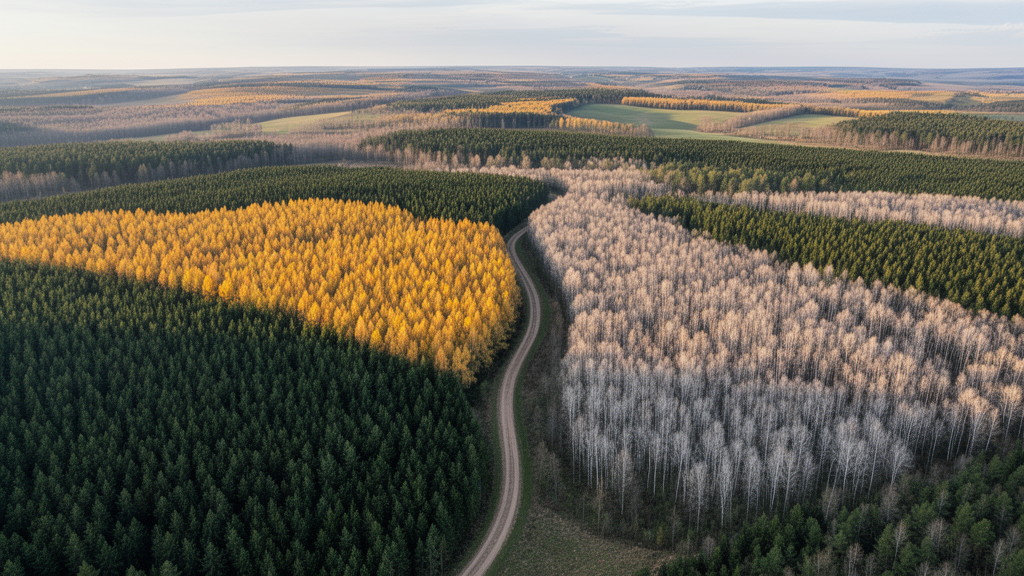
For nearly a century, ecologists have sorted Europe’s forests into categories using a system that quietly depends on a choice nobody ever formalized: how much weight to give the trees compared with the plants growing beneath them. A new analysis of more than 23,000 vegetation surveys from Austria and the surrounding Alps suggests the answer has been hiding in plain sight. When researchers classified forests using only the woody species of the tree and shrub layers, ignoring the herbaceous understorey entirely, the computer-generated groups reproduced the upper levels of the traditional Braun-Blanquet classification with surprising fidelity. The finding, published in Vegetation Classification and Survey, argues that Europe’s forest classes, orders, and even many alliances can be defined by their canopies alone, and that decades of inconsistency in vegetation science stem from never writing that rule down.
The study, conducted by a researcher working with the Austrian Vegetation Database, tackles a problem that has nagged at phytosociology, the discipline of classifying plant communities, since its beginnings. The Braun-Blanquet system, the dominant framework in Europe, groups vegetation by floristic similarity. But in European forests, that principle contains a tension. The continent’s tree flora is remarkably poor in species compared with other parts of the world, so when ecologists calculate overall similarity between two forest plots, the result is usually driven by the herb layer, which contains far more species. Follow pure floristic similarity and forests dominated by the same tree species can end up scattered across different classes. Follow the trees instead, and you abandon strict floristic objectivity. Most authors have split the difference intuitively, case by case, and the study’s author argues those ad hoc decisions are the source of the system’s chronic instability.
The consequences of that arbitrariness are not academic trivia. The EuroVegChecklist, the most recent continental synthesis, places Western Caucasian forests dominated by Turkish pine in the submediterranean deciduous class while assigning the visually similar Turkish pine forests of the Eastern Mediterranean to the evergreen mediterranean class. Boreal birch woods on nutrient-poor soils land in the coniferous class, while birch woods on richer soils join the subarctic deciduous class. Temperate pine forests on acidic soils are shuffled between two classes depending on which reference a reader consults, and silver fir forests are variously merged with beech forests, grouped with spruce forests, or split between the two. Each of these decisions reflects an unspoken judgment about whether the tree layer or the herb layer matters more, and because no general rule exists, different experts reach different conclusions.
To test whether the trees alone could carry the classification, the researcher assembled 23,681 forest and tall-scrub relevés, standardized vegetation plots recording every species present in each layer, from the Austrian Vegetation Database and neighboring parts of the southeastern Alps and northwestern Dinaric mountains. The dataset was carefully filtered before analysis. Spruce and pine plantations were removed, as were stands where non-native woody species covered more than five percent, plots where tree cover had not been estimated separately by layer, and plots dominated by low shrubs such as brambles that do not meet the two-meter height threshold separating forest from low scrub. Only native tree and tall shrub species counted in the classification; every herb, dwarf shrub, moss, and liverwort was stripped from the matrix, along with any record of a woody species appearing in the herb layer. What remained was a matrix of 23,681 plots and just 111 woody taxa.
That matrix was then classified with TWINSPAN, a two-way indicator species analysis developed in 1979 that remains a workhorse of vegetation science despite its age. The algorithm divides the dataset hierarchically, at each step splitting plots along the strongest gradient in woody species composition, using cover thresholds of zero, five, and twenty-five percent to distinguish trace occurrences from dominant ones. The result was 63 clusters, and their arrangement told a clear story. The first division separated lowland forests and scrubs from everything at higher elevation, which means the primary gradient in European forest vegetation, read from the woody species alone, is climate expressed through elevation. The second division split the lowland plots along a soil moisture gradient and separated montane from subalpine communities. These are precisely the factors, broad climatic gradients and moisture differences, that structure global biome and formation systems, suggesting that a tree-defined classification would slot naturally into worldwide vegetation frameworks.
The correspondence with the traditional system was the study’s central result. Clusters of willow carrs reproduced the class Franguletea. Alluvial willow forests and scrubs mapped onto Salicetea purpureae, swamp forests onto Alnetea glutinosae, and the floodplain forests of poplar, grey alder, and bird cherry onto Alno-Populetea. Beech and fir forests of the mountains emerged as a coherent group matching the beech class Carpino-Fagetea, and subalpine krummholz of dwarf pine, along with larch and stone pine woodland, reproduced the coniferous and subalpine units. The higher levels of the phytosociological hierarchy, the classes and orders that ecologists use for continental-scale mapping and comparison, were mostly well reproduced by an algorithm that never saw a single herbaceous plant.
The exceptions are as informative as the matches. Three classes, the submediterranean thermophilous oak forests, the acidophytic oak forests, and the seral scrub class Crataego-Prunetea, intermingled with the beech and hornbeam forests rather than separating cleanly. The author notes this could be read as support for the older, broader concept of a single Querco-Fagetea that some continental authorities still defend, though the two oak classes reach their main distributions outside the study area, which limits what the Austrian data can settle. Silver fir forests did not emerge as a separate cluster at all, instead dissolving into the beech forests, a result that supports the classification used in the Czech Republic over the one used in Austria. Subalpine larch and stone pine woodland grouped with dwarf pine, matching the Austrian national scheme rather than the EuroVegChecklist. And the hop-hornbeam forests of the southern Alps, at their northern limit in the study area and confined to dry calcareous sites, landed oddly near the pine forests, echoing an older classification that placed them in the calcareous pine class.
From these patterns the author builds an argument about what users should expect from a forest classification in the first place. The upper levels of any hierarchy should be easier to recognize than the lower ones, more stable through time, shaped by the factors that govern global vegetation patterns, and consistent with international formation and biome systems. Tree species meet all four criteria: their distributions are controlled by climate and soil moisture, the same forces behind the world’s biomes, and they are far less sensitive to local soil chemistry than the understorey. Herb layer composition, by contrast, registers regional factors like calcium content and can persist independently of the trees above, sometimes even outside the forest altogether. A unit defined only by understorey species can describe a heath one decade and a forest the next, or exist in both simultaneously. The author’s proposal is therefore a division of labor: tree and tall shrub species define the upper levels of the hierarchy, herb and cryptogam species define the lower levels down to the association, so that the basic units still represent the whole forest community while the higher units stop mixing the two layers arbitrarily.
The proposal also resolves a long-standing quarrel about scrub. Tall shrub vegetation has been classified almost exclusively by its shrub layer for decades, because the dense interior of a thicket is nearly devoid of herbs and any herbaceous species recorded there mostly reflect the adjacent grassland at the plot’s edge. Extending that same logic to forests, the author points out, makes the separation of forests from tall scrub a natural consequence of the floristic method rather than an imposed structural rule, and it dissolves the awkward boundary problem posed by species like beech, which grows prostrate at its alpine limit, or hazel, which can reach ten meters despite its shrubby branching. Whether the same rule would reproduce the traditional system outside Central Europe, where the tree flora is richer and the herb layer correspondingly less dominant, remains the obvious next test. But for the continent’s forests, the message of the 23,681 plots is that the canopy was carrying the classification all along, and that writing the rule down would make European forest science more consistent, more teachable, and more comparable with the rest of the world.
Subject of Research: Woody-species-based classification of Central European forest vegetation
Article Title: How to classify forests? A case study from Central Europe
Article References: Willner, W. (2024). How to classify forests? A case study from Central Europe. Vegetation Classification and Survey, 5, 17-26. https://doi.org/10.3897/vcs.117703
Image Credits: AI Generated
DOI: 10.3897/VCS.117703
Keywords: forest classification, Braun-Blanquet system, phytosociology, TWINSPAN, Austrian Vegetation Database, tree layer, herb layer, vegetation ecology, Central Europe, biomes, EuroVegChecklist, relevés
Cite Scienmag News
Gavin Prescott. (October 18, 2026). Trees Alone Can Define Europe’s Forest Types, Study Finds. Scienmag. https://scienmag.com/trees-alone-can-define-europes-forest-types-study-finds/
Gavin Prescott. "Trees Alone Can Define Europe’s Forest Types, Study Finds." Scienmag, 18 October 2026, https://scienmag.com/trees-alone-can-define-europes-forest-types-study-finds/. Accessed 18 October 2026.
Gavin Prescott. "Trees Alone Can Define Europe’s Forest Types, Study Finds." Scienmag. October 18, 2026. https://scienmag.com/trees-alone-can-define-europes-forest-types-study-finds/


