


Every year, hundreds of thousands of older adults undergo major surgery to remove a tumor, and many of them leave the hospital weaker than when they arrived. The combination of cancer itself, the metabolic toll of a major operation, and days spent largely in a hospital bed can strip away muscle mass, blunt appetite, and erode the physical reserves that older patients rely on to live independently. A team of French researchers now wants to find out whether a surprisingly simple countermeasure, walking on a treadmill under professional supervision starting the day after surgery, can help older cancer patients leave the hospital as physically fit as they were when they entered it. Their plan for answering that question, laid out in a newly published study protocol, is drawing attention because it targets one of the most stubborn problems in geriatric oncology: postoperative physical deconditioning.
The trial, known as APPAHOCA-2, is described in BMC Geriatrics by Heidi Solem-Laviec of the Centre François Baclesse in Caen and her colleagues across two French centers. It is designed as a prospective, multicenter, open-label phase II study that will enroll 60 patients aged 65 and older who are scheduled for elective major cancer surgery or operations expected to carry high morbidity. Rather than waiting until complications appear, the investigators intend to measure whether daily supervised treadmill sessions can preserve or restore what geriatricians call functional fitness, using a well-established clinical yardstick: the six-minute walk test, or 6MWT. The distance a patient can cover in six minutes reflects the integrated performance of the heart, lungs, muscles, and nervous system, which is precisely why it has become a favored endpoint in studies of surgical recovery.
The logic of the design rests on a careful baseline. Before any operation takes place, each enrolled patient completes a comprehensive geriatric assessment during the month preceding surgery, and that visit includes a 6MWT measurement that captures the patient’s preoperative walking capacity. This pre-surgical value then becomes the reference point against which recovery is judged. The main endpoint of the trial is the proportion of patients who, at the time of discharge from the surgical ward, have regained their preoperative functional fitness as measured by the same test. In other words, the study does not ask whether patients simply improved over their hospital stay, but whether the intervention allowed them to climb back to their own personal starting line before going home.
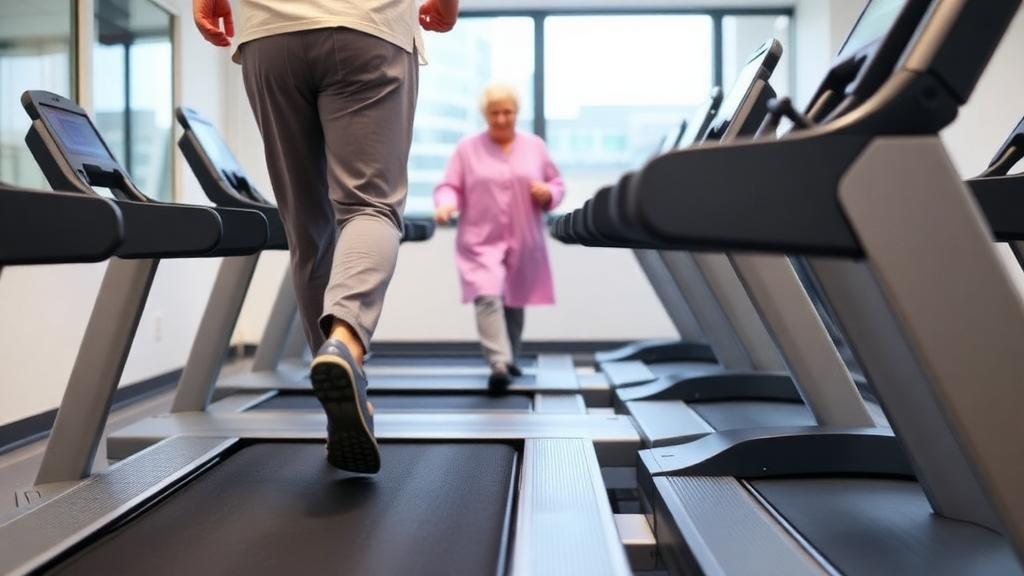
The intervention itself is deliberately pragmatic. Unless a medical contraindication exists, patients in the trial will be offered one to two walking sessions per day on a treadmill, beginning the day after their operation. Each session is supervised by an Adapted Physical Activity Specialist, a professional trained to calibrate exercise intensity to fragile, recently operated patients, and the target duration ranges from six to thirty minutes. That flexibility matters. Early after abdominal, thoracic, or head and neck cancer surgery, a patient may manage only a few cautious minutes, while later in the admission the same person may tolerate a half hour of steady walking. The protocol’s designers have built that natural trajectory into the intervention rather than imposing a rigid dose that many frail patients could not achieve.
The scientific rationale comes in part from an earlier pilot study conducted by the same group, which showed that supervised treadmill walking in older cancer inpatients was feasible and could improve gait speed, with one important caveat: the benefit appeared in patients who were not malnourished. That finding highlights a biological reality that geriatric oncologists know well. Muscle recovery after surgery depends on an adequate supply of protein and energy, and in a patient whose nutrition is compromised, exercise can become a drain rather than a stimulus. The APPAHOCA-2 protocol therefore treats nutritional status as a critical variable, assessing it alongside sarcopenia, the age-related loss of skeletal muscle mass and strength that both cancer and major surgery can accelerate.
What makes the trial unusually comprehensive is the breadth of data it will collect. Assessments are scheduled at three points: before surgery, at hospital discharge, and at routine surgical follow-up visits 30 and 90 days after the operation. At each of these time points, the researchers will record levels of anxiety and depression, concerns about falling, cognitive function, nutritional and sarcopenia status, sleep complaints and changes in sleep-wake patterns, daytime activity, physical performance measures, and results from blood examinations. This multidimensional approach reflects a growing recognition in geriatric medicine that physical recovery cannot be separated from mental health, cognition, sleep, and metabolic state. A patient who walks farther but falls asleep poorly or becomes anxious about falling may not actually function better at home.
The hospital environment itself is a central character in this story. Clinical guidelines on postoperative rehabilitation have long advocated early mobilization, yet hospital wards are rarely designed to make walking safe and appealing for frail older adults. Corridors are busy, floors may be slippery, IV poles and monitoring equipment tether patients to their rooms, and nursing workloads leave little time for escorted walks. A walking treadmill, paradoxically, can offer a more controlled and secure environment than the ward corridor itself: handrails provide support, speed is adjustable and precisely known, and a specialist stands by to intervene. The APPAHOCA-2 investigators are essentially testing whether a piece of equipment more often associated with gyms can be safely redeployed to the surgical ward in the service of older cancer patients.
The study has cleared the standard regulatory hurdles that govern clinical research in France. It received ethical approval from the Comité de Protection des Personnes Ile de France I in December 2023, and the French Health Regulatory Authority, the ANSM, validated the investigation’s compliance with the European Union Medical Device Regulation. The trial is registered on ClinicalTrials.gov under identifier NCT06201884, with registration dated 2 January 2024, and the protocol has reached version 4.1 as of December 2025. Funding comes from the French Ministry of Health through the interregional hospital clinical research program, and the protocol itself was peer-reviewed by the funding body before the trial was granted support. The funding agency, the authors note, played no role in the design, conduct, or analysis of the study. All participants will receive an information file from their surgeons or anesthesiologists and must provide written informed consent before any study-related assessment begins.
The trial’s phase II designation signals its purpose: this is an effectiveness and feasibility study intended to establish whether the intervention works well enough to justify a larger definitive trial. Beyond the primary endpoint, the investigators plan to explore how the level of effectiveness relates to the number and duration of walking sessions patients actually complete during their recovery, a dose-response question that could shape how such programs are prescribed in the future. If patients who accumulate more minutes on the treadmill recover their walking capacity more reliably, that would support structured, supervised early mobilization as a standard component of postoperative care for older adults. If the relationship is weak or absent, the field will need to look elsewhere, perhaps toward nutritional optimization or other rehabilitation strategies.
For now, the value of APPAHOCA-2 lies in its clarity of purpose. It takes a problem that is easy to overlook, the quiet physical decline of older surgical patients during hospital stays, and subjects a simple remedy to rigorous measurement. The six-minute walk test, the geriatric assessments, the 90-day follow-up, and the careful tracking of sleep, mood, cognition, and nutrition together form a portrait of recovery that is far richer than length of stay alone could provide. As populations age and cancer surgery is performed increasingly on patients in their seventies and eighties, the question the French team is asking will only grow more urgent: can the hospital stay itself become part of the cure rather than an obstacle to it? The answer, the researchers hope, may begin with a few supervised steps on a treadmill the day after surgery.
Subject of Research: Early supervised treadmill walking to restore physical fitness in older inpatients recovering from cancer surgery
Article Title: Effectiveness of early supervised walking sessions on a walking treadmill in older inpatients after cancer surgery: study protocol for the APPAHOCA-2 trial
Article References: Solem-Laviec, H., Beauplet, B., Leconte, A., Coquerel, A., Demeude, F., Thuard, O., Ruet, A., Bastit, V., Babin, E., Varatharajah, S., Guilloit, J.-M., Fauvet, R., Waeckel, T., Perrier, J., Lequesne, J., & Clarisse, B. (2026). Effectiveness of early supervised walking sessions on a walking treadmill in older inpatients after cancer surgery: study protocol for the APPAHOCA-2 trial. BMC Geriatrics. https://doi.org/10.1186/s12877-026-08422-6
Image Credits: AI Generated
DOI: 10.1186/s12877-026-08422-6
Keywords: geriatric oncology, cancer surgery, treadmill walking, early mobilization, six-minute walk test, rehabilitation, sarcopenia, gait speed, older inpatients, clinical trial, physical deconditioning, APPAHOCA-2
Cite Scienmag News
Ophelia Keating. (October 6, 2026). Treadmill Walking Right After Cancer Surgery May Help Older Patients Recover Faster. Scienmag. https://scienmag.com/treadmill-walking-right-after-cancer-surgery-may-help-older-patients-recover-faster/
Ophelia Keating. "Treadmill Walking Right After Cancer Surgery May Help Older Patients Recover Faster." Scienmag, 6 October 2026, https://scienmag.com/treadmill-walking-right-after-cancer-surgery-may-help-older-patients-recover-faster/. Accessed 6 October 2026.
Ophelia Keating. "Treadmill Walking Right After Cancer Surgery May Help Older Patients Recover Faster." Scienmag. October 6, 2026. https://scienmag.com/treadmill-walking-right-after-cancer-surgery-may-help-older-patients-recover-faster/


