


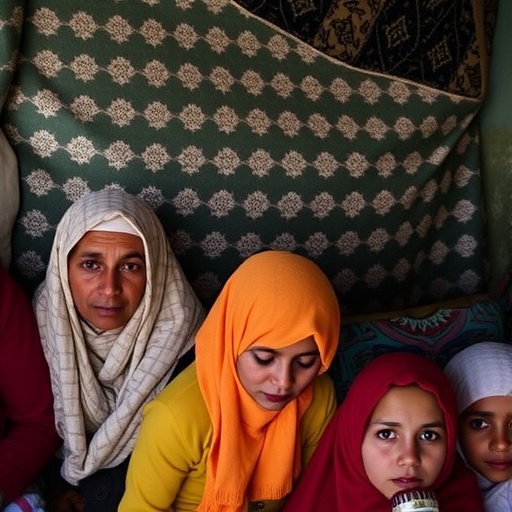
In the evolving discourse surrounding mental health and conflict-induced trauma, new research casts a profound light on the psychological ramifications faced by internally displaced persons (IDPs) in Georgia. As geopolitical upheavals continue to uproot populations worldwide, Georgia stands as a critical case study, with one of the highest proportions of internally displaced individuals globally—approximately 7.5% of the entire population. This demographic shift, resulting from decades of conflict and instability, has ushered in a complex mental health landscape that demands rigorous scientific scrutiny.
A recent epidemiological survey spearheaded by Kovess-Masfety and Makhashvili provides a detailed comparative analysis of the mental health profiles of Georgian IDPs versus their non-displaced counterparts. Deploying a methodologically robust cross-sectional design, the study encompassed data from 1,765 non-displaced individuals and 203 IDPs, offering a comprehensive snapshot of the psychological toll exacted by forced displacement within the region. This work utilizes internationally validated diagnostics, including the International Trauma Questionnaire (ITQ) for post-traumatic stress disorder (PTSD) evaluation and the Composite International Diagnostic Interview (CIDI) for assessing anxiety and depressive disorders, ensuring the reliability and clinical relevance of the findings.
The significance of this study lies in its illumination of the disproportionate burden of trauma borne by internally displaced populations. The IDP group exhibited markedly higher exposure to multiple traumatic events; notably, over twenty-two percent reported experiencing four or more distinct traumatic incidents, a stark contrast to the mere one percent in non-IDP populations. This heightened trauma exposure directly correlates with an increased prevalence of PTSD symptoms, with IDPs demonstrating a PTSD symptom impairment rate exceeding 8.5%, compared to just over 1.3% among non-displaced individuals. These disparities underscore the profound psychological vulnerability fostered by prolonged displacement and insecure living conditions.
Beyond PTSD, the research meticulously charts a pervasive pattern of anxiety disorders within the internally displaced cohort. Generalized anxiety disorder (GAD) and panic disorders surfaced with significantly elevated odds ratios, even after adjusting for sociodemographic variables including age, employment status, and education level. While depressive disorders presented a surprisingly equivalent prevalence between the two groups, the heightened anxiety spectrum disorders bespeak an urgent need for focused intervention strategies tailored specifically for displaced persons.
Interestingly, the prevalence of suicidal ideation among IDPs was found to be lower than that within the non-displaced population, a finding that invites nuanced interpretation. This counterintuitive result may reflect complex psychosocial protective factors embedded within displaced communities, such as shared social networks or cultural resilience, warranting further qualitative investigation. The nuanced mental health profile of Georgian IDPs challenges simplistic narratives and highlights the importance of multifaceted support mechanisms.
The methodological rigor of the survey bolsters confidence in its conclusions. Utilizing face-to-face interviews administered through validated instruments like the ITQ and CIDI short form allows for precise symptom quantification, while the inclusion of tools such as the Alcohol, Smoking and Substance Involvement Screening Test (ASSIST) and the Mental Health Inventory-5 (MH5) enriches the understanding of addictive behaviors and overall psychological distress. This multidimensional approach enables a holistic appreciation of mental health challenges in displaced populations.
One of the critical revelations from the analysis is the enduring nature of psychological distress attributable to displacement, transcending basic sociodemographic factors. Adjusted odds ratios reveal that IDPs are over twelve times more likely to experience PTSD symptoms with functional impairment compared to the general population. Similarly, the risks for generalized anxiety and panic disorders remain significantly elevated, illuminating a chronic mental health crisis masked by the everyday realities of displacement and integration struggles.
The implications of these findings for public health policy and clinical practice are profound. The Georgian case underscores the exigency of embedding mental health support within displacement response frameworks. Psychosocial interventions must prioritize trauma-informed care tailored to the unique experiences of IDPs, reinforcing protective factors and addressing the compounded vulnerabilities induced by forced migration, social marginalization, and economic disenfranchisement.
Moreover, this study invites the global scientific and humanitarian community to re-examine assumptions about mental health outcomes in displaced populations. While PTSD and anxiety emerge as dominant concerns, the equivalence in depressive disorders and substance use disorders indicates heterogeneous mental health patterns that demand adaptive, context-sensitive treatment protocols rather than one-size-fits-all approaches.
Future research trajectories suggested by this survey include longitudinal studies to track the evolution of mental health symptoms among Georgian IDPs over time and experimental interventions designed to ameliorate psychological impairments. Integrating qualitative methodologies could further elucidate the psychosocial dynamics underpinning resilience and coping within displaced communities, providing a balanced perspective amidst the prevailing focus on pathology.
The Georgian example exemplifies the transformative role epidemiological psychiatry can play in unpacking the complex interplay between forced displacement and mental health. As internal displacement remains a pressing global humanitarian challenge, the insights gathered from this national survey resonate far beyond Georgia’s borders, offering critical data to inform international response strategies and to galvanize mental health prioritization in settings of conflict and displacement.
In sum, the study by Kovess-Masfety and Makhashvili stands as a landmark investigation into the psychological consequences of forced migration within Georgia. Its robust design, rigorous data collection, and nuanced analysis provide an indispensable foundation for advancing mental health support for internally displaced persons, highlighting urgent areas for policy action and clinical innovation. The mental well-being of displaced populations hinges on integrating such evidence-based insights into holistic, culturally attuned frameworks of care, a mandate that grows ever more pressing in an era marked by unprecedented human mobility and conflict.
Cite Scienmag News
Glenn Wilkins. (August 4, 2025). Trauma’s Impact on Georgian IDPs’ Mental Health. Scienmag. https://scienmag.com/traumas-impact-on-georgian-idps-mental-health/
Glenn Wilkins. "Trauma’s Impact on Georgian IDPs’ Mental Health." Scienmag, 4 August 2025, https://scienmag.com/traumas-impact-on-georgian-idps-mental-health/. Accessed 5 September 2026.
Glenn Wilkins. "Trauma’s Impact on Georgian IDPs’ Mental Health." Scienmag. August 4, 2025. https://scienmag.com/traumas-impact-on-georgian-idps-mental-health/


