


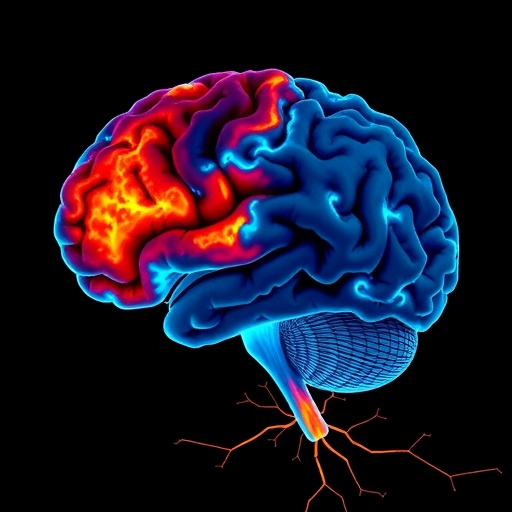
Nightmares linked to trauma may be more than frightening stories generated during sleep. They could reflect the way specific memory systems in the brain remain connected after overwhelming experiences. A new study published in Translational Psychiatry reports that two defining features of trauma nightmares—the intensity of their emotions and the vividness of their visual imagery—map onto connectivity involving the posterior hippocampus, a brain region central to contextual memory, spatial representation, and the reconstruction of past events.
The findings offer a possible neurological explanation for why trauma-related dreams can feel unusually real. People who experience these nightmares often describe scenes that are not merely unpleasant but immersive: images may appear sharply defined, emotions can become overwhelming, and the dream may seem to transport the sleeper back into a threatening moment. By linking these subjective qualities to communication between the posterior hippocampus and other brain regions, the research places the experience within a measurable neural framework.
The hippocampus has long been associated with memory, but it is not a single, uniform structure in terms of function. Its posterior portion is particularly involved in representing the spatial and contextual details of experiences—where events happen, how scenes are organized, and how elements of an episode fit together. In ordinary memory, this system helps reconstruct a coherent situation from stored information. During trauma nightmares, the same machinery may contribute to the vivid reassembly of threatening images and environments.
The study, led by McKenna, Clancy, So and colleagues, examined how features of trauma nightmares correspond to patterns of brain connectivity. In neuroscience, connectivity generally refers to the degree to which activity in one region is statistically or functionally related to activity in another. It does not necessarily mean that one area directly causes activity in the other. Instead, it can reveal networks that operate in coordination, offering clues about how emotional reactions, mental imagery, and memory reconstruction are integrated.
The researchers focused on two dimensions that are often discussed separately but may be tightly connected in traumatic dreaming. Emotional intensity describes the strength of fear, distress, or other affective responses experienced during the nightmare. Visual imagery refers to how clearly and vividly scenes, people, objects, and actions are perceived in the dream. The study’s central observation is that both dimensions can be mapped onto posterior hippocampus connectivity, suggesting that the brain’s systems for reconstructing scenes may be linked to the emotional force of those scenes.
This is important because trauma nightmares are not always simple repetitions of an original event. They can contain altered settings, symbolic elements, or combinations of memories, while still carrying the emotional signature of trauma. A brain network that binds visual context to emotional significance could help explain how a dream becomes both cinematic and terrifying. The posterior hippocampus may contribute the detailed scene construction, while its interactions with emotion-related and perceptual systems help determine whether that scene feels neutral, threatening, or intensely personal.
The findings also deepen the scientific distinction between nightmares and ordinary bad dreams. Many unpleasant dreams fade quickly after waking or are remembered as fragmented narratives. Trauma nightmares, by contrast, may involve persistent sensory detail and a powerful sense of immediacy. Their recurrence can disrupt sleep, increase anticipatory anxiety about going to bed, and reinforce daytime distress. Understanding the neural architecture behind these experiences could eventually help clinicians identify why some patients develop persistent nightmares while others do not.
The research may also have implications for treatment. Existing approaches to trauma-related nightmares include psychological therapies that modify the meaning or expected ending of dream content, as well as interventions designed to regulate arousal and improve sleep. If posterior hippocampus connectivity is associated with imagery and emotional intensity, treatments might be refined to target the reconstruction of visual scenes, the emotional charge attached to them, or the communication between memory and emotion networks. Such possibilities remain speculative, however, and the study does not by itself establish a new therapy or prove that altering connectivity will eliminate nightmares.
More broadly, the work supports a modern view of dreaming as an active brain process rather than random mental noise. Dreams can draw on memory fragments, emotional states, sensory representations, and predictions about danger. In trauma, these systems may become unusually synchronized around threat-related material. By showing that measurable differences in nightmare experience correspond to the connectivity of a specific hippocampal subregion, the study brings researchers closer to explaining why some dreams are remembered as vague impressions while others arrive with the force of lived events. The findings turn a deeply personal symptom into a problem that can be investigated through brain networks, potentially opening new paths for understanding and treating trauma-related sleep disturbance.
Cite Scienmag News
Cassandra Pierce. (August 3, 2026). Trauma Nightmare Intensity and Imagery Linked to Posterior Hippocampus Connectivity. Scienmag. https://scienmag.com/trauma-nightmare-intensity-and-imagery-linked-to-posterior-hippocampus-connectivity/
Cassandra Pierce. "Trauma Nightmare Intensity and Imagery Linked to Posterior Hippocampus Connectivity." Scienmag, 3 August 2026, https://scienmag.com/trauma-nightmare-intensity-and-imagery-linked-to-posterior-hippocampus-connectivity/. Accessed 4 September 2026.
Cassandra Pierce. "Trauma Nightmare Intensity and Imagery Linked to Posterior Hippocampus Connectivity." Scienmag. August 3, 2026. https://scienmag.com/trauma-nightmare-intensity-and-imagery-linked-to-posterior-hippocampus-connectivity/


