


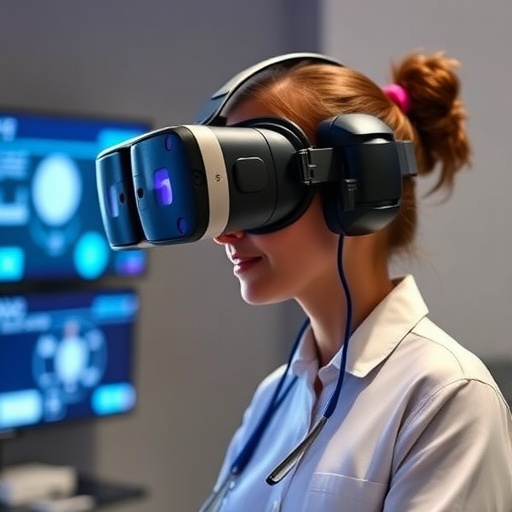
In the burgeoning field of medical education, innovative technologies are increasingly becoming indispensable tools for teaching and learning. One remarkable advancement in this domain is the utilization of immersive virtual reality (VR) systems, particularly those utilizing head-mounted displays (HMDs). A recent systematic review by Zhang, W., Ding, Z., Bakaev, M. and colleagues examines the transformative impact of VR in medical training, revealing its potential for enhancing learning experiences and outcomes for future healthcare professionals.
The primary advantage of virtual reality in medical education lies in its immersive capability, allowing students to engage in realistic simulations that closely emulate real-world clinical environments. This review highlights how HMDs can create believable scenarios where learners can practice procedures, develop motor skills, and encounter a variety of clinical situations without the risk of harming real patients. By immersing students in virtual settings, they are afforded the opportunity to hone their skills in a safe and controlled atmosphere.
One of the key components of effective medical training is the retention of complex information and the application of knowledge in practical scenarios. The systematic review accentuates that VR technology not only aids in information retention but also enhances the transfer of theoretical knowledge to practical skills. For instance, learners navigating through a virtual surgical environment are supported by educational content that reinforces their understanding of anatomy, physiology, and procedural steps, consequently promoting deeper learning.
Moreover, VR in medical education enriches the learning experience by providing immediate feedback. The elaborate simulations often integrated into these virtual platforms allow for real-time assessment of a learner’s performance. This instant feedback mechanism enables students to recognize their shortcomings and improve more promptly than traditional pedagogical methods would allow. As such, learners can adjust their techniques and approaches on the fly, contributing to a more dynamic and responsive learning experience.
In a world where hands-on experience is paramount, the review further details the accessibility of VR simulations. For medical institutions, particularly those facing constraints in resources, utilizing VR can mitigate logistical challenges of arranging in-person training. This technology allows students to access rich educational resources remotely, bridging the gap for those unable to participate in standardized clinical rotations or training due to geographic or institutional limitations.
The systematic review provides compelling evidence of improved engagement among students when VR technology is introduced into their training regimen. Engaging with material through multiple senses – sight, touch, and sound – has been shown to increase motivation and interest in the subject matter. As students become more invested in their learning experiences, their overall performance can significantly improve, thus shaping more competent and confident healthcare providers in the future.
Another noteworthy consideration presented in the review is the versatility of VR applications across various medical disciplines. From surgical simulations to nursing education and public health training, the potential applications of VR are vast. Each specialty can customize learning scenarios that best prepare students for their specific field, showcasing the adaptability of virtual environments to meet diverse educational needs.
Longitudinal studies cited within this review indicate that students who engage with VR technology consistently report higher satisfaction levels regarding their learning experiences. This satisfaction correlates with a greater disposition towards independent learning, fostering a culture of inquiry and self-directed professional development. It suggests that integrating immersive VR into curricula can ignite a passion for lifelong learning, which is essential in the ever-evolving field of medicine.
Safety concerns inherent in medical training, where students traditionally learn on live patients or cadavers, can also be assuaged through VR. The review emphasizes that VR provides a fail-safe environment where students can make mistakes without real-world consequences. This aspect builds their confidence and prepares them adequately for actual clinical encounters.
As VR technology continues to evolve, the implications for medical education are profound. The review showcases how software advancements allow for more sophisticated simulations that can cater to varied learning styles, thereby accommodating the needs of every student. This adaptability is crucial in a profession where knowledge and skills must be continuously refined and updated.
Moreover, the cost associated with developing VR content is becoming increasingly favorable. As hardware becomes more accessible and software is refined, educational institutions may find it feasible to invest in VR training modules. This financial aspect could play a pivotal role in widespread adoption in medical schools, particularly if evident outcomes in student performance and preparedness follow suit.
The systematic review serves as a clarion call for educators and curriculum developers. It highlights the necessity of integrating such innovative technologies into medical training frameworks. The empirical evidence presented outlines a clear trajectory towards improved educational outcomes, advocating for a shift in traditional teaching methodologies to embrace the future of medical education head-on.
In conclusion, the systematic review by Zhang et al. encapsulates significant insights into the efficacy of immersive virtual reality within medical education. By enhancing learning experiences, providing practical applications, facilitating access, and fostering engagement, VR technology stands to revolutionize how future healthcare professionals are trained. As the medical community gravitates towards more informed and effective training approaches, the role of VR as an essential educational tool is increasingly validated.
Cite Scienmag News
Courtney Benton. (November 14, 2025). Transforming Medical Education with VR Headsets: Review. Scienmag. https://scienmag.com/transforming-medical-education-with-vr-headsets-review/
Courtney Benton. "Transforming Medical Education with VR Headsets: Review." Scienmag, 14 November 2025, https://scienmag.com/transforming-medical-education-with-vr-headsets-review/. Accessed 6 September 2026.
Courtney Benton. "Transforming Medical Education with VR Headsets: Review." Scienmag. November 14, 2025. https://scienmag.com/transforming-medical-education-with-vr-headsets-review/


