


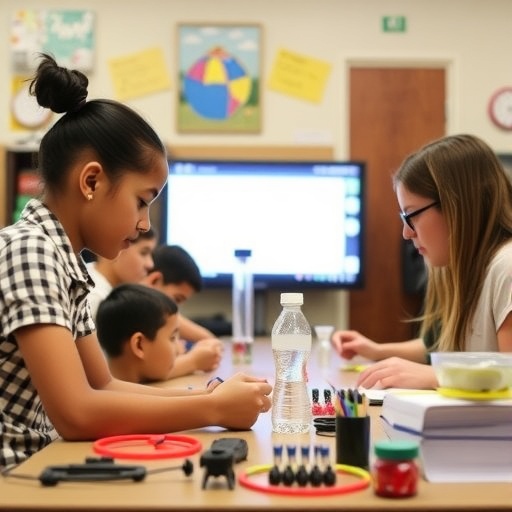
A team of education researchers at the University of Pennsylvania, working with colleagues at Columbia University and the Concord Consortium, has produced some of the clearest evidence yet that the success of interdisciplinary STEM teaching in high school classrooms hinges less on innovative lesson plans and more on whether teachers themselves possess deep, flexible command of the integrated content. The study, published in the International Journal of STEM Education, followed five high school biology teachers as they implemented a bioinformatics curriculum that wove together biology, data literacy, and computational analysis, and it found that the teachers’ so-called adaptive expertise measurably shaped what students experienced in the classroom.
Bioinformatics occupies a singular position in the modern scientific landscape. It fuses computational methods with biological and environmental data to enable large-scale storage, visualization, and analysis, underpinning everything from population-specific medical therapies to environmental monitoring. That makes it an ideal test case for the kind of STEM-integrated instruction that policy frameworks such as the Next Generation Science Standards have long called for, in which science, technology, engineering, and mathematics are deliberately coordinated rather than taught as compartmentalized subjects. Yet integrated curricula of this kind rarely fit neatly into standard course offerings, and researchers have repeatedly documented that teachers struggle with content knowledge, pedagogy, and confidence when asked to teach beyond their primary domain.
The research, funded by the United States National Science Foundation, unfolded in two linked phases. In the first phase, conducted between 2018 and 2020, the five teachers attended a three-week summer professional development workshop led by bioinformatics and education faculty. There they learned content relevant to the curriculum’s central investigation, an air quality unit of roughly twenty hours of instruction, including material on pollutants in the exposome and related population genetics research. The workshop also emphasized a problem-based learning pedagogy with culturally relevant components. Back in their classrooms during the school year, teachers guided students through planning and collecting local air quality measurements, such as carbon monoxide and particulate matter 2.5, using mobile phones fitted with sensors. Students uploaded their readings to a communal database, generated visualizations, compared their results with published Environmental Protection Agency statistics, and formed hypotheses linking poor air quality to elevated asthma rates in urban centers.
To evaluate how well the teachers handled this unfamiliar terrain, the team coded video-recorded classroom observations and fieldnotes against three components of adaptive expertise drawn from the learning sciences literature. The first is flexibility, the capacity to apply content knowledge in new situations and to shift activities on the fly in response to student needs, a quality closely related to Lee Shulman’s notion of pedagogical content knowledge. The second is deep-level understanding, the recognition of how knowledge is structured within a domain, which allows experts to solve problems faster and more effectively than novices because of their well-connected knowledge organization. The third is deliberate practice, the reflective refinement of instruction through conscious deliberation about what worked and what did not. Each teacher received low, medium, or high ratings in each category across a total of 269 scored observations.
The results of that first phase were sobering. Teachers scored strongest on deliberate practice, with a mean of 2.22 on the three-point scale, moderate on flexibility at 1.98, and lowest on deep-level understanding at 1.70. Overall expertise scores ranged from 4.97 to 6.97 out of a possible 9. Teachers themselves attributed their difficulties to the complexity of the new content and their limited preparation in bioinformatics and statistical analysis. One teacher admitted during a debrief, “As far as the statistics and relating that real research to our… and teaching our students that, I think I was a little bit underprepared.” Classroom observations bore this out: when a student asked one teacher to elaborate on the definition of the “exposome,” the teacher replied, “I’m not too sure myself.”
The second phase of the study, the focus of the new paper, asked whether these differences in teacher expertise left fingerprints on students’ classroom experiences. The researchers administered 39-item pre- and post-implementation surveys to 122 students across the five teachers’ classrooms, spanning grades 9 through 12 in schools all eligible for federal Title I funds, indicating substantial low-income enrollment. An exploratory factor analysis confirmed five distinct constructs: interest in working with real-world biological data, learning about bioinformatics content and skills, learning data literacy in science class, learning through computational tools to investigate scientific issues, and applications of science in the local community. Each factor showed strong internal consistency, with Cronbach’s alpha values between 0.79 and 0.89.
Students’ experiences grew significantly in three of the five factors, with small to medium effect sizes. Notably, the two factors tied to interest in working with real-world data and opportunities to develop data literacy skills showed no significant growth; the data literacy mean in fact declined slightly from pre-test to post-test. That pattern, the authors argue, maps directly onto the areas where teachers were weakest. When students cannot get coherent explanations of the statistics underlying a dataset or the computational logic of a visualization, the most novel and potentially inspiring parts of the curriculum lose their power.
To connect the two datasets, the team ran a series of multiple linear regressions with robust standard errors, holding student pre-scores constant so that the coefficients reflected the influence of teacher expertise rather than students’ starting points. The researchers considered a hierarchical linear modeling framework to account for students nested within classrooms but rejected it because only five teacher-level units risked overfitting and unreliable effect estimates, a decision consistent with methodological guidance from McNeish and Stapleton on small cluster sizes. Analyses of variance first confirmed that the five teachers differed significantly in overall adaptive expertise, F(4, 264) = 11.75, p < .001, with post hoc Tukey tests pinpointing significant differences in flexibility and deep-level understanding.
The regressions told a consistent story. Teachers’ adaptive expertise significantly predicted students’ overall STEM-integrated classroom experience, with a small effect size (Cohen’s f² = 0.034). Each one-unit increase in a teacher’s combined adaptive expertise score was associated with a gain of 5.1 scale points in students’ overall experience score, on a scale running from 30 to 150. Three of the five experience factors were significantly driven by teacher expertise: learning bioinformatics content and skills, learning data literacy, and learning through computational tools. By contrast, students’ interest in real-world data was predicted only by their own pre-scores, suggesting that generic enthusiasm for authentic data does not translate into deeper experiences without a teacher capable of animating that data with disciplinary insight.
The findings arrive at a moment when the field of K–12 STEM integration has been described as “embryonic,” with abundant advocacy but thin empirical guidance for teacher preparation. A recent systematic review by the same group, covering 110 high school studies, found that only 24 percent focused on teachers’ disciplinary knowledge, even though those that did reported improvements in instructional quality. The new study sharpens that critique by showing that deep-level disciplinary knowledge may function as a foundational condition enabling adaptive expertise, rather than an optional supplement to good pedagogy. Integrated content knowledge, the authors contend, is necessary but not sufficient; teachers must also be able to flexibly mobilize, apply, and refine that knowledge in context.
The implications for professional development are substantial. The program in this study already incorporated many recognized features of high-quality design, including expert-led training, custom-built resources, peer facilitation, and collaboration. Even so, the researchers found that robust support proved insufficient without an explicit and sustained focus on content integration. They point to promising alternative mechanisms from the literature, including research apprenticeships that immerse teachers in laboratories where STEM-integrated knowledge is actually constructed, prolonged and repeated access to disciplinary experts, and conceptual modeling, all of which demand extended professional development experiences that make integration itself the object of learning. The authors argue for a fundamental shift across the teacher preparation pipeline, from undergraduate coursework through pre-service and in-service education, that treats blended domains the way real scientific practice does, rather than treating each discipline in isolation.
The team is careful to acknowledge the study’s limits. With only five teachers and 122 students in a specific demographic context, generalizability is constrained, and self-report surveys may carry perceptual bias. The authors did not directly measure students’ content knowledge gains, and factors such as school resources and administrative support were outside the scope of analysis. No causal claims can be made from the correlational design. Still, the study offers something the field has lacked: a direct, quantified link between a theoretically grounded measure of teacher expertise and the texture of students’ everyday experiences in an integrated STEM classroom. Whether the pattern holds in other transdisciplinary contexts, from climate science to engineering design, is the question the researchers say future work must now answer.
Cite Scienmag News
Courtney Benton. (September 5, 2026). Strengthening teachers’ STEM knowledge boosts student classroom experiences. Scienmag. https://scienmag.com/strengthening-teachers-stem-knowledge-boosts-student-classroom-experiences/
Courtney Benton. "Strengthening teachers’ STEM knowledge boosts student classroom experiences." Scienmag, 5 September 2026, https://scienmag.com/strengthening-teachers-stem-knowledge-boosts-student-classroom-experiences/. Accessed 5 September 2026.
Courtney Benton. "Strengthening teachers’ STEM knowledge boosts student classroom experiences." Scienmag. September 5, 2026. https://scienmag.com/strengthening-teachers-stem-knowledge-boosts-student-classroom-experiences/


