


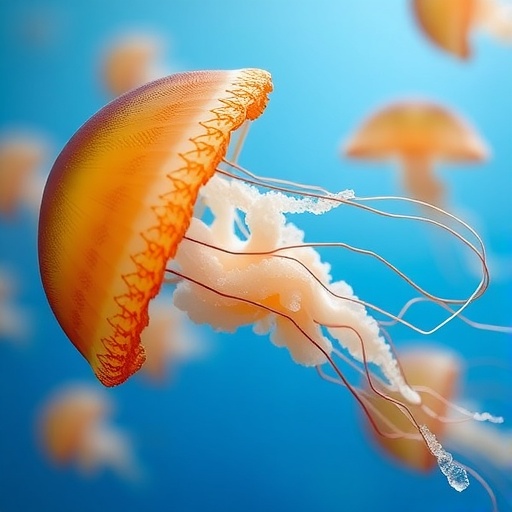
For decades, marine ecosystems have posed intriguing mysteries that continually captivate researchers driven by a passion for uncovering the secrets of the sea. Among the numerous marine organisms populating our oceans, jellyfish remain some of the most enigmatic creatures. Resilient and ecologically significant, these gelatinous animals have thrived for millions of years, yet their role in marine environments is still not fully appreciated. Traditionally viewed with suspicion or outright disdain due to their stings and episodic population explosions known as blooms, jellyfish often suffer from a negative public image. However, new research is challenging these outdated perceptions and ushering in a paradigm shift, highlighting jellyfish as a valuable resource rather than a nuisance.
Recently, a groundbreaking study delved into the sustainable use of jellyfish bycatch—a term referring to jellyfish unintentionally caught alongside commercial fish—demonstrating its untapped potential in biotechnology. This research not only spotlights the prospects of transforming what was once considered waste into a high-value raw material but also exemplifies the principles of a circular bioeconomy aimed at reducing resource waste and generating economic value. By focusing on Rhizostoma pulmo, commonly known as barrel jellyfish, the investigators unveiled the feasibility of repurposing incidental catches from small-scale fisheries into sustainable sources of bioactive compounds, particularly collagen.
Collagen, the primary structural protein found in connective tissues, is prized across several industries, including cosmetics, biomedicine, and food technology. Historically, collagen extraction has centered on mammalian sources such as bovine and porcine tissues; however, concerns about zoonotic diseases, allergenicity, and religious restrictions have driven interest toward marine alternatives. Jellyfish collagen represents a promising substitute, offering unique biochemical properties that may outperform terrestrial analogs, especially in regenerative medicine applications.
This pioneering study involved a meticulous laboratory comparison of collagen extracted from jellyfish collected as bycatch versus specimens gathered through careful hand-net collection. Employing a suite of sophisticated analytical techniques such as protein profiling, molecular weight assessment, and structural characterization via spectroscopy and crystallography, the researchers rigorously evaluated collagen integrity and quality. Remarkably, the findings revealed no significant compromise in collagen quality from bycatch specimens, validating the concept that jellyfish caught incidentally remain a viable and high-quality source for collagen production.
Crucially, this research extends beyond laboratory confines by incorporating the invaluable practical knowledge of small-scale fishers who routinely encounter jellyfish bycatch in their daily work. Through an active collaboration, fishers contributed observational data, catch reports, and photographic evidence, enriching the scientific dataset and fostering a two-way dialogue. This participatory approach empowered fishers to view jellyfish as assets rather than liabilities, stirring interest in developing innovative valorization pathways. The fishers acknowledged potential hurdles, highlighting infrastructural gaps, market uncertainties, and the necessity for targeted training—insights vital for designing feasible implementation strategies.
The societal implications of this holistic approach are profound. By transforming jellyfish bycatch into commercially viable collagen, the initiative offers a multifaceted solution that augments coastal economies, supports sustainable fishery practices, and advances environmental stewardship. This model embodies circular bioeconomy tenets—minimizing waste through reutilization and promoting sustainability while fostering economic resilience among fishing communities. Moreover, it addresses ecological concerns associated with jellyfish blooms by diverting biomass towards productive ends rather than disposal.
From a scientific standpoint, the valorization of jellyfish collagen holds immense promise in biomedical innovations. Marine-derived collagen is increasingly recognized for its biocompatibility and reduced immunogenicity, positioning it as a superior candidate for tissue engineering scaffolds, wound dressings, and drug delivery systems. Furthermore, the prospect of developing functional cosmetic products enriched with jellyfish collagen aligns with consumer preferences for marine-based, sustainable ingredients. The investigation into nutraceutical and food applications also opens new research avenues that could transform dietary supplements and health-promoting products.
Despite these advances, several misconceptions persist within public discourse and industry circles. Some stakeholders narrowly define jellyfish as detrimental invaders with no redeeming qualities, while others assume that bycatch materials are inherently low grade and unsuitable for high-value extraction. The current research actively dispels such myths by supplying empirical evidence demonstrating the integrity and biotechnological worth of jellyfish collagen, substantiating that sustainability and profitability are indeed compatible objectives.
Looking ahead, long-term monitoring of jellyfish populations and bycatch trends across varying fisheries and geographic regions is paramount, especially in the context of climate change-driven shifts in species distribution and marine ecosystem dynamics. Such comprehensive data will inform adaptive management strategies and optimize resource utilization. Concurrently, expanding interdisciplinary collaborations that include policymakers, scientists, fishers, and industry stakeholders will be critical for designing practical, location-specific solutions that leverage scientific insights to benefit communities and ecosystems alike.
The research team emphasizes that open science principles have been instrumental in amplifying the impact and accessibility of their work. By publishing results in open-access platforms, they ensured that findings are accessible beyond academic circles, reaching fishers, entrepreneurs, regulators, and the wider public. This democratization of knowledge accelerates science-to-practice transitions, fosters innovation, and cultivates networks capable of addressing complex sustainability challenges cohesively.
In summary, the valorization of Rhizostoma pulmo jellyfish bycatch for sustainable collagen production offers a compelling example of how reimagining marine resources through a circular bioeconomy lens can yield ecological, economic, and societal dividends. By bridging fundamental research with pragmatic stakeholder engagement and advancing marine biotechnology, this approach paves the way for novel strategies to harness overlooked marine biomass, contributing to ocean conservation and coastal community vitality.
News Publication Date: 11-May-2026
Web References: http://dx.doi.org/10.3389/fmars.2026.1760045
Cite Scienmag News
Gregory Coleman. (May 11, 2026). Transforming Jellyfish Bycatch into a Valuable Collagen Source for Cosmetics and Biotechnology. Scienmag. https://scienmag.com/transforming-jellyfish-bycatch-into-a-valuable-collagen-source-for-cosmetics-and-biotechnology/
Gregory Coleman. "Transforming Jellyfish Bycatch into a Valuable Collagen Source for Cosmetics and Biotechnology." Scienmag, 11 May 2026, https://scienmag.com/transforming-jellyfish-bycatch-into-a-valuable-collagen-source-for-cosmetics-and-biotechnology/. Accessed 6 September 2026.
Gregory Coleman. "Transforming Jellyfish Bycatch into a Valuable Collagen Source for Cosmetics and Biotechnology." Scienmag. May 11, 2026. https://scienmag.com/transforming-jellyfish-bycatch-into-a-valuable-collagen-source-for-cosmetics-and-biotechnology/


