


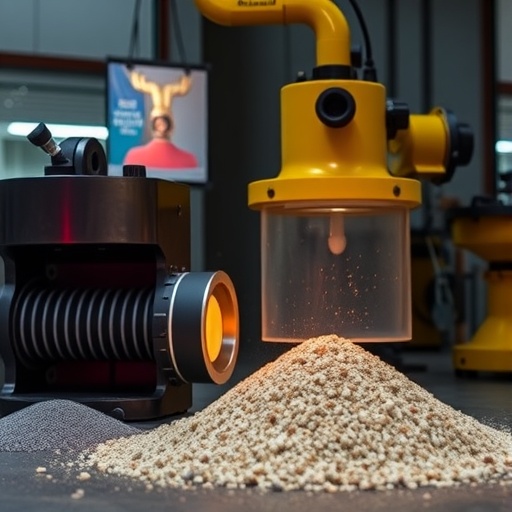
In a groundbreaking development poised to reshape the construction industry and environmental sustainability, researchers have unveiled an innovative approach to reducing the global carbon footprint associated with cement production. Cement, a fundamental material integral to modern infrastructure and urban development, is also notorious for being one of the largest contributors to worldwide CO2 emissions. As urbanization and infrastructure demand continue to rise, tackling the ecological impact of cement manufacturing has become an urgent scientific and industrial challenge.
A team of scientists from Wuzhou University and Guangzhou University in China has pioneered research that transforms a problematic industrial waste—silicon carbide residues from gemstone polishing—into a valuable additive for cement formulation. Silicon carbide, widely used as an abrasive grit across all levels of gemstone processing—from hobbyist rock tumblers to industrial-scale saws and polishing machinery—accumulates in large quantities as waste. Traditionally, this nonbiodegradable by-product has posed substantial environmental disposal challenges, especially concentrated in gemstone polishing hubs such as Guangdong Province.
Published in the journal AIP Advances, their comprehensive study meticulously examines the feasibility of integrating silicon carbide polishing waste into cement-based materials. This innovative approach addresses two critical environmental issues simultaneously: the overwhelming landfill burden of silicon carbide waste and the heavy carbon emissions from cement production processes. The research underscores a vision wherein waste materials are repurposed to enhance industrial products, supporting a circular economy model built on sustainability.
Lead researcher Xiaowei Ouyang elucidates the impetus behind the study, emphasizing the dual environmental challenges. “The accumulation of silicon carbide waste not only exacerbates landfill problems but also underscores the necessity for low-carbon alternatives in cement production,” Ouyang notes. Their work delves deeply into how these waste particles influence cement hydration and strength properties at multiple scales, forming a scientific bridge between nanoscale interactions and macroscopic material performance.
Central to their investigation is the molecular characterization of reactions occurring between the silicon carbide particles and the cement matrix during hydration. The team employed advanced analytical techniques to monitor microcracks and porosity, essential factors that dictate the durability and mechanical resilience of cement. Their findings reveal that while the silicon carbide particles demonstrate a weak but notable affinity for calcium ions—crucial agents in cement hardening—this interaction can be optimized to enhance cement strength.
One of the most surprising outcomes of their multiscale research was the dramatic improvement of the cement’s electrical and thermal properties upon incorporating gemstone polishing waste. Remarkably, the modified cement exhibited thermal conductivity enhancements of up to 159%, paired with a reduction in electrical resistivity by as much as 94%. These attributes confer the modified cement with ‘smart’ functionalities, opening avenues for its utilization in advanced construction applications.
Such enhanced thermal and conductive properties could revolutionize building materials by enabling passive temperature regulation through energy-efficient wall and floor panels. Moreover, embedding these modified materials in structural components like bridges creates potential for real-time damage detection systems; changes in electrical conductivity could serve as early indicators of structural compromise, significantly improving maintenance and safety protocols.
While the study acknowledges the current limitations in the ion affinity of silicon carbide particles, it proposes targeted chemical modifications and processing techniques to overcome these hurdles. This opens the door to tailored cement composites where waste materials not only replace harmful additives but actively improve cement performance over its lifecycle.
Future research directions outlined by the team include extensive long-term field testing to corroborate laboratory results under varying environmental conditions, further optimization of the waste-cement composites for enhanced durability, and exploration of other industrial waste materials with similar potential. This holistic approach represents a significant leap forward in sustainable material science and engineering.
The societal implications of this research are profound. Cement production accounts for a sizeable share of anthropogenic carbon emissions, estimated at approximately 8% globally. Innovations like silicon carbide-enhanced cement can play a pivotal role in mitigating climate change by lowering carbon footprints in one of the most carbon-intensive industries. Additionally, repurposing gemstone polishing waste combats solid waste management challenges, reducing landfill loads and environmental contamination.
This study reflects the broader scientific momentum towards integrating waste valorization within material science to address urgent global environmental challenges. By merging advanced nanochemical insights with practical industrial applications, the research sets a powerful precedent for future efforts aimed at sustainable construction and climate resilience.
The collaborative work of researchers Xiongfei Yang, Yuge Gao, Junpeng Wang, and Xiaowei Ouyang represents a landmark achievement in the quest for greener construction technologies. Their publication titled “Effect of gemstone polishing waste on hydration, strength development, and electrical/thermal properties of cement-based materials: A multiscale study” is accessible in AIP Advances, highlighting the critical intersection of physical sciences and sustainable engineering.
As the cement industry faces mounting pressure to reduce emissions and embrace sustainable practices, materials innovations such as this carry the potential to transform construction paradigms. Silicon carbide-infused cement not only offers a promising route to reduce environmental footprints but also enhances the functional utility of cement, contributing intelligently to smarter, safer, and more sustainable infrastructure development worldwide.
News Publication Date: October 7, 2025
Web References: https://doi.org/10.1063/5.0295026
Keywords
Cement, Construction materials, Engineering, Physics
Cite Scienmag News
Sloane Callahan. (October 7, 2025). Transforming Gemstone Polishing Waste into Smart Cement: A Sustainable Innovation. Scienmag. https://scienmag.com/transforming-gemstone-polishing-waste-into-smart-cement-a-sustainable-innovation/
Sloane Callahan. "Transforming Gemstone Polishing Waste into Smart Cement: A Sustainable Innovation." Scienmag, 7 October 2025, https://scienmag.com/transforming-gemstone-polishing-waste-into-smart-cement-a-sustainable-innovation/. Accessed 5 September 2026.
Sloane Callahan. "Transforming Gemstone Polishing Waste into Smart Cement: A Sustainable Innovation." Scienmag. October 7, 2025. https://scienmag.com/transforming-gemstone-polishing-waste-into-smart-cement-a-sustainable-innovation/


