


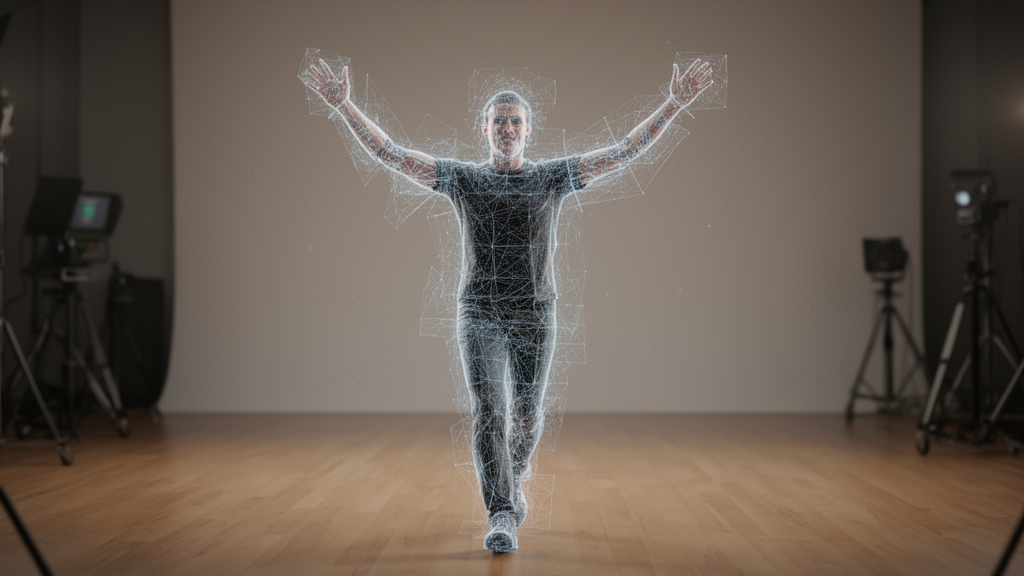
A 2026 machine-learning study reports that a transformer-based system combining multi-scale temporal modeling with spatial and temporal attention can identify human actions in unstructured video with high accuracy while maintaining inference delays near 30 milliseconds per clip. Tested on the HMDB51 and UCF101 action-recognition datasets, the combined model achieved F1 scores of 93.21% and 92.15%, respectively, outperforming the I3D, ST-GCN and Swin Transformer comparisons. Its strongest results appeared in transitional actions, where it reached a key action hit rate of 0.96, and under occlusion: even when 30% of the subject was obscured, the model retained an average F1 score of 0.86. These are controlled dataset results, however, not a test of an automated film editor or of editorial quality.
The researchers developed a Multi-Scale Visual Transformer for Human Action Recognition, abbreviated MSVT-HAR, to address a central difficulty in film and television footage: the same movement may be fragmented, rearranged or shown across multiple shots, while actions can differ greatly in duration and may be obscured by props, scenery or rapid camera movement. The architecture processes a 32-frame segment in four temporal branches representing 4, 8, 16 and 32 frames. Each branch contains four transformer encoder layers with eight attention heads, maps its features into a shared 256-dimensional representation and adds a learnable positional encoding. A scale-weighted context fusion mechanism then adaptively combines information from the current, historical and future segments rather than treating every temporal scale as equally important. This allows the model to relate brief gestures to longer behavioral patterns without requiring a fixed temporal receptive field.
Context is not simply added to the current frame representation. A gating unit, described in the paper as a skeleton control mechanism, estimates how strongly historical and future information should influence each moment. It concatenates current-segment, historical and future features, processes them through 512- and 256-dimensional fully connected layers and applies a sigmoid function. The resulting gate controls context injection and feeds the adjusted features back through a residual connection. The system subsequently applies importance-weighted pooling so that action-defining moments, including initiation, peak movement and transitions, can contribute more strongly to the final representation. A separate aggregation module based on an MLP-Mixer mixes information across time and feature channels, aligns features from the different temporal branches and compresses them into a compact action-level vector for classification.
To make the model focus more deliberately on relevant content, the study added a Multi-Scale Spatial–Temporal Attention mechanism, or MS-STA. Its spatial branch generates learned weights for locations in the feature maps, allowing the network to emphasize regions associated with the person or movement while reducing responses to background movement, sets and props. Its temporal branch adds positional information and uses two transformer encoders, again with eight attention heads, to estimate the contribution of individual moments to action discrimination. The spatial- and temporal-weighted features are then combined through joint aggregation. Four feature maps are resized to a common 14-by-14 spatial resolution, their channels are unified with 1-by-1 convolutions, and their global descriptors are concatenated and compressed into a 512-dimensional fused representation. The authors describe this as a collaborative design rather than a fundamentally new transformer architecture, with the main contribution lying in how multi-scale context, attention and aggregation are integrated for editing-oriented video analysis.
Evaluation used HMDB51, which includes material from digital films, YouTube videos and other public sources, and UCF101, which contains videos filmed in uncontrolled environments. Both include camera movement, viewpoint changes, scale variation, lighting differences, complex backgrounds and human occlusion. The researchers used a 7:3 training and testing division and trained the models with Adam, an initial learning rate of 1 × 10⁻⁴, batch size 16 and early stopping based on validation performance. Each input covered 32 sampled frames at a two-frame interval, and frames were standardized to 224 by 224 pixels. During training, segment starting positions were selected randomly; validation and testing sampled around the video center to reduce variability. Short videos were extended by repeating the final frame, while longer videos supplied one 32-frame segment per batch. Hyperparameter sensitivity tests led to selected weights of 0.6 for temporal importance, 0.55 for spatial attention and 0.65 for temporal attention.
Ablation results indicated that the two main components produced complementary gains. On the test set, a basic transformer ended with about 40.6% accuracy, the standalone attention model reached about 65.2%, and the multi-scale transformer reached about 61.8% in the reported test-duration condition. Combining them produced 89.4% accuracy with relatively small fluctuations as test duration increased. In the fuller benchmark comparison, the combined model again led the three alternatives on both datasets, with F1 values of 93.21% for HMDB51 and 92.15% for UCF101. Statistical comparisons reported p-values below 0.01 for the performance differences. The complete model’s mean forward-inference delays were 29.87 milliseconds on HMDB51 and 31.44 milliseconds on UCF101, measured on an NVIDIA RTX 4090 over 500 runs after 50 warm-up executions. The timing covered model inference only, excluding video decoding, frame sampling, image resizing, storage and other input-processing costs.
Simulation experiments were intended to approximate three editing-related uses: selecting shots, segmenting narrative sequences and providing action cues for editing decisions. Six action types drawn from HMDB51 were tested: walking, running, jumping, sitting down and standing up, waving, and pushing and pulling. The proposed model kept the reported detection error for each category below 0.10, with walking, waving and pushing and pulling mostly below 0.05. In batch-processing tests, its average processing time rose from about 138 milliseconds for 50 clips to about 238 milliseconds for 300 clips, compared with approximately 160 to 286 milliseconds for I3D, 157 to 254 milliseconds for ST-GCN and 147 to 241 milliseconds for Swin Transformer. The metric is described as average processing time, and the source does not explain whether it includes every operation in the end-to-end batch workflow.
Action localization results were more favorable for transitions. The key action hit rate, or KAHR, measures whether a model recognizes predefined action categories and transition segments; it is not a measure of cut accuracy, narrative continuity or the quality of an editorial decision. For simple actions, the proposed model’s KAHR rose from approximately 0.72 at eight tests to about 0.91 at 24. For transitional actions, it reached approximately 0.96 at a test frequency of 32, compared with about 0.82 for Swin Transformer, 0.60 for ST-GCN and 0.48 for I3D. The authors interpret the advantage as evidence that combining long- and short-term context with explicit spatial and temporal weighting can help identify moments when one action gives way to another, a capability potentially useful for shot selection and action-segment labeling.
Robustness was evaluated by increasing the proportion of the human body hidden from view. For the proposed model, average F1 declined from 0.93 at 10% occlusion to 0.90 at 20% and 0.86 at 30%, while the standard deviation remained below 0.02. The comparisons weakened more sharply: at 30% occlusion, the reported F1 scores were 0.77 for Swin Transformer and 0.72 for ST-GCN, with standard deviations above 0.05 for I3D and ST-GCN. Differences between the proposed model and the comparison models were reported as statistically significant at p < 0.01 for all three occlusion levels. These simulations suggest that multi-scale context and attention can reduce sensitivity to missing visual information, although they do not establish how the model behaves under severe camera shake, extreme occlusion or production footage with unfamiliar visual styles.
The study’s principal limitation is the absence of experiments on authentic film and television editing segments. Copyright restrictions, limited access to relevant footage and the lack of standardized annotations for shot transitions, editing rhythm and editorial decisions make a shared, reproducible editing dataset difficult to establish. The simulations therefore test recognition of actions that may inform editing rather than demonstrate autonomous editing or successful integration into a professional workflow. The model also carries computational and storage overhead for ultra-long videos and resource-constrained systems, and the authors acknowledge that severe camera movement and occlusion can still impair action semantics. Future work identified in the paper includes lighter network designs, multimodal feature collaboration and cross-scene adaptation. For now, the results show that purpose-built temporal and spatial attention can improve action recognition in difficult video conditions, while leaving the larger editorial question untested.
Subject of Research: Multi-scale transformer and attention model for human action recognition in film and television video
Article Title: Application of human action recognition in film and television editing based on multi-scale visual transformer and attention mechanism
Article References: Jin, J. (2026). Application of human action recognition in film and television editing based on multi-scale visual transformer and attention mechanism. Discover Artificial Intelligence, 6(1), Article 1058. https://doi.org/10.1007/s44163-026-01904-x
Image Credits: AI Generated
DOI: 10.1007/s44163-026-01904-x
Keywords: human action recognition, video analysis, visual transformers, spatial-temporal attention, film editing, machine learning, action detection, occlusion robustness, Application, human, action, recognition
Cite Scienmag News
Blake Davidson. (October 26, 2026). Transformer model sharpens human action detection for film editing. Scienmag. https://scienmag.com/transformer-model-sharpens-human-action-detection-for-film-editing/
Blake Davidson. "Transformer model sharpens human action detection for film editing." Scienmag, 26 October 2026, https://scienmag.com/transformer-model-sharpens-human-action-detection-for-film-editing/. Accessed 26 October 2026.
Blake Davidson. "Transformer model sharpens human action detection for film editing." Scienmag. October 26, 2026. https://scienmag.com/transformer-model-sharpens-human-action-detection-for-film-editing/


