


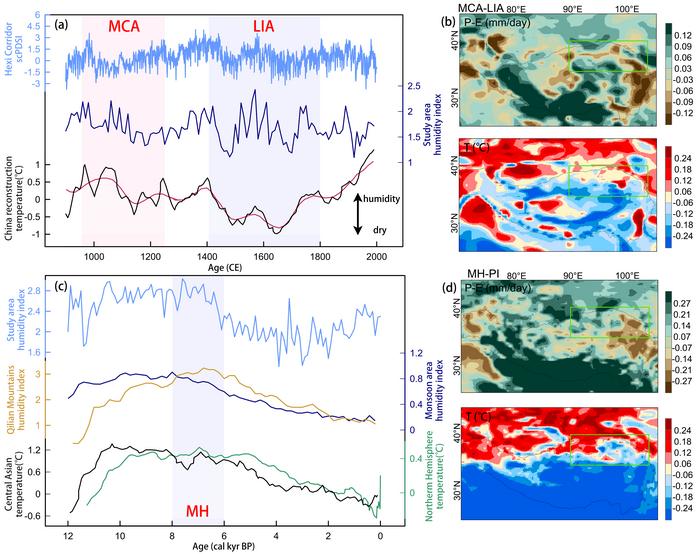
Historical patterns of climate change can provide ways to predict future climate change. During geological history, the earth has experienced many warm periods of different time scales, such as the mid-Holocene warm period, the medieval climate anomaly, etc. The northern margin of the Tibetan Plateau are located at the intersection of the Asian summer monsoon and mid-latitude westerly circulation. It is regional climate change has the unique complexity of the monsoon-westerly transition zone and is sensitive to climate change. The northern margin of the Tibetan Plateau is a typical area for studying climate change and its mechanisms.

Credit: ©Science China Press
Historical patterns of climate change can provide ways to predict future climate change. During geological history, the earth has experienced many warm periods of different time scales, such as the mid-Holocene warm period, the medieval climate anomaly, etc. The northern margin of the Tibetan Plateau are located at the intersection of the Asian summer monsoon and mid-latitude westerly circulation. It is regional climate change has the unique complexity of the monsoon-westerly transition zone and is sensitive to climate change. The northern margin of the Tibetan Plateau is a typical area for studying climate change and its mechanisms.
Recently, based on paleo-environmental records, paleoclimate simulations and modern observations, the team of Professor Yu Li of Lanzhou University compared the wet/dry changes of the Middle Holocene (MH) warm period, the medieval climate anomaly (MCA), the modern warm period and the warm period in the next hundred years in the northern margin of the Tibetan Plateau, and discussed the climate change law and mechanism in this region. They evaluated wet/dry change patterns at the northern edge of the Tibetan Plateau under future global warming scenarios through paleoclimate similarities. Paper “Transformation and Mechanisms of Climate Wet/Dry Change on the Northern Tibetan Plateau under Global Warming: A Perspective from Paleoclimatology, “published in Science China Earth Sciences.
The study found that the climate during the mid-Holocene warm period on the northern edge of the Tibetan Plateau was warm and humid. The enhanced summer monsoon driven by the orbital scale led to increased precipitation. The high-altitude westerly winds in winter strengthened but had little impact on the regional climate. During the medieval climate anomaly, the climate at the northern edge of the Tibetan Plateau was warm and dry, the summer monsoon weakened, and the southward-moving high-altitude westerly winds brought a small amount of precipitation in winter. Increased solar radiation led to increased evaporation, which affected regional wet/dry changes.
During the modern warm period, evaporation decreased significantly, precipitation continued to increase, and the climate on the northern edge of the Tibetan Plateau showed an obvious trend of warming and humidification. In the warm period of the next hundred years, as greenhouse gas concentrations rise, the impact of temperature on regional wet/dry changes will intensify. Continued warming will lead to the expansion of the westerly belt and a gradually humid climate. In the future, the wet/dry changes on the northern edge of the Tibetan Plateau will be more similar to those in the mid-Holocene warm period.
Climate change is generally cyclical, and wet/dry changes in historical warm periods can provide a historical background for predicting future wet/dry changes. Referring to the climate characteristics of the mid-Holocene warm period on a millennium scale, the northern edge of the plateau will experience multiple cold and warm events before the climate reaches stability in the future. The wet/dry pattern on a long time scale is still mainly controlled by the strength and influence range of the monsoon, as well as the interaction with the westerly circulation.
Li Y, Zhang Z, Zhou X, Gao M, Duan J, Xue Y, Shang H, Liu S. 2024. Transformation and mechanisms of climate wet/dry change on the northern Tibetan Plateau under global warming: A perspective from paleoclimatology. Science China Earth Sciences, 67,
Journal
Science China Earth Sciences
Cite Scienmag News
Piper Higgins. (May 16, 2024). Transformation and mechanisms of climate wet/dry change on the northern Tibetan Plateau under global warming: A perspective from paleoclimatology. Scienmag. https://scienmag.com/transformation-and-mechanisms-of-climate-wet-dry-change-on-the-northern-tibetan-plateau-under-global-warming-a-perspective-from-paleoclimatology/
Piper Higgins. "Transformation and mechanisms of climate wet/dry change on the northern Tibetan Plateau under global warming: A perspective from paleoclimatology." Scienmag, 16 May 2024, https://scienmag.com/transformation-and-mechanisms-of-climate-wet-dry-change-on-the-northern-tibetan-plateau-under-global-warming-a-perspective-from-paleoclimatology/. Accessed 5 September 2026.
Piper Higgins. "Transformation and mechanisms of climate wet/dry change on the northern Tibetan Plateau under global warming: A perspective from paleoclimatology." Scienmag. May 16, 2024. https://scienmag.com/transformation-and-mechanisms-of-climate-wet-dry-change-on-the-northern-tibetan-plateau-under-global-warming-a-perspective-from-paleoclimatology/

