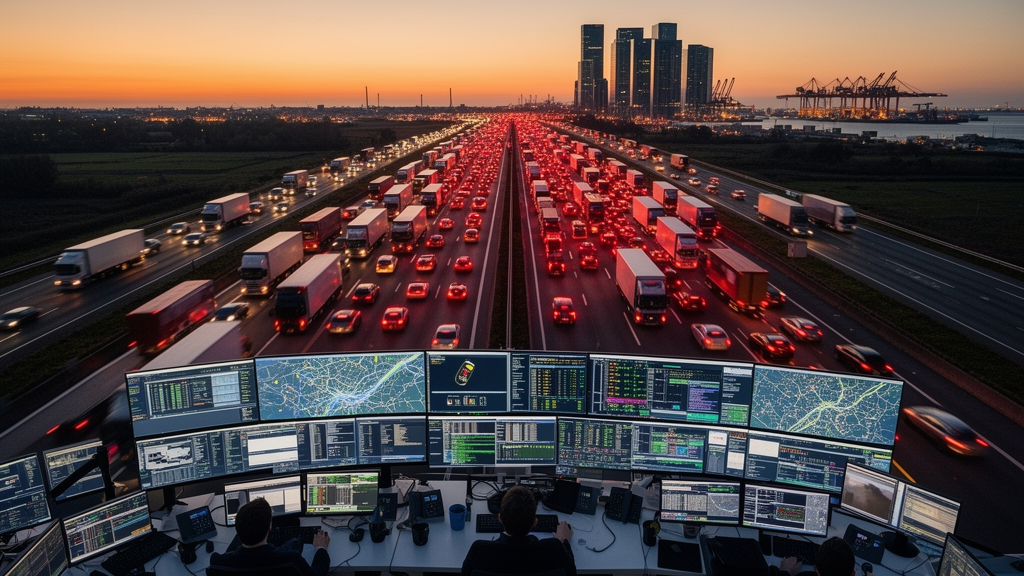
Supply chains break at their narrowest points. A single production station that cannot keep pace with incoming work, a warehouse dispatch operation falling behind on orders, or a port terminal choked by recurring congestion can send queues building upstream and shortages rippling downstream, undermining delivery reliability even when every other resource in the network is available. A new bibliometric review published in Future Business Journal maps how researchers have tried to anticipate exactly these constraints using real-time data, and its central finding is striking: the literature that surfaces under this search is overwhelmingly about traffic, not supply chains.
Authors Qazi Moinuddin Mahmud, Ahmed Jubair Bin Hussain and Kazi Anowarul Hoque analysed 3,638 Scopus-indexed publications from 2016 to 2025, using the Bibliometrix and VOSviewer software packages to chart publication patterns, keyword clusters and thematic evolution. Their motivation was a conceptual gap. Research relevant to predicting supply chain bottlenecks with real-time data is scattered across transportation, logistics and information systems, and the authors argue that the conceptual boundaries between these streams have become blurred, leaving practical insights underdeveloped. Their review is deliberately a map of the retrieved corpus rather than a comprehensive census of supply chain research, a distinction they stress repeatedly.
The headline result is a strong concentration in intelligent transportation systems. Traffic congestion emerged as the most frequent theme in the corpus, appearing 1,083 times in the keyword co-occurrence network with a total link strength of 6,174, while motor transportation appeared 539 times with a link strength of 3,660. VOSviewer clustering identified four thematic groups: traffic management and detection, congestion and travel-time modelling, data infrastructure and analytics, and short-horizon flow control. In the Bibliometrix representation, the map split into two broad groups, one organised around traffic congestion and another around traffic management and control, with machine learning, object detection, traffic flow prediction, IoT and big data connected through linking terms.
The growth of the field itself is dramatic. Publications rose from 68 in 2016 to 874 in 2024, with 849 recorded in 2025. Citation totals climbed from 1,680 for the 2016 cohort to 9,975 for 2020 before falling to 467 for 2025, a pattern the authors attribute largely to reduced citation exposure time for recent papers rather than any decline in activity. Geographically, scientific production is strongest for China and India, with significant output from the United States, Western Europe, Japan and South Korea, and visible contributions from Australia, Canada and Brazil. The authors caution that these patterns reflect the geographic representation of the retrieved literature, not the locations of operational bottlenecks or collaboration networks.
The disciplinary profile reinforces the technical orientation of the field. Computer Science accounts for 27.2 percent of the corpus and Engineering 23.9 percent, followed by Mathematics at 8.0 percent, with Social Sciences at 5.6 percent each, Physics and Astronomy at 5.3 percent, Medicine at 4.0 percent, Energy at 3.1 percent, Materials Science at 2.8 percent and Biochemistry, Genetics and Molecular Biology at 2.5 percent, with the remaining 12.1 percent spread across other areas. Because Scopus papers can carry multiple classifications, these shares overlap and should not be read as mutually exclusive. The most productive sources are IEEE Transactions on Intelligent Transportation Systems with 102 papers, IEEE Access with 97, and Transportation Research Part C: Emerging Technologies with 86, followed by Lecture Notes in Networks and Systems with 77 and Sensors with 61.
Thematic mapping reveals where supply chain concepts actually sit in this landscape. Forecasting, IoT and machine learning occupy the motor theme quadrant, combining relatively high centrality and density. Basic themes such as traffic congestion, motor transportation and intelligent systems hold central but low-density positions, while highway traffic control and management terms form a niche cluster. Crucially, the terms supply chains, supply chain management and blockchain appear in the low-centrality, low-density quadrant, meaning they are poorly integrated with the rest of the network rather than demonstrably emerging or declining. Comparing 2016–2020 with 2021–2025, the thematic evolution shows growing prominence for machine learning and deep learning vocabulary, though the authors note that deep learning was already being applied to traffic forecasting in 2016; what changed is its visibility and the grouping of analytic terms.
Author-level results come with heavy caveats. The label WANG Y tops the productivity ranking with 84 documents, followed by LI Y with 63, ZHANG Y with 61 and WANG X with 45, and leading local h-indices reach 16. The authors emphasise that common surnames and initials can match many different people, requiring disambiguation through Scopus Author IDs, and that a local h-index is a function of the corpus and citation definitions rather than a measure of predictive effectiveness. Publication counts, they add, are not intended to measure collaboration intensity, and country shading carries no such interpretation either.
What the maps cannot do is as important as what they show. The authors are explicit that bibliometric associations can detect interest in a research field and the proximity of concepts, but cannot detect causal relationships, model superiority, or non-reporting. Keyword co-occurrence reflects how often terms appear together in records, not operational mechanisms, and cluster names are summaries rather than observed phenomena. The study relied on a single database, Scopus, with English-language filtering and broad search vocabulary that included general terms such as transport, port, delay and detect to maximise recall. Those choices skew the findings toward traffic themes, and the authors acknowledge that relevant studies using alternative terminology may have been missed while studies beyond advanced supply chain bottleneck prediction may have been captured. The two thematic intervals, 2016–2020 and 2021–2025, are equal in duration but unequal in publication volume, so descriptive flow widths should not be interpreted as comparable growth rates.
The conceptual contribution of the review lies in distinguishing transport-level prediction from supply chain-level bottleneck management. The authors define a supply chain bottleneck as a resource, process or interface whose effective capacity limits the flow of a connected supply chain under certain conditions, and they distinguish it from both delays, which are observable outcomes, and disruptions, which may create bottlenecks by destroying effective capacity. A traffic forecast, they argue, can inform a freight decision only if a connection between the forecast and supply chain throughput is established. They also stress that a forecast is operationally useful only if it arrives in time, concerns a controllable process and supports an actionable decision, requiring time for data acquisition, model computation, decision-making and implementation within the remaining window for intervention. Notably, traffic congestion is relevant to supply chains only when it affects logistics flows; general road congestion does not by itself demonstrate an end-to-end supply chain constraint.
From these observations the authors derive a research agenda emphasising cross-context validation, prediction-to-action integration and explicit tests of forecast usefulness. Proposed questions span congestion forecasting, machine-learning performance, IoT data quality, multimodal detection, short-horizon flow control, cross-context construct validity, digital twin integration and corpus definition sensitivity, each paired with suggested designs ranging from controlled data degradation and rolling temporal tests to simulation pilots and multi-context coding. They rank methodological validation first, arguing that corpus boundaries must be robust and analysis settings transparently reconstructed before substantive follow-up. For practitioners, the review suggests structuring early warning pilots around reliable observation, prediction, data and analytical needs, and response, beginning with a measurable bottleneck phenomenon such as queue build-up or throughput loss, benchmarking any model against a simple baseline predictor within the same horizon, and monitoring warning lead time, missed events, false alarms, implementation cost and service changes. Digital twin simulation can compare candidate responses before field deployment, the authors note, but realised benefits require operational validation. The insights remain bounded by corpus definition and bibliometric settings, yet the review clarifies where the literature stands: transport forecasting has advanced rapidly, while the bridge from local predictions to system-level supply chain constraints is still waiting to be built.
Subject of Research: A bibliometric review of real-time prediction research relevant to supply chain bottlenecks in transport and logistics from 2016 to 2025
Article Title: Predicting supply chain bottlenecks with real-time data: a bibliometric review of transport and logistics research from 2016 to 2025
Article References: Mahmud, Q. M., Hussain, A. J. B., & Hoque, K. A. (2026). Predicting supply chain bottlenecks with real-time data: a bibliometric review of transport and logistics research from 2016 to 2025. Future Business Journal, 12(1), Article 328. https://doi.org/10.1186/s43093-026-01032-z
Image Credits: AI Generated
DOI: 10.1186/s43093-026-01032-z
Keywords: supply chain bottlenecks, bibliometric review, real-time data, predictive analytics, traffic congestion, intelligent transportation systems, machine learning, deep learning, Scopus, VOSviewer, digital twins, logistics
Cite Scienmag News
Blake Davidson. (October 28, 2026). Traffic congestion dominates a decade of research on predicting supply chain bottlenecks with real-time data. Scienmag. https://scienmag.com/traffic-congestion-dominates-a-decade-of-research-on-predicting-supply-chain-bottlenecks-with-real-time-data/
Blake Davidson. "Traffic congestion dominates a decade of research on predicting supply chain bottlenecks with real-time data." Scienmag, 28 October 2026, https://scienmag.com/traffic-congestion-dominates-a-decade-of-research-on-predicting-supply-chain-bottlenecks-with-real-time-data/. Accessed 28 October 2026.
Blake Davidson. "Traffic congestion dominates a decade of research on predicting supply chain bottlenecks with real-time data." Scienmag. October 28, 2026. https://scienmag.com/traffic-congestion-dominates-a-decade-of-research-on-predicting-supply-chain-bottlenecks-with-real-time-data/