


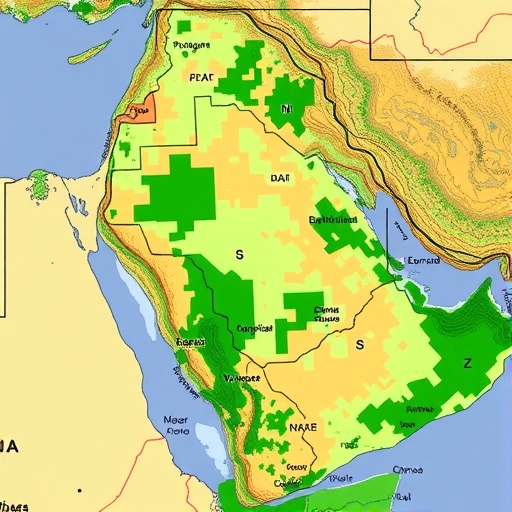
In the vast desert landscape of Algeria, the El Oued Oases has been undergoing significant transformations, marking a pivotal moment for sustainable agriculture. This agricultural system, rooted in the delicate balance of tradition and modernity, is now at the conscious forefront of scientific inquiry. A critical study conducted by a team of researchers led by Daich S. explores the spatiotemporal dynamics of land use and land cover changes in this region. Utilizing cutting-edge methodologies, the research sheds light on shifting agricultural practices that are crucial for maintaining ecological equilibrium.
The researchers employed a combination of remote sensing technology and GIS-based approaches to gather data on land use and land cover across the Ghouts. This method offers an expansive view of spatial changes over time and allows researchers to model and predict future shifts. By analyzing satellite imagery alongside historical data, they have constructed a detailed narrative of ecological and agricultural shifts, providing insights essential for sustainable management strategies in the face of climate change.
One critical aspect of the research is its focus on sustainability. The El Oued Oases has been traditionally reliant on date palm cultivation, a practice that has evolved but remains deeply connected to the area’s cultural identity. The study highlights how changing climatic patterns and socio-economic factors are challenging farmers in the region. This examination is imperative, as it can guide the development of practices that not only support local economies but also preserve the region’s unique ecological characteristics.
As the researchers delved deeper into the intricate relationships between environmental factors and human activity, they discovered alarming trends. Rapid urbanization and increasing agricultural demands have led to substantial changes in land use. The burgeoning population in the region places additional pressure on limited resources, forcing local farmers to adapt their practices continuously. This dynamic is particularly concerning as it potentially jeopardizes the sustainability of the agricultural system that has thrived in the oases for centuries.
Furthermore, the team’s analysis presents a framework for understanding future predictions regarding land cover. By integrating historical trends with predictive modeling, they were able to forecast potential scenarios for the coming decades. This predictive capacity is invaluable, as it enables policymakers to anticipate challenges and work toward implementing proactive measures that can mitigate negative outcomes.
The research also emphasizes the importance of monitoring land use changes over time. Continuous assessment allows for timely interventions and enhances the resilience of agricultural practices against environmental stressors. By deploying remote sensing technologies, the team can keep track of fluctuations in water use, soil quality, and crop yields. This data is vital for farmers to make informed decisions about their practices, ensuring sustainability in an era of unpredictability.
Moreover, the study identifies significant areas where intervention may be necessary. For example, the research points out regions experiencing severe degradation due to unsustainable practices. Addressing these areas could not only aid recovery but also foster greater overall resilience in the agricultural system of the El Oued Oases. This dual focus on recovery and resilience is crucial, as it addresses both immediate needs and long-term sustainability concerns.
One of the most compelling findings of the research is the interplay between technology and tradition in fostering sustainable practices. As farmers adopt modern technologies such as drip irrigation and precision agriculture, there is a risk of abandoning traditional farming methods that have historically ensured ecological balance. The challenge lies in harmonizing these two approaches to create a robust agricultural framework that maximizes output while minimizing environmental impact.
Community involvement is also a cornerstone of the researchers’ recommendations. Engaging local stakeholders in decision-making processes is vital for the successful implementation of sustainable practices. The researchers emphasize that interventions must be culturally sensitive and considerate of local customs to foster acceptance and participation. Building a sense of ownership among community members can significantly enhance the effectiveness of sustainability initiatives.
In terms of policy implications, the findings of this research carry significant weight. Policymakers are encouraged to integrate scientific insights into their frameworks to develop more effective conservation strategies. By understanding the spatial and temporal dynamics of land use, they can craft policies that protect not only the environment but also the livelihoods of local communities. Such an integrative approach ensures a balanced development path that does not sacrifice ecological integrity for the sake of economic gain.
The publication of this research marks a significant contribution to the field of environmental monitoring and assessment. The methodologies employed have broader implications beyond the El Oued Oases, suggesting a replicable framework for studying land use changes in other vulnerable ecosystems worldwide. As climate change continues to pose threats to agricultural systems globally, such insights are essential for developing effective resilience strategies.
Ultimately, the implications of this research extend far beyond regional boundaries. As the world grapples with the ramifications of climate change, understanding local adaptive strategies can inform global solutions to food security and environmental sustainability. The collective knowledge crafted through studies such as this one paves the way for a future where agricultural practices are not merely sustainable but thrive within the context of an ever-changing planet.
In summary, the study led by Daich S. and colleagues serves as a beacon of hope for sustainable agriculture in challenging climates. It articulates the complex dynamics at play in land use changes while providing a roadmap for future interventions. As researchers continue to refine their methods and expand their inquiries, the commitment to ensuring ecological sustainability in places like the El Oued Oases remains a clarion call for action. The convergence of tradition, technology, and sustainability offers a promising pathway toward a resilient agricultural future.
Daich, S., Saadi, M.Y., Santoro, A. et al. Spatiotemporal analysis, monitoring, and future prediction of land use/land cover changes in Ghouts: a sustainable agricultural system in the El Oued Oases, Algeria.
Environ Monit Assess 197, 1062 (2025). https://doi.org/10.1007/s10661-025-14488-3
Cite Scienmag News
Violet Maxwell. (August 30, 2025). Tracking Land Use Changes in El Oued Oases. Scienmag. https://scienmag.com/tracking-land-use-changes-in-el-oued-oases/
Violet Maxwell. "Tracking Land Use Changes in El Oued Oases." Scienmag, 30 August 2025, https://scienmag.com/tracking-land-use-changes-in-el-oued-oases/. Accessed 4 September 2026.
Violet Maxwell. "Tracking Land Use Changes in El Oued Oases." Scienmag. August 30, 2025. https://scienmag.com/tracking-land-use-changes-in-el-oued-oases/


