

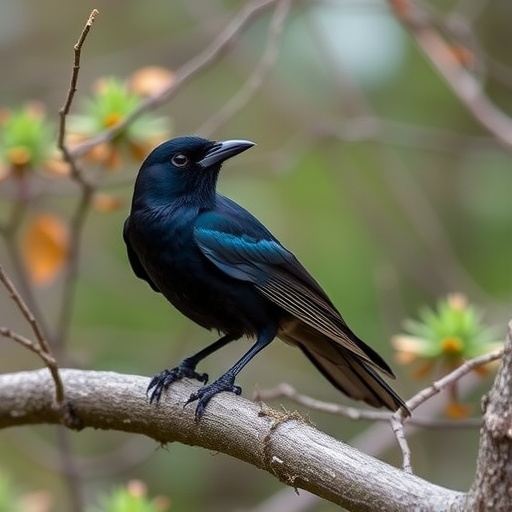
In a groundbreaking study published in “Animal Cognition,” researchers have turned their attention to the rich vocal communication of corvids, a family of birds renowned for their intelligence and social complexity. The paper, authored by Valerio Baglione, Daniele Canestrari, and Maria Cusimano, among others, presents high-resolution data collected via innovative low-impact miniaturized tags. This study sheds new light on how these fascinating birds communicate in their natural habitats, and the implications of their findings have the potential to reshape our understanding of avian vocalization.
Corvids, which include species such as crows, ravens, and magpies, possess a remarkable repertoire of calls and vocalizations. These calls are not merely random sounds; they serve crucial functions in social interactions, foraging, and warning others of predators. Until now, much of what we knew about their vocal behavior was gleaned from observational studies conducted in lab settings or captured through less precise recording methods. The introduction of miniaturized tags allows researchers to collect data in more naturalistic settings and contexts, enabling a deeper understanding of vocal communication in free-living birds.
The researchers’ approach is a revolutionary shift in the study of animal behavior. By using low-impact tags that cause minimal disruption to the birds, the team was able to capture real-time vocalizations as the corvids went about their daily lives. This methodological advancement is significant, as it permits insights that were previously unattainable, heralding a new era in the study of wildlife communication. The tags, lightweight and designed to adhere seamlessly to the birds, have allowed for long-term tracking without hindering the birds’ natural behaviors.
One of the most striking elements of the study is the rich variety of calls noted among the corvids. The data revealed not only the number of vocalizations but also the contexts in which they were employed. For instance, the birds displayed different vocal patterns when interacting with kin versus unfamiliar individuals. This behavioral nuance suggests that corvids possess a level of social awareness and emotional intelligence that parallels that of some primates.
Accompanying the vocal communication, the study’s findings highlight the role of body language in corvid interactions. Researchers noted that specific calls were often accompanied by particular postures or movements, suggesting a multidimensional approach to communication that encompasses both auditory and visual signals. This observation underscores the complexity of corvid social interactions and emphasizes the importance of examining communication through a holistic lens, combining vocalization with physical gestures.
The technology employed in the research is worth noting. Miniaturized tags utilize advanced recording technology that captures sound with high fidelity, while also retaining the ecological integrity of the study environment. This balance between technological advancement and ethical wildlife research exemplifies a growing trend in the field. As ecological concerns mount, it is imperative that researchers continue to find innovative ways to study wildlife without imposing significant disturbances on their natural behaviors.
Additionally, this research opens the door for comparative studies. Understanding vocal communication in corvids can provide insights into similar phenomena in other bird species and even mammals. Corvids are often viewed as highly intelligent, problem-solving creatures; understanding their communication can inform conservation efforts and enhance our comprehension of biodiversity. The implications of vocal communication extend beyond mere observation; they have the potential to influence how we approach wildlife management and conservation strategies.
As studies like this emerge, they challenge pre-existing assumptions about animal communication and cognition. The corvids’ complex social structures and vocalizations encourage a reevaluation of intelligence in the animal kingdom. The findings resonate with ongoing conversations in ethology, highlighting that cognitive traits are not solely reserved for species traditionally regarded as “intelligent,” such as dolphins and primates.
The publishing of these innovative findings in “Animal Cognition” is likely to stimulate further research and discussion. Scholars and enthusiasts alike will take notice as they weave the threads of vocal communication into the broader tapestry of animal behavior. As more data and studies emerge, it is expected that our understanding of avian communication will continue to evolve, revealing deeper insights into the social lives of these birds.
Looking forward, researchers plan to expand their study to include other species within the corvid family. The aim is to discern whether variations in vocal communication correlate with environmental factors, social structures, or even evolutionary adaptations. Such research could paint a clearer picture of how and why vocal communication differs among species, invoking questions around adaptability and survival.
Moreover, this study invites us to consider the ethical dimensions of wildlife research. As technology advances, scientists must remain vigilant about the impacts their tools may have on the subjects of their studies. The development of low-impact, miniature devices demonstrates a step in the right direction, fostering responsible research practices that prioritize the wellbeing of animal subjects while facilitating scientific inquiry.
Finally, the implications of this study transcend academic interest; they touch upon broader environmental and societal conversations regarding cohabitation with wildlife. The complexity of corvid communication and behavior reflects an intricate web of ecological interactions, begging the question of how human activities are influencing these dynamics. Through continued research and awareness, society may cultivate a deeper appreciation for the avian world that exists parallel to our own.
In summary, the research undertaken by Baglione and colleagues represents a significant advancement in our understanding of corvid vocal communication. By leveraging low-impact technologies to collect data in free-living settings, they illuminate the intricate dynamics that govern avian communication and social interaction. This seminal work not only enhances our grasp of corvid behaviors but also challenges us to rethink our relationship with the wildlife surrounding us.
Subject of Research: Corvid vocal communication and behavior
Article Title: Capturing vocal communication in a free-living corvid: high-resolution data from low-impact miniaturized tags
Article References:
Baglione, V., Canestrari, D., Cusimano, M. et al. Capturing vocal communication in a free-living corvid: high-resolution data from low-impact miniaturized tags.
Anim Cogn 28, 85 (2025). https://doi.org/10.1007/s10071-025-02018-0
Image Credits: AI Generated
DOI:
Keywords: Corvids, vocal communication, animal behavior, wildlife research, social interaction, ecological impact.


