


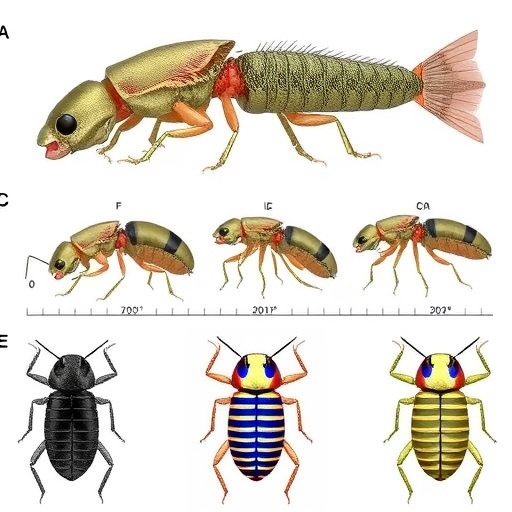
In a groundbreaking study that promises to reshape our understanding of flea evolution, a team of scientists has successfully sequenced the first complete mitochondrial genome (mitogenome) of the family Pygiopsyllidae, shedding new light on the phylogenetic relationships within the order Siphonaptera. This achievement not only fills a critical gap in entomological genomics but also provides unprecedented insight into how these blood-feeding ectoparasites have evolved over millions of years. The findings, published recently in Acta Parasitologica, offer a molecular window into the deep evolutionary history of fleas and challenge some long-held taxonomic assumptions.
Fleas, belonging to the order Siphonaptera, are notorious for their parasitic lifestyle, affecting a wide range of mammalian and avian hosts worldwide. Despite their ecological importance and relevance to public health—considering their role as vectors of plague and other diseases—their evolutionary pathways have remained somewhat enigmatic. This largely stems from incomplete genetic data across flea families, with Pygiopsyllidae notably absent from genomic resources until now. By sequencing the complete mitogenome of a member of this family, researchers have opened a new chapter in the molecular study of flea evolution.
The mitochondrial genome plays a pivotal role in evolutionary biology due to its relatively conserved gene content, maternal inheritance, and generally rapid mutation rates. These attributes make mitogenomes ideal candidates for reconstructing phylogenies, particularly among organisms like fleas where morphological convergences and plasticity can cloud true evolutionary relationships. The research team employed next-generation sequencing technologies to generate a high-quality mitogenomic assembly, which was subsequently annotated and compared against available genomes from other flea families.
Their phylogenetic analyses reveal several unexpected relationships within Siphonaptera. The mitogenome data suggest that the family Pygiopsyllidae occupies a unique position within the flea tree of life, which had been previously hypothesized but never molecularly confirmed. Distinct genetic signatures emerging from this study provide evidence for re-evaluating the monophyly of specific flea lineages. This, in turn, could necessitate a revision of the current taxonomy, which has largely depended on morphological traits that may be subject to convergent evolution due to similar ecological pressures.
Beyond taxonomy, the study offers insights into the evolutionary timeline of Siphonaptera. Molecular clock estimations based on mitochondrial sequence data suggest that diversification within Pygiopsyllidae and related families occurred alongside significant geological and climatic events. These events likely influenced host distributions and, by extension, the adaptive radiation of fleas as specialized parasites. Understanding these temporal patterns is crucial for comprehending how fleas have adapted to their hosts and the environments they inhabit.
Moreover, the study highlights the mitochondrial gene rearrangements unique to Pygiopsyllidae, a feature that contrasts with the more conserved gene order found in closely related families. Such rearrangements could be linked to the flea’s parasitic adaptations, potentially affecting mitochondrial function in ways that provide selective advantages in blood-feeding or host interaction. The functional implications of these genomic modifications remain an exciting avenue for future research, with potential implications for flea biology and control strategies.
Crucially, this first mitogenome sequence from Pygiopsyllidae sets a precedent for future genomic explorations across other underrepresented flea families. By building a more comprehensive mitogenomic database, researchers can drive more robust phylogenetic reconstructions and uncover evolutionary trends that have been obscured by incomplete data. This genomic approach marks a significant transformation from traditional morphology-reliant studies, enabling a more nuanced appreciation of flea biodiversity and evolution.
The study also underscores the importance of integrating genomic data with ecological and morphological observations. Molecular insights, while powerful, must be contextualized within the biological life history and ecological interactions of fleas. The researchers emphasize that a multidisciplinary approach, combining mitogenomics with field studies and morphological taxonomy, is essential to unravel the complex evolutionary narratives of these ectoparasites.
Additionally, understanding flea evolution through mitochondrial genomics has direct implications for public health. Fleas serve as vectors for numerous zoonotic diseases, and evolutionary relationships can inform predictions about host range, vector competence, and potential emergence of new flea-borne diseases. Enhanced phylogenetic frameworks can improve vector control strategies by identifying evolutionary conserved targets and vulnerabilities within flea biology.
The methodological rigor of the study stands out, as the team meticulously applied stringent bioinformatic pipelines for sequence assembly, annotation, and phylogenetic inference. By comparing multiple analytic approaches, including maximum likelihood and Bayesian inference, they ensured the robustness of their evolutionary conclusions. Such comprehensive methodology sets a high standard for future mitogenomic research in parasitology and entomology.
Importantly, the mitochondrial genome also provides markers for molecular identification and barcoding of flea species. This is particularly valuable in biodiversity surveys and epidemiological monitoring, where accurate species identification can inform ecological dynamics and disease surveillance. The newly sequenced Pygiopsyllidae mitogenome thus contributes significantly to the genetic toolkit available for flea research.
Despite these advances, the authors acknowledge several challenges that lie ahead. The complexity of mitochondrial evolution, including issues like incomplete lineage sorting and heteroplasmy, can complicate phylogenetic inferences. Additionally, the lack of complete nuclear genomes for most flea species limits integrative genomic analyses, underscoring the need for expanded genomic resources beyond mitochondria.
Future research directions highlighted by this study include expanding mitogenome sequencing to a wider array of flea families, integrating nuclear genomic data, and exploring the functional consequences of mitochondrial gene rearrangements. Such research will deepen our understanding of the molecular evolution of parasitism and the co-evolutionary dynamics between fleas and their hosts.
This pioneering work exemplifies the transformative power of genomic science in illuminating the evolutionary origins of even the most elusive and medically relevant insect orders. The comprehensive mitogenomic characterization of Pygiopsyllidae not only enriches the phylogenetic tapestry of fleas but also opens new horizons for evolutionary biology, parasitology, and vector-borne disease research. As molecular technologies continue to advance, the enigmatic world of the Siphonaptera order will undoubtedly become clearer, offering new insights that could ultimately inform both science and public health.
Cite Scienmag News
Gavin Prescott. (August 7, 2025). Tracing Siphonaptera Evolution via Pygiopsyllidae Mitogenome. Scienmag. https://scienmag.com/tracing-siphonaptera-evolution-via-pygiopsyllidae-mitogenome/
Gavin Prescott. "Tracing Siphonaptera Evolution via Pygiopsyllidae Mitogenome." Scienmag, 7 August 2025, https://scienmag.com/tracing-siphonaptera-evolution-via-pygiopsyllidae-mitogenome/. Accessed 5 September 2026.
Gavin Prescott. "Tracing Siphonaptera Evolution via Pygiopsyllidae Mitogenome." Scienmag. August 7, 2025. https://scienmag.com/tracing-siphonaptera-evolution-via-pygiopsyllidae-mitogenome/


