

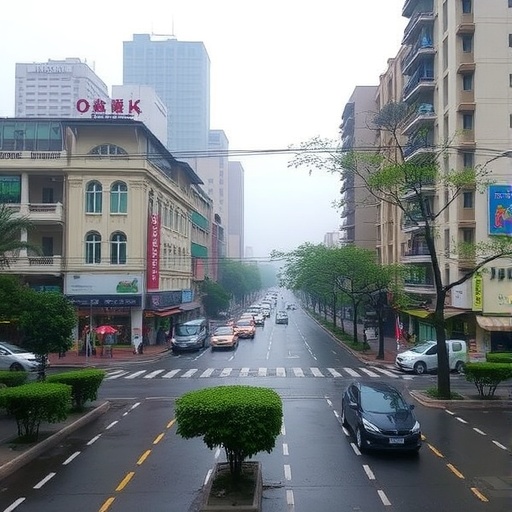
In the sprawling urban and suburban landscapes of Hanoi, a silent threat cloaks the city’s atmosphere with alarming intensity, especially during the summer months. Recent advances in environmental science have brought to light nuanced details about the particulate matter pervading the air—specifically, the fine particulate matter known as PM2.5. This minuscule yet menacing pollutant carries within it an intricate blend of organic and elemental carbon compounds, components that are critical to understanding both air quality and public health ramifications. A groundbreaking study spearheaded by Bui, Luong, Hoa, and colleagues delves deep into these components, uncovering revelations that could redefine urban air pollution dynamics in megacities like Hanoi.
PM2.5, defined by particles with diameters less than 2.5 micrometers, penetrates deep into respiratory systems, delivering a potent mix of chemicals capable of exacerbating cardiovascular and pulmonary conditions. Of particular interest are the two dominant carbonaceous constituents in PM2.5: organic carbon (OC) and elemental carbon (EC). These compounds not only influence the toxicity and reactivity of aerosols but also provide fingerprints of their diverse origins. The study meticulously characterizes these components across varied urban and suburban zones during the summer, a period marked by intensified photochemical reactions and elevated pollutant emissions.
The methodology employed by the researchers involves state-of-the-art analytical techniques that isolate and quantify OC and EC, enabling a granular view of their distribution and sources. Data was gathered from strategically placed monitoring stations, covering a spectrum of Hanoi’s environmental contexts—from dense, traffic-intensive urban centers to more dispersed suburban settings influenced heavily by residential and industrial activities. The choice of the summer season is particularly pertinent, as elevated temperatures and solar radiation accelerate the formation and transformation of secondary organic aerosols, complicating the PM2.5 composition.
Findings from this comprehensive characterization paint a complex picture. Urban zones demonstrated significantly higher concentrations of EC, a marker often associated with combustion-related sources such as vehicular emissions and biomass burning. This elemental carbon not only impairs visibility and contributes to climatic effects like atmospheric warming but also serves as a carrier for toxic substances, exacerbating health risks. Conversely, the suburban areas showed a relative increase in organic carbon fractions, pointing towards a dominance of biogenic sources and secondary organic aerosol formation fueled by volatile organic compounds emitted from both natural and anthropogenic activities.
Intriguingly, the study identifies nuanced temporal and spatial variations in OC and EC levels. Morning and evening rush hours coincide with peaks in elemental carbon, aligning with traffic-density patterns. Meanwhile, elevated midday organic carbon levels hint at ongoing photochemical processes, underpinned by complex chemical transformations driven by solar radiation. This diurnal pattern underscores the interplay between direct emission sources and atmospheric chemistry, a dynamic critical for devising effective pollution mitigation strategies.
The research also highlights the interconnectedness between human activities, meteorological conditions, and air pollutant profiles. Hanoi’s unique urban morphology, along with prevailing summer climatic factors such as temperature inversion layers and humidity variations, influence pollutant dispersion and concentration. Higher temperatures hike emission rates and encourage formation of secondary organic aerosols, while humidity modulates particle growth and cloud condensation processes, thereby affecting both the quantity and quality of PM2.5.
The health implications stemming from these insights are profound. Elemental carbon’s role as a vector for toxic pollutants potentiates respiratory illnesses and systemic inflammation, while organic carbon participates actively in atmospheric reactions that produce ozone and other harmful secondary pollutants. Recognition of source-specific carbonaceous fractions facilitates targeted public health interventions, focusing efforts on controlling primary combustion emissions and managing precursor species contributing to secondary aerosol formation.
Beyond direct health outcomes, the study’s findings bear significant environmental and climatic relevance. Elemental carbon’s light-absorbing properties contribute prominently to urban heat retention and regional climate forcings. Meanwhile, organic carbon’s reflectance and cloud-interacting traits modulate radiative balances, linking urban air pollution with broader ecological consequences. These multidimensional impacts emphasize the urgency of integrating carbonaceous aerosol characterization into urban environmental management frameworks.
On a policy level, this research provides an empirical foundation for refining Hanoi’s air quality standards and pollution control initiatives. The spatial differentiation of OC and EC sources enables policymakers to prioritize interventions—such as upgrading vehicle emission standards, promoting cleaner fuels, enhancing public transportation infrastructure, and regulating industrial discharge. Additionally, understanding seasonal variation can guide temporal deployment of mitigation measures to maximize efficacy during critical pollution episodes.
Importantly, the study’s methodological approach offers a replicable blueprint for similar assessments in other rapidly industrializing and urbanizing regions across Southeast Asia and beyond. As megacities grapple with balancing economic growth and environmental sustainability, precise scientific data on pollutant composition and behavior remains a cornerstone of responsible urban planning and public health protection.
This investigation further reinforces the imperative of continuous air quality monitoring and public dissemination of findings. Transparent communication bridges the gap between scientific analysis and community engagement, fostering awareness and behavioral changes that cumulatively reduce exposure and emissions. It also advances global efforts to track progress towards Sustainable Development Goals related to health, sustainable cities, and climate action.
In light of escalating urban vulnerabilities to air pollution, integrating advanced sensor technologies, chemical analysis, and atmospheric modeling emerges as a promising frontier. The nuanced quantification of carbonaceous fractions enriches predictive capacities and supports dynamic response frameworks adaptable to evolving emission landscapes and climate scenarios.
Ultimately, the work by Bui and colleagues underscores the complexity and urgency of managing organic and elemental carbon in urban aerosols. It delineates a path from scientific observation to practical intervention, anchored in rigorous data and contextualized within Hanoi’s unique environmental tapestry. This pioneering study not only elevates our comprehension of fine particulate matter but also galvanizes multi-sectoral collaboration essential for achieving cleaner, healthier cities.
As urban centers worldwide confront the multifaceted challenges posed by particulate pollution, such in-depth characterizations illuminate avenues for innovation and resilience. By unraveling the constituents and behaviors of PM2.5, we gain vital tools to safeguard human health, mitigate environmental degradation, and build sustainable urban futures that thrive amidst accelerating change.
Subject of Research: Characterization and implications of organic and elemental carbon in PM2.5 during the summer season across urban and suburban zones of Hanoi.
Article Title: Characterizing organic and elemental carbon in PM2.5 during the summer season across urban and suburban zones of Hanoi: Sources and implications.
Article References:
Bui, T.H., Luong, N.D., Hoa, H.X. et al. Characterizing organic and elemental carbon in PM2.5 during the summer season across urban and suburban zones of Hanoi: Sources and implications. Environmental Earth Sciences 85, 44 (2026). https://doi.org/10.1007/s12665-025-12778-0
Image Credits: AI Generated


