


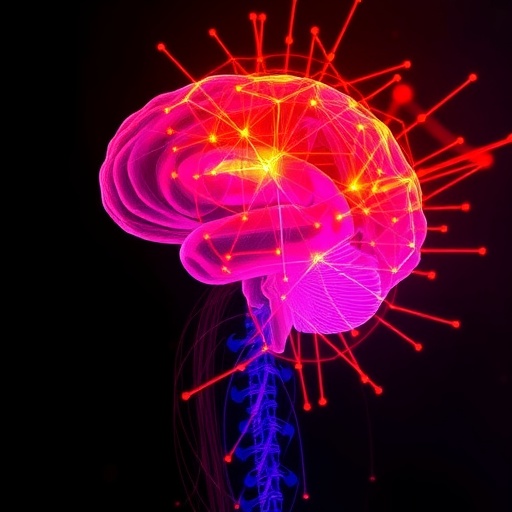
A groundbreaking advancement in decoding the brain’s electrical activity has emerged from researchers at Chiba University, Japan. This novel technology tackles a long-standing challenge in interpreting electroencephalography (EEG) signals associated with motor imagery (MI), a process where individuals imagine movements without executing them physically. Traditionally, interpreting these EEG signals has been hindered by their inherent noisiness, non-linear behavior, and temporal variability. This new approach, spearheaded by Ph.D. candidate Chaowen Shen alongside Professor Akio Namiki, introduces a topology-aware multiscale feature fusion network (TA-MFF) that significantly enhances decoding accuracy and robustness.
EEG remains a cornerstone technology for non-invasive brain-computer interfaces (BCI) due to its ability to capture neural activity with electrodes placed strategically on the scalp. Its utility extends across cognitive neuroscience, neurological diagnostics, and the burgeoning field of neuroprosthetics, where understanding the brain’s intent to move can directly control robotic limbs or assistive devices. However, MI-EEG signals, which are critical for activating imagined movement paradigms, present complex patterns that are elusive to existing analytical methods. Conventional machine learning approaches have focused on extracting individual temporal, spatial, and spectral features, yet these models often miss critical interactions across these domains.
Deep learning has promised new possibilities by autonomously discerning features from raw or preprocessed EEG data. Yet, many existing models extract primarily spatiotemporal features and neglect the relationships within the spectral domain, which reflect different frequency components inherently linked to brain oscillations. Moreover, the spatial topologies between EEG electrodes have been addressed superficially, without capturing the deeper geometric and topological structures encoded in neural interactions. Recognizing these gaps, the Chiba University team crafted a holistic architecture that exploits complex dependencies across spatial, temporal, and spectral domains through three integrated modules within the TA-MFF network.
Central to their innovation is the spectral network (S-Net), which begins by converting EEG signals into power spectral density representations using the Welch method. This spectral transformation reduces noise and highlights frequency-specific signal power variations crucial for differentiating motor imagery states. Following this, the spectral-topological data analysis-processing module (S-TDA-P) employs persistent homology—a computational topology technique—to uncover enduring patterns in the relationships between EEG electrodes based on their spectral features. Persistent homology reveals multi-scale, robust spatial patterns that conventional feature extraction techniques often overlook.
Parallel to S-TDA-P, the inter-spectral recursive attention (ISRA) module analyzes correlations among distinct frequency bands. By recursively applying attention mechanisms, ISRA accentuates key spectral features pertinent to MI decoding while diminishing redundant or irrelevant signals. This selective channeling of information mirrors the brain’s own focus mechanisms and enhances the network’s sensitivity to meaningful neural oscillations tied to imagined movement.
The spatiotemporal network (ST-Net) processes the raw EEG signal to extract dynamic temporal and spatial characteristics, encapsulating how activity evolves over time across the electrode array. However, the true power of the TA-MFF network arises in how it synthesizes these diverse feature sets. The spectral-topological and spatiotemporal feature fusion (SS-FF) unit first merges the topological and spectral representations before integrating this composite with spatiotemporal data. This two-tiered fusion strategy captures profound interdependencies between feature domains, enabling the model to interpret EEG signals within a richer, multidimensional context rarely achieved before.
When benchmarked against state-of-the-art MI-EEG decoding techniques, the TA-MFF paradigm consistently delivers superior classification accuracy, showcasing not only improved performance but also greater robustness to signal variability and noise. This represents a transformative step for BCI technologies, which require precise and reliable interpretation of neural signals to translate thought into action, especially for individuals with motor impairments.
Professor Namiki explains the broader implications of their work: the potential to empower people with limited mobility through interfaces that respond intuitively to imagined movements. By refining our understanding of how the brain orchestrates motion at the neural level, such technologies could control computers, robotic arms, or wheelchairs purely by thought, paving the way for renewed independence and quality of life.
This approach also advances the methodological landscape of EEG analysis by integrating topological data analysis with deep learning in a manner unprecedented in the field. It moves beyond superficial feature concatenation, emphasizing deeply interconnected representations that reveal hidden spatial and spectral structures in brain signals. Such advancements open exciting possibilities for other applications, including cognitive state monitoring and neurological disorder diagnostics.
As BCIs continue to evolve, innovations like the TA-MFF network will form the backbone of next-generation systems that respond to subtle cognitive cues with speed and accuracy. These systems promise to bridge the divide between human intention and machine response more seamlessly than ever before, heralding a future where mind-controlled interfaces become everyday realities.
Beyond technological impact, the research reflects a profound interdisciplinary synergy between computational topology, neural engineering, and artificial intelligence. It highlights the importance of rethinking feature extraction philosophies to accommodate the geometric complexity of brain data rather than relying solely on traditional statistical descriptors, thereby inspiring a paradigm shift in neural data interpretation.
The study, soon to be published in the renowned journal Knowledge-Based Systems, sets a new benchmark in EEG decoding. As the scientific community assimilates these findings, they are likely to spark numerous follow-up studies aimed at adapting topology-aware frameworks to other challenging neural decoding problems, accelerating innovation across neuroscience and clinical neurotechnology alike.
For those interested in exploring this breakthrough and its technical underpinnings, the full details will be available under DOI 10.1016/j.knosys.2025.114540. As brain-machine interfacing enters its next phase, approaches like the TA-MFF network underline the vast untapped potential waiting to be unlocked within the intricate electrical patterns of the human brain.
Cite Scienmag News
Reid Dalton. (November 11, 2025). Topology-Aware Deep Learning Advances EEG-Based Motor Imagery Decoding. Scienmag. https://scienmag.com/topology-aware-deep-learning-advances-eeg-based-motor-imagery-decoding/
Reid Dalton. "Topology-Aware Deep Learning Advances EEG-Based Motor Imagery Decoding." Scienmag, 11 November 2025, https://scienmag.com/topology-aware-deep-learning-advances-eeg-based-motor-imagery-decoding/. Accessed 4 September 2026.
Reid Dalton. "Topology-Aware Deep Learning Advances EEG-Based Motor Imagery Decoding." Scienmag. November 11, 2025. https://scienmag.com/topology-aware-deep-learning-advances-eeg-based-motor-imagery-decoding/


