


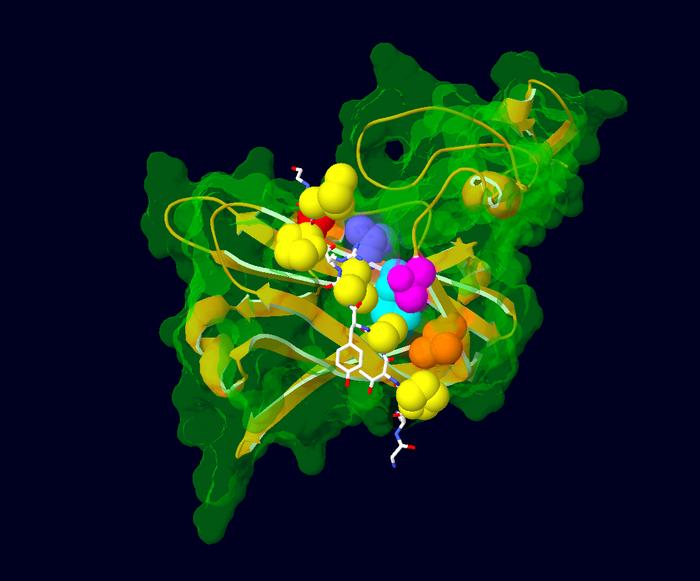
New research from the University of Lausanne reveals that both the excess and the deficiency of a single protein can lead to severe intellectual deficiencies. The discovery offers critical insights for early diagnosis of a rare developmental disorder.

Credit: Nicolas Guex © UNIL
New research from the University of Lausanne reveals that both the excess and the deficiency of a single protein can lead to severe intellectual deficiencies. The discovery offers critical insights for early diagnosis of a rare developmental disorder.
A team of scientists led by Alexandre Reymond, an expert in human genetics at the Center for Integrative Genomics (CIG) and professor at the Faculty of Biology and Medicine (FBM) of the University of Lausanne (UNIL), presents a major step forward in the detection of a rare genetic disease. For the first time, the authors show that both the accumulation and the deficiency of the so-called AFF3 protein are detrimental to development. The research, published in Genome Medicine, follows on from the group’s 2021 discovery of the KINSSHIP syndrome, caused by mutations in the AFF3 gene and resulting in intellectual disability, an increased risk for epilepsy, kidney malformations, and bone deformation in affected children.
Discovery of the genetic cause of KINSSHIP syndrome
KINSSHIP syndrome affects about thirty individuals worldwide. As a result, there are few documented cases and understanding of the disease remains limited, making early and accurate diagnosis challenging. “In our previous study we demonstrated that this pathology resulted from an abnormal accumulation of the AFF3 protein. Meanwhile, available genetic data from individuals of the general population suggested that a lack of this same protein could be similarly deleterious”, explains Dr. Sissy Bassani, a postdoctoral researcher in Professor Reymond’s team and the lead author of the current study.
Large genome database points researchers to a new hypothesis
The geneticists formulated their hypothesis using gnomAD, a database containing genome sequences from several hundred thousand unrelated individuals. By mining the available data for AFF3 variants, the scientists found that loss-of-function mutations in this gene are rare, indicating their likely harmful nature. This implies that this gene plays a critical role and that its loss likely has detrimental consequences for the organism. To test their hypothesis, the authors searched for individuals with only one copy of the gene, instead of the two normally present in the human genome. Collaborating with researchers from nine different countries across Europe and North America, they identified 21 patients with such an anomaly. They all showed similar but less severe symptoms than those of KINSSHIP syndrome patients.
Experiments reveal the developmental impact of AFF3 gene mutations
To demonstrate that both insufficient and excessive amounts of AFF3 are detrimental, the researchers used several different experimental systems: cells of patients, mice, and zebrafish. Artificially decreasing or increasing the protein quantity in zebrafish eggs revealed major developmental defects in the resulting fish embryos. “These results confirm that a precise amount of AFF3 is crucial for proper embryonic development and that mutations affecting its function and/or dosage cause severe malformations”, concludes Prof. Reymond.
Impact for prenatal diagnostics
The authors’ findings are an important advancement for the diagnosis of this rare disorder, as testing for AAF3 mutations during fetal development could improve early detection of these gene defects.
Journal
Genome Medicine
Method of Research
Experimental study
Subject of Research
People
Article Title
Variant-specific pathophysiological mechanisms of AFF3 differently influence transcriptome profiles
Article Publication Date
30-May-2024
COI Statement
Annabelle Tuttle, Houda Zghal Elloumi and Chaofan Zhang are employees of GeneDx and Desiree DeMille works for ARUP Laboratories. James R. Lupski has stock ownership in 23andMe and is a paid consultant for Genome International. Claudia M.B. Carvalho provides consulting service for Ionis Pharmaceu‐ ticals. The other authors have no competing interests to declare.
Cite Scienmag News
Louis Brooks. (May 30, 2024). Too much or too little: The impact of protein dosage on development. Scienmag. https://scienmag.com/too-much-or-too-little-the-impact-of-protein-dosage-on-development/
Louis Brooks. "Too much or too little: The impact of protein dosage on development." Scienmag, 30 May 2024, https://scienmag.com/too-much-or-too-little-the-impact-of-protein-dosage-on-development/. Accessed 4 September 2026.
Louis Brooks. "Too much or too little: The impact of protein dosage on development." Scienmag. May 30, 2024. https://scienmag.com/too-much-or-too-little-the-impact-of-protein-dosage-on-development/

