

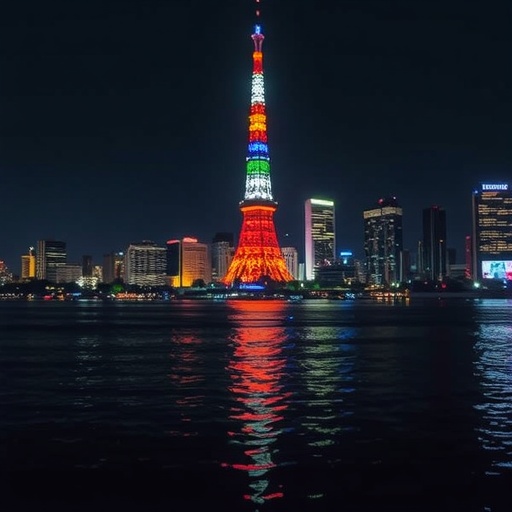
In the rapidly urbanizing landscape of the 21st century, artificial light at night (ALAN) has emerged as a pervasive environmental pollutant, profoundly altering natural ecosystems. This phenomenon extends far beyond mere illumination; it disrupts the circadian rhythms, behavioral patterns, and physiological functions of a multitude of species, rewriting fundamental ecological interactions. Coastal ecosystems, in particular, reveal acute sensitivity to these nocturnal illuminations due to their unique biological communities and pronounced exposure to human activity. Recent research spearheaded by Assistant Professor Daiki Sato at Chiba University, Japan, elucidates the complex ways in which metropolitan coastal nighttime lighting drives ecological and genetic divergence in closely related marine organisms, specifically the isopods Ligia laticarpa and Ligia furcata.
Coastal habitats serve as critical interfaces between terrestrial and marine environments, harboring diverse assemblages of intertidal species that have evolved to thrive under natural light-dark cycles. The intrusion of ALAN, predominantly from urban infrastructure such as seawalls, piers, and artificial embankments, disrupts these endogenous rhythms, leading to altered activity patterns and ecological behaviors. Despite the growing corpus of work documenting ALAN’s physiological and behavioral impacts, its role as a driver of intraspecific genetic differentiation had remained largely speculative until this groundbreaking investigation focused on the urbanized environs of Tokyo Bay.
Tokyo Bay stands as an archetype of intense urbanization, characterized by brightly lit shorelines juxtaposed with areas of variable anthropogenic influence. Within this gradient, Professor Sato applied an integrative methodology combining high-resolution genomic sequencing, comprehensive environmental data spanning nearly three decades, and controlled laboratory experiments to dissect the influence of nocturnal lighting on two sympatric Ligia isopods. These crustaceans, inhabiting the narrow intertidal zone, offer a robust model due to their sedentary nature and ecological specificity, often occupying anthropogenic substrates prone to intense nocturnal illumination.
Genomic analyses revealed a striking correspondence between lighting gradients and species distribution: Ligia laticarpa predominates in the highly illuminated inner-bay zones, while Ligia furcata is predominantly found in the comparatively dimmer outer-bay sectors. This spatial segregation coincides with a pronounced genetic discontinuity, suggestive of long-standing reproductive isolation reinforced by environmental variables. Absence of recent gene flow between these species underscores how urban lighting regimes not only influence ecological partitioning but also maintain genetic boundaries implicated in speciation processes.
Intriguingly, at the population level, the study detected genetic admixture signals indicating the presence of an additional, cryptic Ligia lineage within select inner-bay populations. This finding implicates human-mediated transport mechanisms, notably dense commercial ship traffic, as facilitators of inter-population gene flow through inadvertent species translocations. These anthropogenic vectors augment the complexity of coastal ecosystems by introducing novel genetic and ecological interactions within an already dynamic urban matrix.
Furthermore, over the span of 28 years, analytical models integrating environmental variables highlighted nighttime light intensity as a primary correlate of the observed species partitioning. Complementary factors such as salinity gradients and vegetation coverage also contribute to habitat differentiation but are systematically modulated by the overarching influence of ALAN. Such multifactorial environmental pressures compound to define microhabitat suitability, ultimately shaping species’ geographic distributions and evolutionary trajectories within coastal zones.
To elucidate possible mechanistic underpinnings, controlled laboratory experiments subjected Ligia furcata specimens to prolonged ALAN exposure, revealing significant detriments to growth rates and locomotive activity. Contrastingly, Ligia laticarpa demonstrated greater physiological resilience under similar conditions, suggesting species-specific adaptive responses that may be critical in sustaining populations amid urban lighting pressures. These findings affirm that ALAN acts as a selective force, promoting divergence by imposing differential survival and fitness outcomes across related taxa.
The implications of this research extend to fundamental evolutionary biology, highlighting the role of anthropogenic environmental modifications in fostering rapid plastic and genetic divergence. Artificial light emerges not solely as a disruptive agent but as a potent ecological factor that can generate evolutionary novelty by reshaping selective landscapes. This paradigm shift urges a reevaluation of human disturbances from a purely degradative lens toward one recognizing their potential to stimulate adaptive processes and speciation dynamics.
Moreover, the detection of human-mediated species translocation via ship traffic introduces new considerations for biodiversity conservation in coastal urban centers. Such inadvertent biotic exchanges may have profound consequences for local ecosystems, potentially facilitating invasive species establishment or genetic homogenization. Hence, integrated management strategies must encompass lighting policies alongside transportation vectors to sustain ecological integrity.
This work advocates for environmentally informed urban planning frameworks that incorporate lighting design optimized to mitigate ecological impacts. Reducing nocturnal light pollution may preserve natural behavioral patterns and promote biodiversity resilience in increasingly urbanized coastal landscapes. Incorporating adaptive lighting technologies sensitive to the biological rhythms of native species could reconcile human development with nature conservation objectives.
Assistant Professor Daiki Sato’s multi-disciplinary approach merges genomic science with ecological investigation to unravel the nuanced interplays between urbanization and natural systems. His findings, published in the prestigious journal PNAS Nexus, epitomize the necessity of combining long-term environmental assessment with cutting-edge molecular techniques to grasp the full spectrum of anthropogenic influences on evolution.
In conclusion, the study powerfully demonstrates that metropolitan coastal night lighting acts as a defining force in ecological and genetic structuring within marine intertidal isopods. By aligning artificial illumination patterns with species divergence, it spotlights the intricate ways human-derived environmental changes permeate biological systems, accelerating evolutionary pathways and molding biodiversity in the Anthropocene. This research not only broadens scientific understanding but also underlines the critical need for integrative conservation efforts addressing illumination as a key ecological driver.
Subject of Research: Animals
Article Title: Metropolitan coastal night lighting aligns with ecological and plastic divergence in closely related Ligia isopods
News Publication Date: 24-Feb-2026
Web References: https://doi.org/10.1093/pnasnexus/pgag020
References: Sato, D.X. (2026). Metropolitan coastal night lighting aligns with ecological and plastic divergence in closely related Ligia isopods. PNAS Nexus. https://doi.org/10.1093/pnasnexus/pgag020
Image Credits: Assistant Professor Daiki Sato, Chiba University, Japan
Keywords: Life sciences; Behavior genetics; Developmental genetics; Genomics; Ecology; Environmental impact assessments; Aquatic ecology; Aquatic ecosystems; Species interaction


