


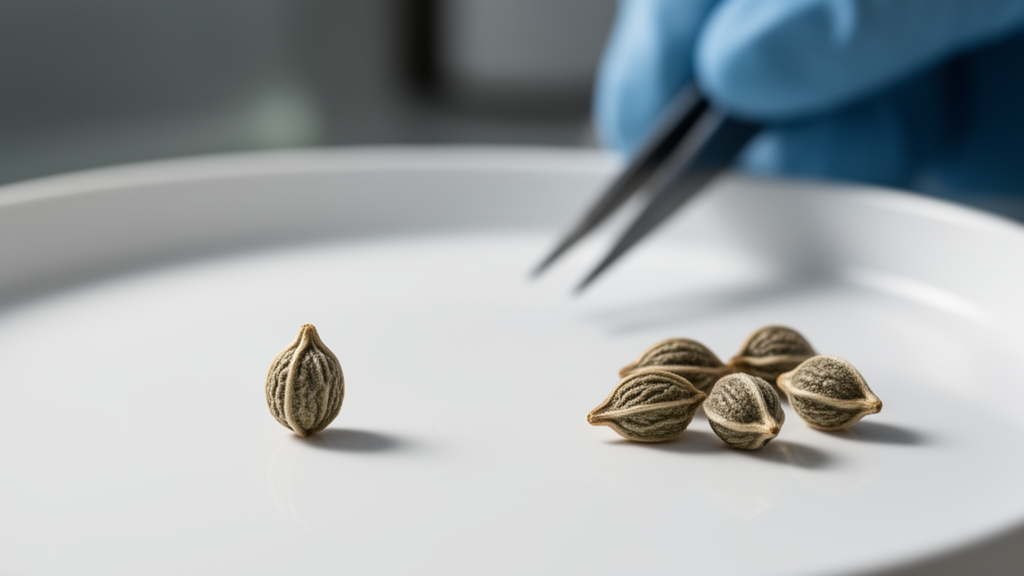
Deep in the herbarium cabinets of Japan, a quiet revolution in plant taxonomy is underway. Researchers have turned their attention to one of the smallest and most overlooked structures in the mint family: the nutlet, the tiny dry fruit of Salvia, commonly known as sage. In a study published in the journal PhytoKeys, scientists examined the nutlet micromorphology of 19 taxa of Japanese Salvia, representing four sections, and found that these miniature structures carry a wealth of systematic information that could reshape how botanists understand the genus in the Japanese archipelago.
Salvia is a species-rich and easily recognizable genus within the subtribe Salviinae, comprising approximately 1,088 species distributed almost cosmopolitanly. The genus has undergone significant species radiations in three global biodiversity hotspots: the Americas, Asia, and Europe. At the country level, Mexico harbors the highest number of species, followed by Russia, Turkey, the United States, and China. Japan, though not among the top hotspots, hosts 12 distinct Salvia species, eight of which are endemic to the archipelago. The remaining four have broader distributions, including S. japonica, also found in Korea, Taiwan, and China; S. nipponica, present in both China and Japan; and S. plebeia, widely distributed across Asia and Australia. Most recently, Hayakawa and colleagues reported the first naturalization of Salvia lyrata from a roadside on Niijima Island in the Izu Islands, a species native to the United States that is cultivated as a garden herb in Japan and has shown the potential to escape from cultivation.
Japanese Salvia has traditionally been classified into three subgenera: subg. Salvia, subg. Sclarea, and subg. Allagospadonopsis. However, based on molecular and morphological evidence, Hu and colleagues reclassified all East Asian Salvia into a newly recognized subgenus, Glutinaria, and further recognized eight sections within this subgenus. All native Japanese Salvia species were placed in subg. Glutinaria and assigned to three sections: sect. Sobiso, sect. Glutinaria, and sect. Notiosphace. The recently introduced S. lyrata was originally placed in sect. Heterosphace within subgenus Leonia, a subgeneric name later noted as invalidly published. Recent molecular phylogenetic studies instead place S. lyrata within an informally named Heterosphace clade, treated by some authors as an unranked subgenus pending formal validation.
Previous studies have demonstrated the taxonomic significance of nutlet morphology in several Salvia taxa. Nutlet characters, including size, shape, surface ornamentation, and abscission scar morphology, provide relatively conservative and independent morphological evidence that complements the floral and staminal characters traditionally used for taxonomic circumscription. Although Bentham’s traditional classification of Old World Salvia was primarily based on staminal and corolla morphology, subsequent studies have shown that nutlet morphological characters, particularly surface ornamentation, correspond closely with sectional boundaries. Among these characters, nutlet surface ornamentation has consistently been identified as one of the most informative diagnostic features for sectional delimitation. Yet the nutlet morphology of Japanese Salvia remains poorly documented despite its systematic importance. To date, only two species, S. lyrata and S. plebeia, had been investigated, both of which are also examined in the present study.
The researchers examined 84 herbarium specimens representing 19 Salvia taxa, using both light microscopy and scanning electron microscopy. Mature nutlets were detached from specimens housed at the HYO and KYO herbaria. Numerical traits were recorded from 5 to 40 nutlet samples per specimen for each taxon. For scanning electron microscope analysis, mature nutlets were selected, surface debris was removed using 70 percent ethanol, and the air-dried nutlets were mounted on aluminum stubs using double-sided adhesive tape and coated with gold. The surface sculpturing was then examined and photographed using a KEYENCE scanning electron microscope. Nutlet shapes were assessed from both dorsal and ventral perspectives, with the dorsal surface used to characterize surface sculpturing patterns and the ventral surface examined to determine the position of the abscission scar.
The results revealed remarkable diversity across all examined nutlet characters. Nutlet size ranged from 0.64 by 0.45 millimeters in S. plebeia, belonging to sect. Notiosphace, to 3.27 by 2.27 millimeters in S. koyamae, belonging to sect. Glutinaria. The length-to-width ratio varied from 1.06 in S. glabrescens var. repens to 2.54 in S. pygmaea var. pygmaea. Nutlet shapes were elliptic, narrow-elliptic, and ellipsoidal in sect. Sobiso; ovoid to obovoid and spherical in sect. Glutinaria; and ovoid in both sect. Heterosphace and sect. Notiosphace. Abscission scar morphology varied among the sections, being squarish, triangular, irregular, or orbicular in sect. Sobiso; irregular to orbicular in sect. Glutinaria; orbicular in sect. Heterosphace; and triangular in sect. Notiosphace.
Four major types of surface sculpturing were recognized across the studied sections. Type I, reticulate, features a net-like pattern formed by distinct pentagonal to hexagonal cells and characterizes sect. Sobiso. Type II, tuberculate, bears prominent knob-like irregular projections and defines sect. Heterosphace. Type III, colliculate, displays low rounded hill-like elevations and marks sect. Glutinaria. Type IV, verrucate, is covered with numerous small wart-like projections and distinguishes sect. Notiosphace. Under high-resolution scanning electron microscopy, the surface cells of sect. Sobiso taxa ranged from pentagonal to hexagonal, were rarely irregularly polygonal, and were mostly isodiametric, with distinct, slightly sinuate, raised anticlinal walls. In contrast, the nutlet surface cells of sect. Glutinaria taxa appeared irregular, with indistinct, raised anticlinal walls.
Principal component analysis based on taxon means demonstrated that nutlet size-related characters contributed most strongly to the observed variation among the studied taxa. The first two principal components together explained 83.7 percent of the total variation, with the first accounting for 63.9 percent and the second for 19.8 percent. The first principal component showed similar positive loadings for nutlet length and abscission scar width, with a weaker negative loading for the nutlet length-to-width ratio, primarily representing overall variation associated with nutlet and abscission scar size. Salvia species with the highest scores, including S. koyamae, S. glabrescens var. glabrescens, and S. nipponica, grouped toward the positive side, reflecting their relatively larger nutlet and abscission scar dimensions. The second principal component was dominated by the negative loading for the abscission scar length-to-width ratio, separating species primarily by shape rather than size.
The findings align with a broad consensus that brown coloration with darker markings is a conserved feature across Old World Salvia rather than a section-specific diagnostic character. The smallest nutlets recorded in S. plebeia correspond with measurements reported by previous researchers for the same species, suggesting that nutlet size may represent a relatively consistent character at the species level. The tuberculate ornamentation with small knob-like projections observed in S. lyrata is consistent with the original description by Marín and colleagues. These comparisons demonstrate that nutlet ornamentation is a relatively stable character with considerable taxonomic importance for species identification and infrageneric classification in Salvia.
Overall, the study provides the first comprehensive account of nutlet morphology in Japanese Salvia and establishes a robust morphological framework for evaluating both interspecific and intraspecific variation. The consistency of the four ornamentation patterns, together with other nutlet morphological characters, provides additional support for the existing sectional circumscription of Japanese Salvia and is congruent with the recently proposed infrageneric classification. In contrast, some nutlet characters, such as nutlet shape, size, and abscission scar morphology, were more informative for species identification than for supporting the current sectional classification. The diversity of nutlet morphology highlights the diagnostic value of these characters for taxonomic identification at both the species and sectional levels within Japanese Salvia, offering botanists a powerful new lens through which to view the hidden architecture of one of the world’s most species-rich plant genera.
Subject of Research: Nutlet micromorphology and its systematic significance in Japanese Salvia
Article Title: Nutlet micromorphology of Japanese Salvia ( Salviinae , Lamiaceae ) and its systematic significance
Article References: Khan, A., Takano, A., Lee, C.-K., & Ishida, H. (2026). Nutlet micromorphology of Japanese Salvia (Salviinae, Lamiaceae) and its systematic significance. PhytoKeys, 279, 85-110. https://doi.org/10.3897/phytokeys.279.199134
Image Credits: AI Generated
DOI: 10.3897/phytokeys.279.199134
Keywords: Salvia, Lamiaceae, nutlet micromorphology, scanning electron microscopy, plant taxonomy, Japan, systematic botany, Nutlet, micromorphology, Japanese, Salviinae, systematic
Cite Scienmag News
Gavin Prescott. (October 17, 2026). Tiny Seeds Tell Big Stories: Nutlet Surfaces Reveal Hidden Divisions Among Japanese Sage Plants. Scienmag. https://scienmag.com/tiny-seeds-tell-big-stories-nutlet-surfaces-reveal-hidden-divisions-among-japanese-sage-plants/
Gavin Prescott. "Tiny Seeds Tell Big Stories: Nutlet Surfaces Reveal Hidden Divisions Among Japanese Sage Plants." Scienmag, 17 October 2026, https://scienmag.com/tiny-seeds-tell-big-stories-nutlet-surfaces-reveal-hidden-divisions-among-japanese-sage-plants/. Accessed 17 October 2026.
Gavin Prescott. "Tiny Seeds Tell Big Stories: Nutlet Surfaces Reveal Hidden Divisions Among Japanese Sage Plants." Scienmag. October 17, 2026. https://scienmag.com/tiny-seeds-tell-big-stories-nutlet-surfaces-reveal-hidden-divisions-among-japanese-sage-plants/


