


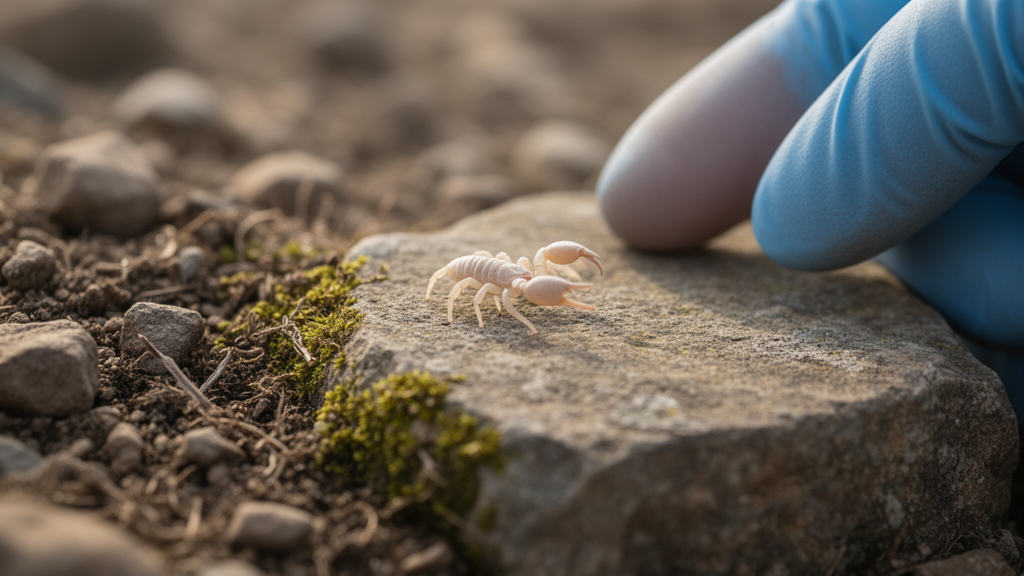
In a quiet canyon in the Armenian highlands, a creature barely larger than a grain of rice has rewritten the map of life in the Caucasus. A single male pseudoscorpion, plucked from sifted leaf litter near the town of Vedi in the Ararat region, has become the first representative of the family Atemnidae ever recorded in Armenia. The specimen, identified as Diplotemnus balcanicus (Redikorzev, 1928), was described in the journal Caucasiana, and its discovery pushes the country’s known pseudoscorpion fauna from sixteen species across five families to include an entirely new family for the national checklist.
Pseudoscorpions are among the most overlooked predators on Earth. These minute arachnids resemble tiny scorpions, complete with formidable pincer-like pedipalps, but they lack the characteristic tail and stinger. Instead, they carry their venom in a small apparatus housed within one of the fingers of their pincers, which they use to subdue springtails, mites, and other micro-arthropods. Despite their global distribution and their role as regulators of soil-dwelling invertebrate communities, pseudoscorpions remain chronically understudied in many regions, and Armenia is a prime example of this research gap.
Until this discovery, the most recent accounting of Armenia’s pseudoscorpion fauna, drawn from the World Pseudoscorpion Catalogue, listed just sixteen species belonging to five families: Cheliferidae, Chernetidae, Neobisiidae, Chthoniidae, and Olpiidae. The foundational works on the pseudoscorpions of the South Caucasus, covering Armenia together with Azerbaijan and Georgia, were published by Schawaller and Dashdamirov in 1988 and by Dashdamirov and Schawaller in 1992, but little has been added since. The scarcity of research and the small number of recorded taxa indicate that the pseudoscorpion fauna of this country is still very poorly studied, making every new record biologically significant.
The specimen that changed the picture was collected on 14 May 2022 by Dr. Jonas Astrin as part of the Caucasus Barcode of Life (CaBOL) project, an initiative dedicated to cataloguing the biodiversity of the Caucasus region through DNA barcoding. The animal was found by sifting leaf litter at Angel’s Canyon, near the town of Vedi, at an altitude of 1025 meters above sea level in the Ararat valley, and was extracted from the debris using a Wikler funnel extractor, a standard tool for teasing small arthropods out of soil samples.
Back in the laboratory, the specimen underwent a careful morphological workup. It was cleared in lactic acid, examined as a temporary slide preparation under stereo and light compound microscopes, rinsed in distilled water, and finally preserved in 70 percent ethanol. Measurements and photographs were acquired through Capta Vision software, and the animal is now deposited at the LIB Biobank at Museum Koenig in Germany. Identification was based on key taxonomic references, including Beier (1932), Novák and Harvey (2015), and Krajčovičová and colleagues (2021).
The morphological evidence is rich in technical detail. The carapace of the Armenian specimen is 1.37 times longer than wide, strongly granulated, and bears two transverse furrows, with two pairs of eyes and a single pair of preocular setae. The chelicera, the mouthpart structure, is 2.02 times longer than broad and carries five setae on the hand, with a serrula exterior of 18 blades. The pedipalps are robust and strongly granulated, dark reddish-brown in contrast to the yellowish-brown carapace and tergites, with the femur 2.91 times, the patella 2.06 times, and the chela 2.55 times longer than broad. The fixed chelal finger carries thirty-two cusped teeth, and the movable finger, which is shorter than the hand without its pedicel, carries thirty-two as well. The venom apparatus is present only in the fixed finger, a diagnostic feature of the genus.
Leg morphology provided further confirmation. On leg I, the tarsus is 5.08 times longer than broad, while on leg IV the femoropatella is 3.13 times, the tibia 4.11 times, and the tarsus 3.97 times longer than broad. Critically, the right leg IV bears a submedial tactile seta on the tarsus, positioned somewhat proximal to the middle of the article. This placement is a key character separating Diplotemnus from the closely related genus Atemnus, in which the corresponding trichobothrium sits near the base of the article. The total body length of the specimen is 3.27 millimeters, with the carapace measuring 1.09 by 0.80 millimeters.
Distinguishing the Armenian specimen from its closest relatives required careful comparison. Diplotemnus balcanicus differs from D. pieperi, which has three preocular setae, by having only one, and from the larger D. egregius by its markedly smaller pedipalpal femur and patella measurements. The Armenian individual is also smaller than a Slovakian specimen rediscovered in 2019, with a body length of 3.27 millimeters versus 3.75 millimeters and a palpal femur of 0.89 versus 1.25 millimeters. The authors attribute this difference to geographical distance and intraspecific variation. Notably, the recently synonymized Diplotemnus lindbergi from Afghanistan is the closest to the Armenian specimen in body measurements, with a holotype body length of 3.5 millimeters.
The family Atemnidae currently comprises 21 genera and 190 species worldwide, and the genus Diplotemnus, found across Asia, Africa, and Europe, includes nine known species, of which only D. balcanicus occurs in the Caucasus region apart from Georgia. In neighboring countries, two other atemnids are known: Atemnus politus from Azerbaijan, Georgia, Iran, and Turkey, and A. syriacus from Turkey. The taxonomic status of D. balcanicus was recently clarified by Novák and Harvey in 2015, who synonymized several taxa with it, including Diplotemnus insolitus, D. insolitus sinensis, D. vachoni, and Withius soderbomi, reflecting the species’ broad distribution and high morphological variability.
The discovery is more than a checklist update. Given the enormous distribution area of D. balcanicus, stretching across Europe, Asia, and North Africa, and the high degree of morphological variation observed across its range, the authors argue that molecular genetic methods are now necessary to improve taxonomic understanding and reveal possible cryptic diversity hidden within this seemingly widespread species. The Armenian specimen, smaller than many of its European counterparts, adds valuable new information on the dimensional variation of the species and underscores how much remains to be learned about the pseudoscorpion fauna of the Caucasus, one of the world’s great biodiversity hotspots.
Subject of Research: First record of the family Atemnidae (Pseudoscorpiones) from Armenia
Article Title: First record of the family Atemnidae ( Pseudoscorpiones ) from Armenia
Article References: Gogshelidze, M., & Novák, J. (2024). First record of the family Atemnidae (Pseudoscorpiones) from Armenia. Caucasiana, 3, 257-262. https://doi.org/10.3897/caucasiana.3.e137446
Image Credits: AI Generated
DOI: 10.3897/caucasiana.3.e137446
Keywords: pseudoscorpions, Armenia, biodiversity, taxonomy, CaBOL, Atemnidae, Diplotemnus balcanicus, Caucasus, First, record, family, Pseudoscorpiones
Cite Scienmag News
Margaret Porter. (October 17, 2026). Tiny Predator Makes History: First Atemnid Pseudoscorpion Found in Armenia. Scienmag. https://scienmag.com/tiny-predator-makes-history-first-atemnid-pseudoscorpion-found-in-armenia/
Margaret Porter. "Tiny Predator Makes History: First Atemnid Pseudoscorpion Found in Armenia." Scienmag, 17 October 2026, https://scienmag.com/tiny-predator-makes-history-first-atemnid-pseudoscorpion-found-in-armenia/. Accessed 17 October 2026.
Margaret Porter. "Tiny Predator Makes History: First Atemnid Pseudoscorpion Found in Armenia." Scienmag. October 17, 2026. https://scienmag.com/tiny-predator-makes-history-first-atemnid-pseudoscorpion-found-in-armenia/


