


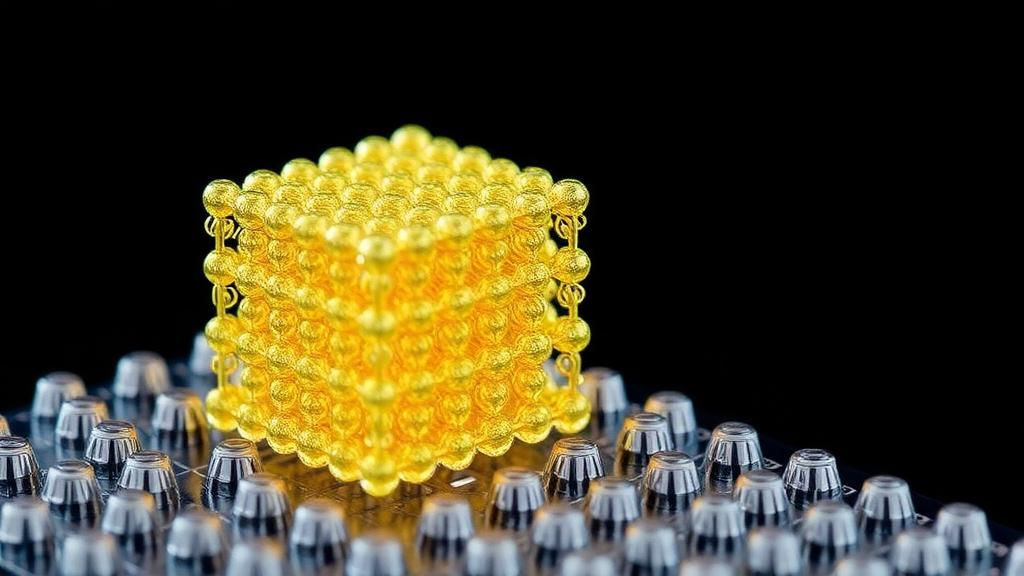
Lithium-ion batteries have quietly become the workhorses of modern civilization, powering everything from smartphones to electric vehicles, yet their performance limits are often decided at a scale invisible to the human eye. Inside every electrode lies a dense, disordered landscape of active material particles, and the way those particles are sized and arranged can determine whether a battery delivers brisk power or sluggish energy. A new study published in the journal Ionics by Biyao Wu, Jian-Chun Wu, and colleagues at Jiangsu University in China now offers one of the most detailed computational pictures yet of how particle size and its distribution govern the electrochemical behavior of battery electrodes, and the findings point toward a surprisingly precise recipe for designing high-power cells.
The research team constructed three-dimensional heterogeneous composite electrode models in which the active particles were represented as ellipsoids rather than the idealized spheres used in most classical battery theory. This choice matters, because real electrode particles are rarely perfect spheres, and their aspherical shapes can create nonuniform lithium intercalation patterns that simpler models miss entirely. Using a graphite–lithium iron phosphate system as a representative platform, the researchers simulated the discharge process under different microstructural scenarios, comparing electrodes built from particles of a single uniform size, known as monodisperse systems, with electrodes containing a mixture of small and large particles, known as bidisperse systems.
The simulations, which coupled the physics of ion transport in the electrolyte, electronic conduction, and solid-state diffusion within the particles, yielded a clear hierarchy of effects. The dominant factor controlling overall electrochemical performance turned out to be solid-phase diffusion limitation, the sluggishness with which lithium ions move inside the active material itself. This limitation becomes especially punishing in electrodes built from large particles, where lithium must travel farther to reach or leave the interior of each grain. In practical terms, a battery electrode crowded with oversized particles simply cannot keep up when the cell is asked to discharge rapidly, because the inner volume of each particle remains electrochemically stranded.
Perhaps the most striking insight from the work concerns the division of labor inside polydisperse electrodes, those containing a range of particle sizes. The simulations revealed that small particles dominate the initial stage of discharge, shouldering most of the electrochemical reaction while the cell is fresh and concentration gradients are shallow. As discharge proceeds, however, the large particles become increasingly active, gradually taking over the workload as the small particles approach their capacity limits. This temporal handoff between particle populations had been hypothesized before, but the new three-dimensional models quantify it with a clarity that earlier pseudo-two-dimensional approaches, which average away much of the microstructural detail, could not achieve.
The researchers went further, showing that the presence of small particles does more than simply add extra reactive surface area. Incorporating them actively modulates both the transport resistance through the porous electrode and the reaction kinetics at particle surfaces, thereby altering the entire pattern of mass transport during discharge. In other words, the microstructure does not merely scale performance up or down; it reshapes the way current and lithium flow through the electrode as a whole. This mechanistic understanding is precisely what electrode designers need, because it transforms particle size distribution from a manufacturing afterthought into a deliberate engineering lever.
One of the study’s most counterintuitive findings is that the relationship between the fraction of small particles and discharge capacity is not monotonic. Adding small particles initially boosts capacity, as their short diffusion paths and abundant surface area accelerate reaction kinetics. But beyond a certain point, further increases in the small-particle fraction cause capacity to decline again, likely because an excess of fine particles congests the pore network and impedes electrolyte transport through the electrode. The result is a curve that first rises and then falls, meaning there is a genuine optimum rather than a simple rule of thumb that more small particles are always better.
That optimum, the team reports, corresponds to a total volume fraction of 57.4 percent for the bidisperse system they studied. At this composition, the electrode achieves the best balance between kinetic enhancement, delivered by the small particles, and transport efficiency through the available pore space. This kind of quantitative design target is rare in battery microstructure research, where guidance often remains qualitative. For manufacturers, a number like this offers a concrete starting point for tuning slurry formulations and calendering processes, the industrial steps that ultimately fix the particle arrangement inside a commercial electrode.
The study focuses on thin-electrode configurations, and the authors are careful to frame their conclusions within that context. Thin electrodes, in which ions face relatively short tortuous paths through the porous matrix, are increasingly relevant for high-power applications where rate capability matters more than maximum energy density. The finding that solid-phase diffusion is the governing bottleneck in such geometries clarifies which design strategies are worth pursuing: reducing particle size or blending size classes attacks the true limiting step, whereas efforts focused solely on improving electrolyte-phase transport may yield diminishing returns in thin electrodes.
The work also sits within a broader movement in battery science toward microstructure-resolved modeling. Traditional pseudo-two-dimensional models, descended from the framework developed by John Newman and colleagues decades ago, treat electrodes as homogeneous continua and represent particles with averaged radii. While computationally efficient, such models can obscure the heterogeneity that modern imaging techniques, from X-ray nano-computed tomography to scanning electrochemical microscopy, have revealed inside real electrodes. By building fully three-dimensional heterogeneous models with realistic ellipsoidal particle shapes and explicit size distributions, the Jiangsu University team bridges the gap between what microscopes actually see and what simulations can predict.
The implications extend beyond the graphite–lithium iron phosphate chemistry used as the test platform. Because the governing physics of solid-state diffusion, interfacial reaction kinetics, and porous transport applies broadly across intercalation materials, the design principles extracted here, including the non-monotonic capacity trend and the existence of an optimal bidisperse composition, provide a theoretical foundation that can be adapted to other chemistries and electrode architectures. As demand grows for batteries that can charge in minutes and deliver high power without sacrificing longevity, studies like this one demonstrate that some of the most valuable improvements may come not from new chemistry, but from arranging familiar materials with new precision, one particle at a time.
Subject of Research: 3D multiphysics modeling of particle size distribution effects on lithium-ion battery electrode performance
Article Title: 3D multiphysics modeling and optimization of li-ion battery electrodes: effects of particle size and distribution
Article References: Wu, B., Wu, J.-C., Zhou, H., Gao, H., Deng, Y., Wang, T., Lan, H., & Wang, N. (2026). 3D multiphysics modeling and optimization of li-ion battery electrodes: effects of particle size and distribution. Ionics. https://doi.org/10.1007/s11581-026-07556-2
Image Credits: AI Generated
DOI: 10.1007/s11581-026-07556-2
Keywords: lithium-ion batteries, electrode microstructure, particle size distribution, 3D modeling, multiphysics simulation, solid-phase diffusion, graphite anode, lithium iron phosphate, rate capability, discharge capacity, bidisperse electrodes, electrochemical optimization
Cite Scienmag News
Faith Mcneil. (October 6, 2026). Tiny Particles, Big Power: 3D Models Reveal How Electrode Microstructure Shapes Battery Performance. Scienmag. https://scienmag.com/tiny-particles-big-power-3d-models-reveal-how-electrode-microstructure-shapes-battery-performance/
Faith Mcneil. "Tiny Particles, Big Power: 3D Models Reveal How Electrode Microstructure Shapes Battery Performance." Scienmag, 6 October 2026, https://scienmag.com/tiny-particles-big-power-3d-models-reveal-how-electrode-microstructure-shapes-battery-performance/. Accessed 6 October 2026.
Faith Mcneil. "Tiny Particles, Big Power: 3D Models Reveal How Electrode Microstructure Shapes Battery Performance." Scienmag. October 6, 2026. https://scienmag.com/tiny-particles-big-power-3d-models-reveal-how-electrode-microstructure-shapes-battery-performance/


