


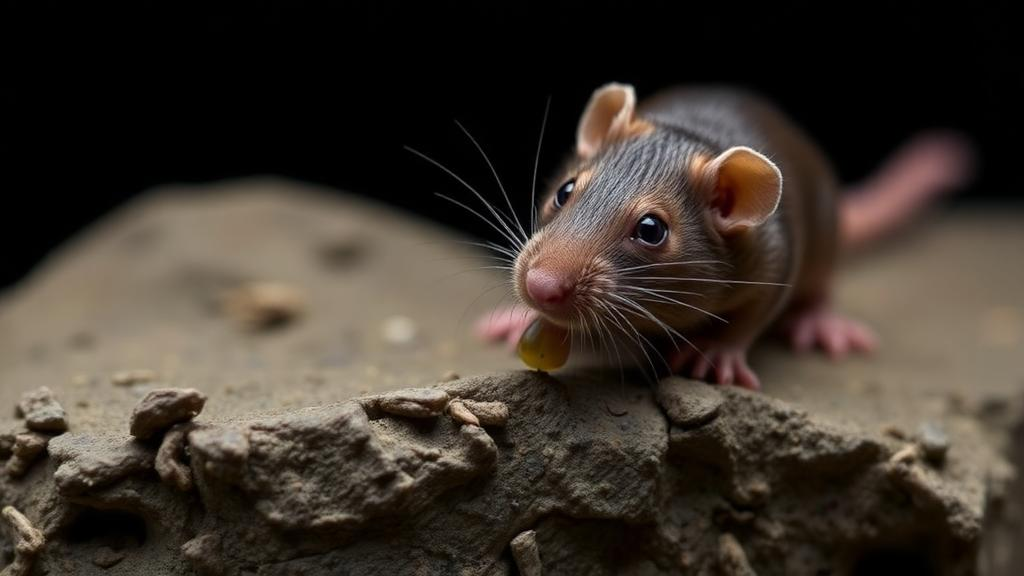
A subtle seam in the enamel of a fossil rodent’s front tooth has forced paleontologists to carve a new genus out of one of the most widely assigned names in Eurasian mammal paleontology. The tiny molars and incisors, recovered by screen washing Oligocene sediments in Anatolia and the Balkans, belong to rodents that had long been labelled Eucricetodon, a catch-all muroid genus established more than half a century ago. A new study argues that these eastern species carry a fundamentally different evolutionary signature from their European namesakes, and it formally names them Dekamyarion, a genus whose teeth mark it as the oldest known representative of the family Spalacidae, the group that today includes the blind mole rats, bamboo rats and zokors.
The key evidence lies not in the chewing surfaces of the molars, which in these early muroids form a confusing mosaic of subtle features with no clear directional trend, but in the three dimensional microstructure of the lower incisor enamel, known in the literature as the schmelzmuster. Because rodents grow continuously growing incisors with enamel organised in repeating prismatic patterns, the internal arrangement of these prisms varies systematically between lineages. Decades of work have shown that this microstructure is phylogenetically informative, essentially a barcode written into the tooth itself. Eleven principal types have been distinguished, and the study focuses on two of them: K4, found in the European Eucricetodon, and K10, found in the Anatolian species. The two patterns are equally derived but entirely different, indicating that the European and eastern rodent populations followed geographically separated evolutionary trajectories rather than forming a single widespread genus.
The reclassification matters because it anchors the origin of an entire mammal family in deep time. K10 enamel is characteristic of the Spalacidae, a family whose living members are highly specialised burrowers spread across Eurasia and Africa. Molecular studies estimate that the spalacids split from other muroids around 34.5 million years ago in the Late Eocene, and that the three extant subfamilies, the Spalacinae, Rhizomyinae and Myospalacinae, diverged from one another in the Late Oligocene. The oldest fossil carrying the K10 signature is a species from Yeniköy in the Sivas basin of Anatolia, now placed in Dekamyarion, whose age is estimated at about 29 million years and supported by magnetostratigraphy. That makes the new genus not merely another entry in the taxonomic catalogue but the earliest known branch of a family whose descendants still tunnel beneath fields from the Balkans to East Asia.
The geographic setting is as important as the teeth themselves. The study recognises four Late Eocene and Oligocene biogeographic provinces within Eurasia: Western Europe, West and Central Asia, South Asia, and the Balkan–Anatolian province. This last region, a neck of land formed by terranes now incorporated into Iran, Anatolia and the Balkans, emerged during the Eocene and progressively separated the Paratethys Sea from the Mediterranean Tethys. Deep Alpine foreland basins kept it effectively isolated from Western Europe, while connections southward and eastward tied it to Asia. Earlier in the Middle Eocene, the same region hosted a highly endemic island fauna on the Pontide terrane, complete with African-type embrithopods, European Paleocene relicts, stem marsupials and even a primate. That insular world ended around 41 million years ago when Asiatic mammals flooded in across new land connections.
What followed was a rodent world split by seaways. Late Eocene and Oligocene assemblages of the Balkan–Anatolian province are dominated by muroids of apparent South Asian origin, accompanied by dipodids, diatomyids and baluchimyids. Western Europe, by contrast, retained its endemic theridomorphs and glirids until the famous Grande Coupure, the major faunal turnover at the Eocene–Oligocene transition roughly 33.7 million years ago, when Asian mammals poured in. Crucially, those muroids did not arrive through the Balkans. The disappearance of the Turgai Strait barrier around 37 million years ago, combined with falling sea levels, opened a northern route into Europe. The southern route through Balkan–Anatolia carried a different cast: South Asian ruminants such as Iberomeryx and Bachitherium reached Western Europe via this corridor later, around 31 million years ago, and muroid exchange between the two provinces remained limited throughout the Oligocene.
Against this paleogeographic backdrop, the fate of Eucricetodon becomes intelligible. Established in 1966 as a provisional grouping for species that fit awkwardly elsewhere, the genus grew to include more than forty species stretching from the Isle of Wight to the Indian subcontinent. The type species and its closest European relatives, the collatus and dubius groups, possess K4 incisors. But the Anatolian species from Gözükızıllı and Yeniköy, and a growing list of so-called Eucricetodon from Kazakhstan, Mongolia and northern China, show the longitudinal ridges and underlying syncline of the K10 pattern instead. The new genus Dekamyarion, named for the Greek word for ten, now holds the Anatolian species, including material from Ugljevik in Bosnia and the Thrace basin, while the Asiatic species are also excluded from the European genus, likely destined for reassignment of their own.
Molar morphology alone had disguised this split. Dekamyarion’s teeth carry high, well-developed cusps and low ridges, with a divided anterocone on the first upper molar and low ectolophs on the first two upper molars, features that overlap with those of Atavocricetodon and Eucricetodon. The study’s authors had already recognised this hazard: fossil assemblages often yield broken, isolated incisors that researchers assume cannot be matched to molars, so incisor evidence is routinely ignored. Yet in assemblages with few competing taxa, incisors and molars can be paired with reasonable confidence, and comparisons across multiple assemblages can resolve remaining ambiguities. Once incisor structure was treated as a primary character rather than an afterthought, the genus boundaries snapped into focus.
The K10 signature also untangles a transcontinental mystery. North American Oligocene and Miocene rodents of the tribe Leidymini, such as Leidymys and Paciculus, were long thought to have acquired their K10 enamel independently, because their supposed Eurasian ancestor Eucricetodon clearly had K4 incisors. With Asiatic Eucricetodon now shown to carry K10, the American pattern is revealed as an inheritance: these rodents descend from Asian forebears that crossed the Bering land bridge. Similarly, Miocene Deperetomys from Oregon shows a central incisor ridge consistent with K10, extending the family’s reach into western North America.
The wider spalacid family tree comes into view as well. By the Late Oligocene, at least thirteen muroid genera displayed K10 incisors, a radiation coinciding with the molecularly inferred divergence of the three living subfamilies. Some extinct genera can be attached to specific lineages: the Balkan genera Heramys, Vetusspalax, Pannoniamys and Debruijnia belong to the Spalacinae, whose modern representative Spalax carries a slightly more derived K11 pattern; the immense subfamily Cricetodontinae, with an estimated thirty species of Cricetodon alone, probably includes the ancestors of the zokors, whose molars transformed from low-crowned bunodont teeth to high-crowned, flat-wearing lophodont grinders over the Miocene. Others, including Dekamyarion, Meteamys, Enginia and Muhsinia, belong to the family’s stem group, extinct branches that radiated early and left no living descendants.
Even the enigmatic K2 incisors of the Asian bamboo rats Rhizomys and Cannomys find an explanation. Given their molecular relationship to the African root-rat Tachyoryctes, whose lineage retains K10, the bamboo rats’ transversely oriented Hunter–Schreger bands must have rotated ninety degrees at some point after the rhizomyines’ initial dispersal to Africa around 18 million years ago. The new study thus weaves enamel microstructure, molecular clocks and plate tectonic history into a single narrative: a Late Eocene origin, an Oligocene radiation centred on the Balkan–Anatolian and Asian provinces, and waves of dispersal through Beringia, Africa and Europe. What began as broken incisors overlooked in screen-washed sediment samples has ended up rewriting the deep history of one of the Old World’s most successful burrowing rodent lineages.
Subject of Research: Oligocene origin and biogeographic dispersal of spalacid rodents based on a new genus from the Balkan–Anatolian province
Article Title: A new Oligocene genus of the Spalacidae ( Rodentia ) from the Balkan–Anatolian biogeographic province: spalacid relationships and their dispersal through time
Article References: van de Weerd, A. A., & Wessels, W. (2026). A new Oligocene genus of the Spalacidae (Rodentia) from the Balkan–Anatolian biogeographic province: spalacid relationships and their dispersal through time. Zitteliana, 100, 93-116. https://doi.org/10.3897/zitteliana.100.191308
Image Credits: AI Generated
DOI: 10.3897/zitteliana.100.191308
Keywords: Spalacidae, Dekamyarion, Oligocene, rodents, biogeography, incisor enamel microstructure, Anatolia, Balkans, Eucricetodon, paleontology, muroidea, Grande Coupure
Cite Scienmag News
Gavin Prescott. (October 15, 2026). Tiny fossil teeth rewrite the story of how blind mole rats conquered the Old World. Scienmag. https://scienmag.com/tiny-fossil-teeth-rewrite-the-story-of-how-blind-mole-rats-conquered-the-old-world/
Gavin Prescott. "Tiny fossil teeth rewrite the story of how blind mole rats conquered the Old World." Scienmag, 15 October 2026, https://scienmag.com/tiny-fossil-teeth-rewrite-the-story-of-how-blind-mole-rats-conquered-the-old-world/. Accessed 15 October 2026.
Gavin Prescott. "Tiny fossil teeth rewrite the story of how blind mole rats conquered the Old World." Scienmag. October 15, 2026. https://scienmag.com/tiny-fossil-teeth-rewrite-the-story-of-how-blind-mole-rats-conquered-the-old-world/


