


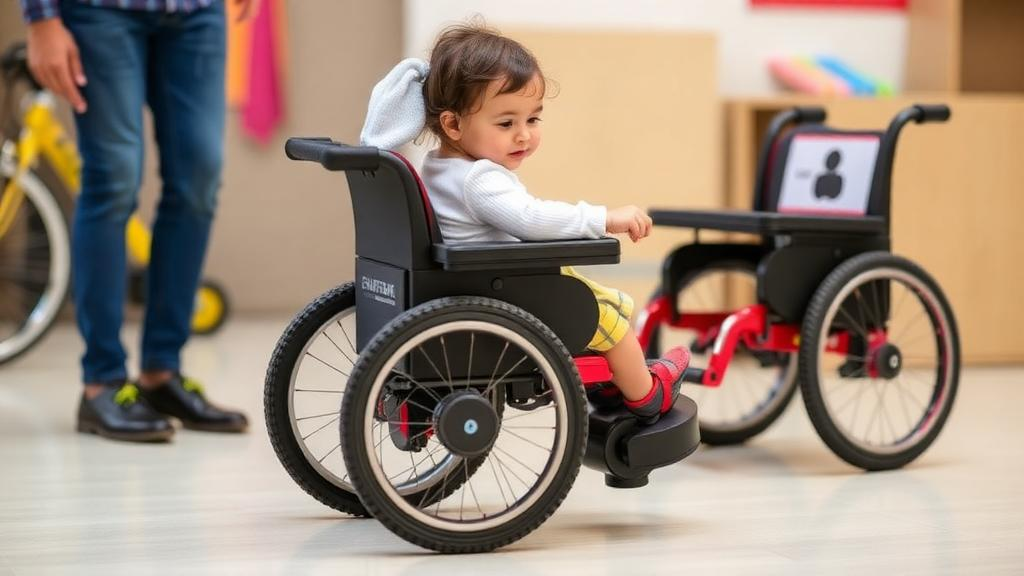
For most children, the world opens up somewhere between seven and fifteen months of age, when crawling gives way to those first wobbly steps. Independent movement is not merely a milestone; it is the engine of early development, the mechanism through which toddlers explore objects, test social boundaries, and discover that their actions can change the world around them. Children with complex disabilities are frequently denied this engine. Unable to move on their own, they risk sliding into what researchers call learned helplessness, a passive dependence in which the child stops trying to reach, explore, and initiate, because experience has taught them that nothing they do changes their circumstances. A new Norwegian study now offers a detailed, ground-level account of what happens when clinicians try to break that cycle by handing toddlers something radical: a powered wheelchair.
The research, published in the Scandinavian Journal of Occupational Therapy, explored the experiences of occupational therapists who introduce electric wheelchairs to children under three years of age. Åshild Meinich-Bache Vassbø and Gry Mørk conducted three focus groups with ten municipal occupational therapists drawn from ten different municipalities across two Norwegian counties, ranging from rural districts to urban centers. The researchers analyzed the discussions using systematic text condensation, a qualitative method developed by Kirsti Malterud that moves through four stages, from an open first reading of the material to the final synthesis of themes and concepts. The team began with two focus groups, found strong overlap in the accounts but enough divergent nuance to justify a third session, and reached data saturation with that final group. The result is one of the first Norwegian studies to document how early powered mobility actually plays out in municipal health services.
The study arrives amid a quiet paradigm shift in pediatric rehabilitation. For decades, the electric wheelchair was treated as a last resort, prescribed only to older children after every other mobility option had been exhausted. That logic reflected a deep cultural commitment to walking as the gold standard of childhood movement. Today, a growing body of evidence reframes powered mobility as a therapeutic tool in its own right, one that can support cognitive, visual-perceptual, and language development while opening up social worlds that would otherwise remain closed. A scoping review by Livingstone and Paleg, cited in the study, found that powered mobility can enable independent movement for children as young as twelve months, and found no evidence that early use interferes with the later development of walking. Yet the older mindset persists. Studies consistently show that both parents and clinicians still hesitate, and the Norwegian therapists in this study encountered that hesitation at nearly every turn.
From their analysis, the researchers distilled five themes, which cluster into two overarching findings. The first three themes describe implementation as a genuinely complex process shaped by the child, the family, and the environment. The final two themes capture what powered mobility actually delivers: greater self-determination and new social roles for the child, and expanded participation in play. The interplay is recursive, the authors note. More mobility fosters self-determination, self-determination deepens participation, and richer participation in turn strengthens the child’s sense of agency.
On the question of which children should even be assessed for a powered wheelchair, the therapists had no definitive answer, and that uncertainty is itself informative. Diagnoses and prognoses in infancy are often unclear, and functions such as cognition, language, and vision are typically not formally assessed at such a young age. What emerged instead was a hierarchy of practical signals. Cognition was described as the single most important prerequisite, outweighing chronological age, because some children mastered joystick control after brief exposure while others needed extensive training and support. Motor skills mattered too: operating a joystick demands a baseline of hand function, postural control, and head control. But the most telling indicator was the child’s own drive, the visible urge to move and the curiosity to seek out other people. The therapists also wrestled with harder cases, including children with muscular diseases, where the trade-off between preserving walking ability and conserving energy for participation required careful, individualized judgment.
The family theme revealed the emotional terrain on which these decisions are made. Some parents welcomed the idea of a powered wheelchair; others were skeptical or openly resistant. For many families, the device would be the child’s first piece of assistive technology, a moment that makes the disability unmistakably visible. Some parents described the wheelchair, in the therapists’ accounts, as a symbol of lost dreams. Others feared that early powered mobility would undermine the child’s chances of learning to walk, a concern the therapists worked hard to reframe: powered mobility is a supplement, not an either-or choice, and it does not replace existing interventions. Parents in the midst of grief over a new life situation sometimes wanted to postpone any assistive device for as long as possible, holding on to the hope that their child would eventually walk. The therapists emphasized giving families time to process, while ensuring that postponement remained an informed decision rather than one driven by unprocessed loss. Practical family circumstances, from kindergarten transitions to housing suitability, also shaped whether implementation could succeed.
Environment proved to be the third pillar, and in many ways the most stubborn. The therapists identified parents, kindergarten staff, and user-controlled personal assistants as essential collaborators, since it is these adults who run the daily practice sessions even though the occupational therapist holds overall training responsibility. Attitudes were decisive. If the adults around the child were not engaged, the child’s opportunities shrank accordingly; skepticism about electronics and fears that a toddler might harm themselves or others were recurring obstacles. Young children also lead crowded therapeutic lives, packed with gait training, standing frames, stretching, and communication work, so a shared prioritization across professions, particularly with physiotherapists, was described as a key prerequisite. Physical barriers compounded the social ones. Homes and kindergartens often lacked adaptations, storage space, or charging options, and the absence of universal design repeatedly surfaced as the reason a child could not join playground games or field trips. As one therapist put it, the wheelchair itself was not the obstacle, but rather the choice of destination or the design of the playground.
Against those difficulties, the benefits the therapists reported were striking. Self-determination sat at the center: the ability to move toward a desired toy, seek out a friend, or, in one of the study’s most memorable observations, simply hide behind something safe, as toddlers everywhere love to do. Children who had always been pushed and positioned by adults could, for the first time, approach their mother for comfort on their own initiative or withdraw from a play activity they did not want. New roles followed. Peers began initiating play more often, drawn in by what one therapist called the coolness factor of a child with an exciting vehicle. The therapists stressed that children must be allowed to be children, including the freedom to be mischievous, to drive away when they please, and to express emotions through movement. These transformations, the participants noted, evoked happiness and hope in the parents themselves.
Participation in play expanded in concrete, measurable-feeling ways. The optimal moment for introducing powered mobility, the therapists found, was when peers began moving upright, because a seated toddler gains eye-level contact with running two-year-olds instead of watching the action from the floor. Children could independently reach the sandbox, join field trips, and take part in games of tag, peek-a-boo, and red light-green light that had previously been inaccessible. Play became less adult-directed and more exploratory. The therapists linked this expanded participation to gains in cognitive, communicative, and social development, echoing the F-words framework for childhood disability, which emphasizes Functioning, Family, Fitness, Fun, Friends, and Future over fixing the child. The findings also align with the ON Time Mobility framework, which frames mobility as a children’s rights issue grounded in Article 20 of the Convention on the Rights of Persons with Disabilities.
The study’s authors conclude that powered mobility for children under three is a complex process requiring careful attention to the child’s capabilities, the family’s emotional standpoint, and the surrounding environment, and that success depends on fostering supportive social settings while adapting physical spaces to enable self-initiated exploration. As the first Norwegian study of its kind, it carries clear implications: therapists must time introductions well, tailor training to each child’s developmental level, and ensure that children with severe impairments are not excluded from consideration. The deeper message resonates beyond rehabilitation science. When a two-year-old can drive to the sandbox, hide behind a bush, or steer away from a game they dislike, mobility stops being a medical question and becomes what it always was for every other child, a fundamental expression of personality, autonomy, and the right to belong.
Subject of Research: Early powered mobility intervention for children under three years of age with disabilities
Article Title: Children’s opportunities and rights for mobility and participation: Occupational therapists’ experiences with paediatric powered mobility
Article References: Vassbø, Å. M.-B., & Mørk, G. (2025). Children’s opportunities and rights for mobility and participation: Occupational therapists’ experiences with paediatric powered mobility. Scandinavian Journal of Occupational Therapy, 32(1), Article 2520863. https://doi.org/10.1080/11038128.2025.2520863
Image Credits: AI Generated
DOI: 10.1080/11038128.2025.2520863
Keywords: powered mobility, pediatric rehabilitation, occupational therapy, electric wheelchairs, early intervention, child development, disability rights, participation, occupational justice, assistive technology, learned helplessness, Norway
Cite Scienmag News
Ophelia Keating. (October 3, 2026). Tiny Electric Wheelchairs Transform Play and Independence for Toddlers With Disabilities. Scienmag. https://scienmag.com/tiny-electric-wheelchairs-transform-play-and-independence-for-toddlers-with-disabilities/
Ophelia Keating. "Tiny Electric Wheelchairs Transform Play and Independence for Toddlers With Disabilities." Scienmag, 3 October 2026, https://scienmag.com/tiny-electric-wheelchairs-transform-play-and-independence-for-toddlers-with-disabilities/. Accessed 4 October 2026.
Ophelia Keating. "Tiny Electric Wheelchairs Transform Play and Independence for Toddlers With Disabilities." Scienmag. October 3, 2026. https://scienmag.com/tiny-electric-wheelchairs-transform-play-and-independence-for-toddlers-with-disabilities/


