


Turbine blades, boiler headers, and steam pipes live brutal lives. They sit for tens of thousands of hours at temperatures exceeding 600 degrees Celsius in ferritic steels and 800 degrees Celsius in nickel-based superalloys, all while carrying mechanical loads that slowly, inexorably stretch their microstructure. The result is creep: a time-dependent deformation that quietly accumulates until, in the worst cases, it triggers catastrophic fracture. Unplanned outages driven by creep damage can cost power plant operators millions of dollars per day, which is why engineers have long sought reliable ways to assess how much safe life remains in these safety-critical components. The problem is that measuring creep traditionally requires standard-sized test coupons, and you cannot slice large chunks out of an operating turbine blade without destroying it.
That constraint has fueled the rise of miniature specimen testing, a family of techniques that extract creep data from tiny slivers of material harvested by non-destructive methods such as scoop sampling or in-situ trepanning. The real power of the approach lies in targeted sampling: instead of testing generic material, engineers can take specimens from the exact locations that have experienced actual service temperatures and stresses. Yet each established miniature technique carries a trade-off. Impression creep specimens have an equivalent gauge length of only about two millimeters, making them poorly suited to the low stress levels, often below 80 megapascals for 9 to 12 percent chromium steels at 600 to 650 degrees Celsius, that represent real operating conditions. Small punch tests can trace complete deformation-time curves, but the complex, multi-axial deformation they impose has prevented the emergence of a universally accepted data conversion method.
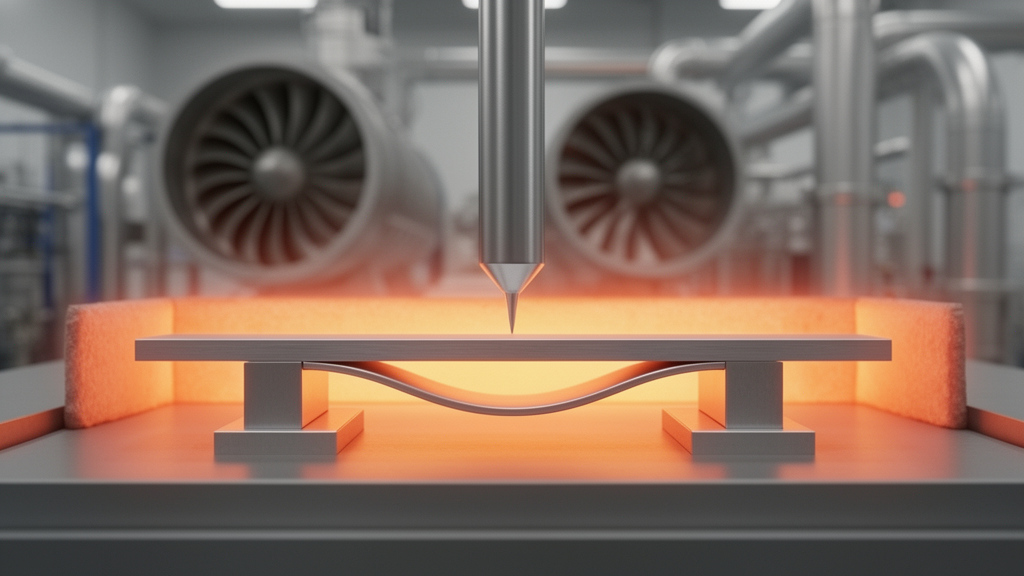
A new synthesis published in Results in Engineering argues that a class of bending-dominated miniature specimens deserves far more attention. Simply supported beams, fixed-end beams, cantilevers, and three-point bending plates share a crucial property: they are inherently flexible. Under load they undergo large, easily measurable deflections dominated by bending, which translates into a much larger equivalent gauge length than other miniature specimens of similar overall size. That gauge length is the fundamental key to sensitivity. A three-point bending specimen with an equivalent gauge length of roughly 8.6 millimeters produces nearly four times the displacement of an impression creep specimen of about 2.2 millimeters at the same equivalent strain, allowing accurate testing at low stresses where stiffer geometries would barely deform over practical test durations. The simple rectangular geometry is also easier to manufacture than rings or punch discs, and the pure bending mode permits closed-form analytical solutions grounded in classical beam theory.
The intellectual backbone of the framework is the reference stress method, pioneered by A. C. MacKenzie in 1968. The idea is elegantly simple: a complex structure creeping under load deforms at the same rate as a uniaxial specimen tested at a specific, constant reference stress. For a material obeying Norton’s power law, in which creep strain rate scales with stress raised to a power n, the steady-state displacement rate of a structure depends on both material constants and geometry. The reference stress method introduces a scaling factor that cleanly separates the two. Crucially, the reference stress depends only on the applied load and specimen geometry, not on the material’s creep properties, which makes the interpretation scheme transferable across steels, superalloys, and beyond.
Two dimensionless conversion parameters anchor the data reduction. The stress conversion factor eta relates the nominal stress of the bending specimen to the equivalent uniaxial reference stress, while the strain conversion factor beta, multiplied by a characteristic length, defines the equivalent gauge length: the length of a hypothetical uniaxial specimen that would experience the same strain as the measured displacement of the bending specimen. Both parameters are material-independent but geometry- and loading-mode-dependent, so once they are established for a given configuration they can be applied to any material tested with that geometry. For a simply supported three-point bending beam, eta is approximately 0.89, and a typical miniature specimen with a 10-millimeter span and 1.54-millimeter thickness yields an equivalent gauge length near 8.6 millimeters. Fixed-end and cantilever configurations follow the same mathematics with different moment distributions, while the three-point bending plate spans the continuum from plane stress in narrow beams to plane strain in wide plates, where the deformation rate drops by roughly a factor of three for a stress exponent of six. For intermediate width-to-span ratios, finite element analyses supplied piecewise polynomial correction functions with errors generally below one percent.
The derivations themselves rest on the complementary strain energy method, a classical technique that dates back nearly a century to MacCullough’s 1933 work on creep in bending and Popov’s later analyses. For a beam under pure bending, strain compatibility requires a linear strain distribution through the depth, and the bending moment relates to the curvature rate through a generalized moment of inertia that depends on the stress exponent. Castigliano’s second theorem then converts the total complementary strain energy into a load-line displacement rate, producing closed-form expressions for each configuration. The historical lineage runs through Kraus, Boyle and Spence, and more recently Altenbach and Naumenko’s creep-damage analyses of beams, plates, and shells, culminating in the present unified treatment.
Where the framework becomes genuinely forward-looking is in its extension beyond steady-state creep. By coupling the bending analysis with the Kachanov-Rabotnov continuum damage mechanics model, the method captures tertiary creep, the accelerating stage that precedes rupture. Damage accumulates through the beam cross-section, reducing the load-carrying capacity in a way that makes the governing equations nonlinearly coupled; no closed-form solution exists, but numerical implementation reproduces full deflection-time curves. Calibration against P91 steel data at 650 degrees Celsius, a material exhibiting insignificant primary creep, a clear secondary stage, and a long ductile tertiary stage with more than 20 percent strain to failure, showed that the analytical formulation accurately predicts center displacements across a range of loads when compared with finite element results. That opens the door to full creep curve characterization and rupture life assessment through inverse parameter identification from a single tiny beam.
The authors also confront the method’s limits honestly. Small-deformation assumptions underpin the conversion relationships, but under high loads and long durations specimens enter large-deformation regimes where regressed parameters can go badly wrong, producing artificial stress dependencies or incorrect activation energies. An error function based on the exact curvature expression defines a critical rotation angle of 14.37 degrees, corresponding to a 10 percent curvature error, and a finite-element-derived correction factor accounts for the transient stress redistribution from elastic to steady-state creep. Multi-layer systems such as coatings, thermal barrier layers, and weldments introduce further complexity: stress distributions become discontinuous at material interfaces and the neutral axis shifts from the geometric center as layers with different creep resistances redistribute load. Inverse procedures can nonetheless extract unknown layer properties, a capability that matters enormously where coating layers are orders of magnitude too thin for conventional uniaxial testing.
Experimental validation supports the approach for the configurations tested. Miniature three-point bending specimens of turbine rotor steel 23CrMoNiWV88, just 19.8 millimeters long and 1.54 millimeters thick, were tested at five load levels at 540 degrees Celsius on a custom-built system. When the measured displacement rates were converted through the reference stress framework, the resulting equivalent stress-strain rate data agreed well with conventional uniaxial creep tests on standard plate specimens, running slightly conservative. A comparative analysis across techniques, from small punch and impression creep to miniature rings and thin-plate tension, shows that bending tests occupy a sweet spot of material utilization, measurement sensitivity, and data-conversion capability, requiring only about 56 cubic millimeters of effective material while delivering both steady-state and rupture information. The authors close with a practical selection matrix and a research agenda: extending the reference stress framework to anisotropic single-crystal superalloys and additively manufactured materials, establishing minimum specimen dimensions against size effects, validating with tests of thousands of hours where oxidation becomes significant, and developing the test standards needed for industrial adoption. If those steps succeed, the humble bent beam may become the standard instrument for reading the remaining life of the machines that keep the lights on and the aircraft flying.
Subject of Research: Miniature bending-dominated creep testing methods for assessing remaining life of high-temperature components
Article Title: Bending-dominated miniature creep testing: A synthesis of theory and practice
Article References: Sun, W., Zhou, G.-Y., Li, M., Luo, R., Wen, Z., Yue, Z., & Tu, S.-T. (2026). Bending-dominated miniature creep testing: A synthesis of theory and practice. Results in Engineering, 32, Article 113468. https://doi.org/10.1016/j.rineng.2026.113468
Image Credits: AI Generated
DOI: 10.1016/j.rineng.2026.113468
Keywords: creep testing, miniature specimen testing, reference stress method, three-point bending, equivalent gauge length, Norton creep law, Kachanov-Rabotnov damage model, turbine blades, high-temperature materials, P91 steel, thermal barrier coatings, remaining life assessment
Cite Scienmag News
Denise Maddox. (October 14, 2026). Tiny Bending Beams Offer a Powerful New Way to Test Creep in Jet Engines and Power Plants. Scienmag. https://scienmag.com/tiny-bending-beams-offer-a-powerful-new-way-to-test-creep-in-jet-engines-and-power-plants/
Denise Maddox. "Tiny Bending Beams Offer a Powerful New Way to Test Creep in Jet Engines and Power Plants." Scienmag, 14 October 2026, https://scienmag.com/tiny-bending-beams-offer-a-powerful-new-way-to-test-creep-in-jet-engines-and-power-plants/. Accessed 14 October 2026.
Denise Maddox. "Tiny Bending Beams Offer a Powerful New Way to Test Creep in Jet Engines and Power Plants." Scienmag. October 14, 2026. https://scienmag.com/tiny-bending-beams-offer-a-powerful-new-way-to-test-creep-in-jet-engines-and-power-plants/


