


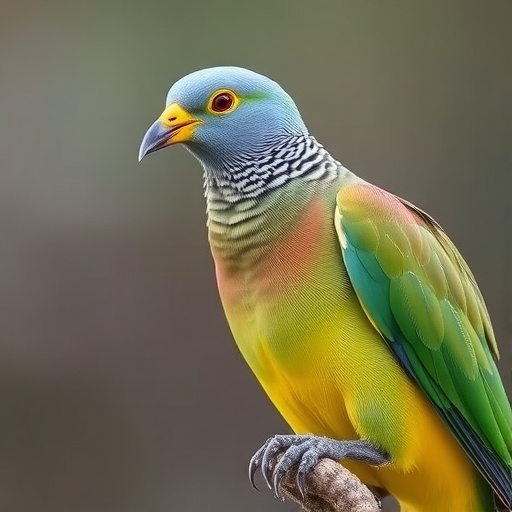
In the remote and biologically unique island of Timor, an urgent conservation crisis is unfolding as the Timor green pigeon (Treron psittaceus) faces a precipitous decline toward extinction. This vibrant fruit-eating bird, a striking shade of green reminiscent of ripening mangoes, is endemic to this region straddling eastern Indonesia and Timor-Leste. Despite its presence being historically noted in both territories, recent comprehensive field surveys captured by researchers from Charles Darwin University and BirdLife International reveal the species now teeters on the brink of disappearing entirely. The findings, published in the prestigious journal Oryx by Cambridge University Press, make a compelling case to up-list the Timor green pigeon from Endangered to Critically Endangered on the IUCN Red List—a change that would prioritize immediate protective measures.
The Timor green pigeon’s plight is a manifestation of compounded threats, chiefly hunting and habitat degradation. Over the past two decades, the number of individuals has plummeted, with contemporary field efforts estimating fewer than 500 birds remain within Timor-Leste’s boundaries, and populations in Indonesia considered functionally extinct. This stark reality clashes with the bird’s previous resilience, when sightings were relatively frequent in well-forested areas, such as Lautem district and adjacent islands including Rote and Semau. Early 21st-century observations described a bird that was detectable with moderate effort in primary forest habitats. However, the rapid loss of suitable habitat and persistent hunting pressures have dramatically reduced the distribution and population density of this species.
The extensive longitudinal study underpinning these conclusions involved over 1,400 days of dedicated fieldwork from 2002 to 2025, combining observational data gathered by ornithologists, local birdwatchers, and conservationists. The methodology incorporated a robust synthesis of historical records dating back to 1969 with contemporary sightings, yielding a dataset that highlights an alarming contraction of the pigeon’s range and a steep drop in the number of recorded individuals. Crucially, about 82% of the limited sightings occurred within protected zones, predominantly the Nino Konis Santana National Park in Timor-Leste. Despite the establishment of this protected area in 2008, enforcement shortcomings and continued hunting have undermined its ability to safeguard the pigeon’s habitat effectively.
Local cultural practices pose distinct conservation challenges. Hunting remains ingrained in regional traditions, complicating efforts to reduce human predation. Conservation biologist Jafet Potenzo Lopes, native to Lautem district and intimately familiar with the ecological and societal context, highlights the delicate balance between respecting cultural livelihoods and ensuring species survival. Encouraging behavioral change among hunters requires nuanced engagement strategies that transcend simple prohibition, incorporating education, incentive structures, and community-led stewardship that emphasize the intrinsic and ecological value of the Timor green pigeon.
Biogeographically, the island of Timor occupies a critical position within Wallacea, a transitional zone of high evolutionary significance where Asian and Australasian faunas intersect. This region supports remarkable levels of endemism, and the Timor green pigeon exemplifies the fragile biodiversity sustained here. Unfortunately, the broader avifauna of this family—Columbidae, comprising pigeons and doves—is among the most threatened globally, with species internationally imperiled by habitat loss, hunting, and invasive species. The precarious status of the Timor green pigeon thus serves as an urgent indicator for the health of Wallacea’s forest ecosystems.
In an ecological context, the Timor green pigeon functions as an important frugivore, contributing to seed dispersal and forest regeneration. The loss of this species could disrupt mutualistic plant-animal interactions integral to ecosystem functioning. Given the small estimated population ranging from 100 to 500 individuals, genetic diversity is likely severely constrained, further imperiling the species’ adaptability and long-term viability. Functional extinction in Indonesia converges with declining numbers in Timor-Leste to present a sobering conservation scenario.
Researchers argue that immediate, multi-faceted intervention is imperative to avert total species extinction. Dr. Colin Trainor, a leading figure in this long-term study, articulates the urgency: the survival prospects hinge on convincing a relatively small contingent of hunters in remote areas to alter their practices. Strategies might encompass community-based conservation programs offering alternative livelihoods and economic incentives alongside rigorous enforcement of hunting restrictions. The study underscores a rare window of opportunity; while populations are critically diminished, the species persists, presenting a chance for recovery if conservation is prioritized.
The urgency of elevating the Timor green pigeon’s threat status to Critically Endangered reflects not only scientific rigor but also a call to global conservation policymakers and local governance. The ineffectiveness of current measures—exemplified by continued decline despite national park designation—calls for reassessment of protected area management, community engagement, and resource allocation. BirdLife International and Conservation International stress that garnering international attention to Timor-Leste’s overlooked biodiversity importance is vital to catalyze systemic conservation support and funding.
Moreover, the case of the Timor green pigeon challenges broader ecological conservation paradigms by highlighting the tensions between cultural practices and species protection in biodiversity hotspots. This calls for interdisciplinary approaches integrating socio-economic understanding, ecological science, and participatory conservation frameworks tailored to local realities. In light of accelerating global biodiversity loss, the story of the Timor green pigeon resonates as a microcosm of challenges faced by endemic species worldwide.
The comprehensive dataset compiled over more than two decades serves not only as a grim record of decline but also as a foundation for informed conservation action. The open-access publication ensures transparency and accessibility, inviting collaboration and awareness from conservation scientists, policymakers, and the global public. The authors’ call to action is clear: without coordinated and immediate intervention, the island’s emblematic green pigeon risks vanishing forever, representing both a biological and cultural loss.
The critical conservation dilemma facing the Timor green pigeon spotlights the intersection of scientific discovery, cultural context, and urgent environmental stewardship. It exemplifies how long-term empirical research can inform and potentially transform conservation trajectories. As this colourful bird edges closer to extinction, it becomes a symbol of the fragile balance between humans and nature, and a clarion call for preserving biodiversity on the frontlines of ecological crisis.
News Publication Date: 5-May-2026
Web References:
http://dx.doi.org/10.1017/S0030605326102877
Cite Scienmag News
Margaret Porter. (May 5, 2026). Timor Green Pigeon Faces Imminent Extinction Without Immediate Conservation Efforts. Scienmag. https://scienmag.com/timor-green-pigeon-faces-imminent-extinction-without-immediate-conservation-efforts/
Margaret Porter. "Timor Green Pigeon Faces Imminent Extinction Without Immediate Conservation Efforts." Scienmag, 5 May 2026, https://scienmag.com/timor-green-pigeon-faces-imminent-extinction-without-immediate-conservation-efforts/. Accessed 4 September 2026.
Margaret Porter. "Timor Green Pigeon Faces Imminent Extinction Without Immediate Conservation Efforts." Scienmag. May 5, 2026. https://scienmag.com/timor-green-pigeon-faces-imminent-extinction-without-immediate-conservation-efforts/


