


Recent advancements in the study of plasmons have paved the way for groundbreaking insights into the behavior and characteristics of spin textures known as meron pairs. Plasmons, the collective oscillations of electrons in a solid, have long held significance in various applications including sensing, catalysis, and light harvesting. The study of surface plasmon polaritons, which are plasmonic waves traveling along metal surfaces, has captivated researchers due to their unparalleled ability to enhance electromagnetic fields. A colossal leap in our understanding of these phenomena has been achieved through the innovative application of time-resolved electron microscopy.
Time-resolved electron microscopy is a state-of-the-art technique that leverages ultrashort laser pulses to unveil the intricate dynamics of plasmonic waves as they evolve in real-time. Recently, an international team of researchers fundamentally altered the trajectory of plasmonics by introducing a method that employs multiple time-delayed laser pulses of varying polarizations. This technique enabled them to capture the complete electric field dynamics of the plasmonic waves, thereby achieving a remarkable level of precision previously thought unattainable. The implications are profound, because this method permits scientists to explore complex electromagnetic fields in a way that was not feasible before.
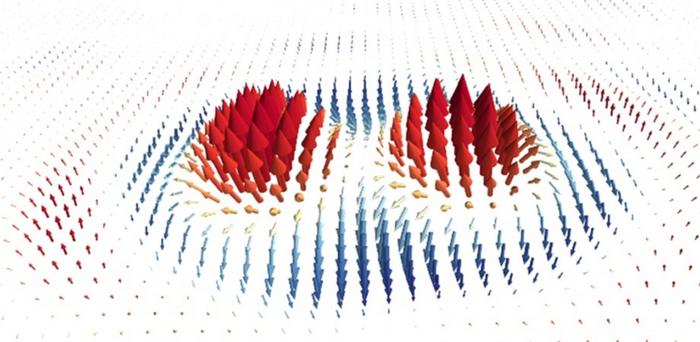
To validate their innovative approach, the team chose to investigate the specific spin texture referred to as a meron pair. A meron is a particularly fascinating topological structure, characterized by a unique spin configuration that only covers half of a sphere. This distinguishing feature sets merons apart from other similar structures, such as skyrmions, whose spin configurations encompass the entirety of a sphere. By unraveling the properties of meron pairs, the researchers have provided a vital piece to the puzzle in the field of spintronics — an area dedicated to studying the spin of particles to enhance electronic capabilities.
A crucial part of the research involved accurately reconstructing the spin texture based on the vectors of the electric and magnetic fields associated with the surface plasmon polaritons. While the electric field vectors could be directly measured with precision, the true challenge lay in calculating the magnetic field vectors. The researchers accomplished this by meticulously analyzing the behavior of the electric fields over both time and space, using their novel methodology to successfully recreate the spin texture of the meron pair. Integral to this process was determining the Chern number—an essential parameter that describes how many times the spin texture wraps around the surface of a sphere. In this instance, the Chern number was calculated to be one, undeniably signifying the presence of a meron pair.
One of the most astonishing revelations from this research is the inherent stability of the spin texture throughout the duration of the plasmonic pulse. Even in the presence of fast-oscillating electric and magnetic field vectors, the meron pair maintained its integrity. This stability is particularly intriguing given that it suggests potential applications for creating stable, topologically protected states that could be employed in developing advanced materials and devices at the nanoscale.
Moreover, researchers highlighted that the approach utilized in this study is not confined to examining meron pairs alone; it can be adapted to explore a broader range of complex surface plasmon polariton fields. The significance of understanding these fields and their topological properties cannot be overstated, especially in nanoscale applications. Topological protection mechanisms could lead to improvements in the stability and performance of future electronic devices, thus further enhancing our ability to manipulate light and matter.
By employing advanced techniques to probe the behavior and characteristics of complex spin textures, the research holds promise for unearthing new avenues of exploration in fundamental physics and technological innovation. The ability to reconstruct the electric and magnetic fields of surface plasmon polaritons with unmatched accuracy opens a treasure trove of possibilities for investigating the topological properties of electromagnetic near fields.
These findings have broad-ranging implications in areas such as quantum information technologies and nanophotonics, where the technologically driven demand for precision and efficiency continues to grow. As we delve deeper into the quantum realm, understanding these intricate relationships may offer new insights into the behavior of matter and light at unprecedented scales. With advancements in plasmonic research at the forefront, the potential to revolutionize how we control electromagnetic interactions is rapidly becoming a reality.
In summary, the research sheds light on the previously elusive characteristics of plasmons, specifically focusing on meron pairs and their stability during rapid oscillations. This new methodology not only contributes to our understanding of fundamental physics but also opens the door to practical applications in electronic and optical devices. As plasmonics continues to evolve, the anticipated advancements in this field could lead to new technologies that far surpass our current capabilities.
Through continued exploration and innovation, the community stands on the brink of discovering transformative applications that could redefine the realms of physics, engineering, and materials science. No longer confined to theoretical exploration, the integration of advanced measurement techniques is heralding a new era in the understanding and application of plasmonic systems.
With every discovery, the capabilities of plasmon-based technologies become more diverse and promising, indicating a future where such innovations could play critical roles in various sectors, including computing, sensing, and beyond. As researchers continue to unveil the secrets of plasmons and their associated spin textures, the horizon of potential applications expands, resonating with the excitement of scientific advancement.
Keywords:
Plasmons, Surface plasmon polaritons, Time-resolved electron microscopy, Spin textures, Meron pairs, Chern number, Topological protection, Nanotechnology, Quantum information, Electromagnetic fields, Optical devices, Research advancements.
Cite Scienmag News
Bethany Barker. (December 23, 2024). Time-Resolved Polarimetric Electron Microscopy Uncovers Spin Meron Pairs. Scienmag. https://scienmag.com/time-resolved-polarimetric-electron-microscopy-uncovers-spin-meron-pairs/
Bethany Barker. "Time-Resolved Polarimetric Electron Microscopy Uncovers Spin Meron Pairs." Scienmag, 23 December 2024, https://scienmag.com/time-resolved-polarimetric-electron-microscopy-uncovers-spin-meron-pairs/. Accessed 6 September 2026.
Bethany Barker. "Time-Resolved Polarimetric Electron Microscopy Uncovers Spin Meron Pairs." Scienmag. December 23, 2024. https://scienmag.com/time-resolved-polarimetric-electron-microscopy-uncovers-spin-meron-pairs/


