

Sunday, August 16, 2026
Science
No Result
View All Result
  • Login
  • HOME
  • SCIENCE NEWS
  • CONTACT US
  • HOME
  • SCIENCE NEWS
  • CONTACT US
No Result
View All Result
Scienmag
No Result
View All Result
Home Science News Biology

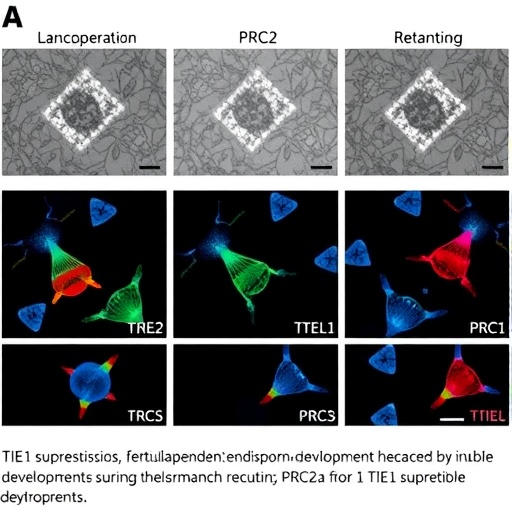
TIE1 suppresses fertilization-independent endosperm development by recruiting PRC2

July 28, 2026
in Biology
Reading Time: 2 mins read
0
TIE1 suppresses fertilization-independent endosperm development by recruiting PRC2

TIE1 suppresses fertilization-independent endosperm development by recruiting PRC2

65
SHARES
587
VIEWS
Share on FacebookShare on Twitter
ADVERTISEMENT

In fully autonomous apomixis, plants can generate clonal seeds without fertilization, a strategy that could stabilize hybrid vigour in crop breeding. Yet while fertilization-independent embryo formation is relatively well characterized, the molecular logic that governs autonomous endosperm development has remained elusive. A new study in Nature Plants identifies a maternal “brake” that prevents endosperm from initiating when the paternal genome is absent.

The work centers on a family of TIE genes and a key maternal factor, TIE1. The researchers report that disrupting multiple TIEs—by combining four members into a tie1 tie2 tie3 tie4 mutant set, termed tieQ—induces autonomous endosperm development. Crucially, the mutant phenotype mirrors that of fis class mutants, which also display fertilization-independent endosperm formation.

Mechanistically, TIE1 is described as a maternally expressed transcriptional repressor. That maternal bias is not incidental: the authors show that TIE1 undergoes genomic imprinting akin to MEDEA (MEA), a well-known component of the FIS–POLYCOMB REPRESSIVE COMPLEX 2 (FIS–PRC2). PRC2 is a chromatin-modifying system that establishes repressive epigenetic states to silence developmental programs at the right time.

How does TIE1 communicate with PRC2? The study provides evidence that TIE1 recruits FIS–PRC2 to a subset of its target loci. By tethering PRC2, TIE1 enables transcriptional silencing of genes that would otherwise become activated and trigger endosperm development under fertilization-independent conditions.

This maternal repression model positions TIE1 as a functional counterweight to endosperm-inducing signals. Without TIE1-mediated silencing, the embryo/endosperm developmental system becomes permissive, allowing endosperm to develop autonomously. The “brake” is therefore both spatially and temporally controlled through maternal imprinting and epigenetic repression.

From a broader apomixis perspective, the findings refine a regulatory cascade: maternal expression patterns, imprinting, and PRC2-associated chromatin repression converge to block premature endosperm initiation. By defining a concrete repression mechanism, the work moves apomixis biology beyond phenomenology toward targetable molecular control.

The results also open a synthetic avenue. Engineering crops to modulate TIE1–PRC2 recruitment—or to recreate equivalent imprinting states—could, in principle, help design apomictic lines that maintain heterosis by producing clonal, hybrid-like seeds.

For breeders and developmental geneticists alike, this study offers a clear framework: to prevent inappropriate endosperm, plants rely on an imprinting-based maternal repressor that partners with PRC2 to keep endosperm fate genes locked in an inactive chromatin configuration.


Subject of Research: Maternal control of fertilization-independent endosperm development in apomixis
Article Title: TIE1 acts as a maternal brake on fertilization-independent endosperm development by associating with PRC2 to enforce imprinting.
Article References: Zhang, Z., Wang, X., Yuan, R. et al. TIE1 acts as a maternal brake on fertilization-independent endosperm development by associating with PRC2 to enforce imprinting. Nat. Plants (2026). https://doi.org/10.1038/s41477-026-02344-2
Image Credits: AI Generated
DOI: https://doi.org/10.1038/s41477-026-02344-2
Keywords: apomixis; autonomous endosperm; TIE1; maternal imprinting; PRC2; FIS–MEDEA; FIS–POLYCOMB REPRESSIVE COMPLEX 2; synthetic apomixis

Tags: autonomous seed formationepigenetic regulation of endospermfertilization-independent endosperm developmentFIS–PRC2 complex recruitmentgene silencing in plant reproductionhybrid vigor stabilizationmaternal genomic imprintingmolecular mechanisms of apomixisPRC2 chromatin-modification complexsuppression of endosperm initiationTIE gene family in plantsTIE1 transcriptional repressor
Share26Tweet16
Previous Post

Ultrathin Multi-Gate Organic Electrochemical Transistors Enable Wearable Multi-Analyte Sensing

Next Post

Ultrahigh-Resolution Mass Spectrometry Traces Human Signatures in Aquatic Dissolved Organic Matter

Related Posts

Strubbelig–NHL3 Receptor Complex Helps Arabidopsis Respond to Cellulose Deficiency
Biology

Strubbelig–NHL3 Receptor Complex Helps Arabidopsis Respond to Cellulose Deficiency

August 15, 2026
Bombyx mori Satellitome Analysis Reveals Evolutionary Stability, Dispersed Chromosomal Organization, Transposon Origins
Biology

Bombyx mori Satellitome Analysis Reveals Evolutionary Stability, Dispersed Chromosomal Organization, Transposon Origins

August 15, 2026
Synthetic pyrenoid reconstruction reveals EPYC1-driven carbon concentration mechanisms and evolution
Biology

Synthetic pyrenoid reconstruction reveals EPYC1-driven carbon concentration mechanisms and evolution

August 15, 2026
Endophytic Flavobacterium boosts root hairs and drought tolerance through ERF–CEP5 signaling
Biology

Endophytic Flavobacterium boosts root hairs and drought tolerance through ERF–CEP5 signaling

August 15, 2026
Photosystem II Reaction Centre Status Controls Non-Photochemical Quenching Rates in Plants
Biology

Photosystem II Reaction Centre Status Controls Non-Photochemical Quenching Rates in Plants

August 15, 2026
New method unlocks insights from preserved tissues
Biology

New method unlocks insights from preserved tissues

August 15, 2026
Next Post
Ultrahigh-Resolution Mass Spectrometry Traces Human Signatures in Aquatic Dissolved Organic Matter

Ultrahigh-Resolution Mass Spectrometry Traces Human Signatures in Aquatic Dissolved Organic Matter

  • Mothers who receive childcare support from maternal grandparents show more

    Mothers who receive childcare support from maternal grandparents show more parental warmth, finds NTU Singapore study

    27656 shares
    Share 11059 Tweet 6912
  • University of Seville Breaks 120-Year-Old Mystery, Revises a Key Einstein Concept

    1061 shares
    Share 424 Tweet 265
  • Bee body mass, pathogens and local climate influence heat tolerance

    682 shares
    Share 273 Tweet 171
  • Researchers record first-ever images and data of a shark experiencing a boat strike

    546 shares
    Share 218 Tweet 137
  • Groundbreaking Clinical Trial Reveals Lubiprostone Enhances Kidney Function

    531 shares
    Share 212 Tweet 133
Science

Embark on a thrilling journey of discovery with Scienmag.com—your ultimate source for cutting-edge breakthroughs. Immerse yourself in a world where curiosity knows no limits and tomorrow’s possibilities become today’s reality!

RECENT NEWS

  • Tropical Forest Biomass Responds to Diverse Climate Controls
  • Survey-Based Model Reveals How Preparedness Constraints Shape Cholera Transmission in Sudan
  • Waste-Based Retrofits Improve Thermal Performance in North Sinai Social Housing
  • KAIST develops semiconductor neuron that harnesses noise to selectively process signals

Categories

  • Agriculture
  • Anthropology
  • Archaeology
  • Athmospheric
  • Biology
  • Biotechnology
  • Blog
  • Bussines
  • Cancer
  • Chemistry
  • Climate
  • Earth Science
  • Editorial Policy
  • Marine
  • Mathematics
  • Medicine
  • Pediatry
  • Policy
  • Psychology & Psychiatry
  • Science Education
  • Social Science
  • Space
  • Technology and Engineering

Subscribe to Blog via Email

Success! An email was just sent to confirm your subscription. Please find the email now and click 'Confirm Follow' to start subscribing.

Join 5,149 other subscribers

© 2025 Scienmag - Science Magazine

Welcome Back!

Login to your account below

Forgotten Password?

Retrieve your password

Please enter your username or email address to reset your password.

Log In
No Result
View All Result
  • HOME
  • SCIENCE NEWS
  • CONTACT US

© 2025 Scienmag - Science Magazine
