


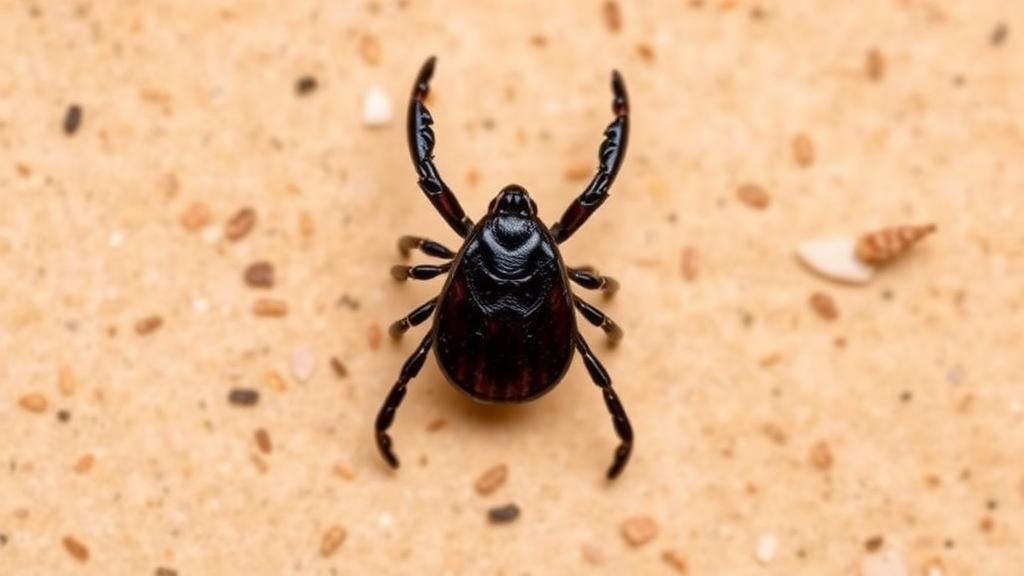
In the semi-arid riparian corridors and grasslands of southern Arizona, a quiet partnership between ticks and bacteria has been running for generations without much help from the mammals that scientists long assumed were essential. A new field study, published in the journal Parasites & Vectors, reports that two closely related spotted fever group bacteria, Rickettsia parkeri and the still unofficially named “Candidatus Rickettsia andeanae,” persist in populations of the Gulf Coast tick Amblyomma maculatum sensu lato largely through inheritance from mother tick to offspring. The finding reshapes how researchers think about the ecological reservoir of these pathogens: rather than relying on a cycle of infection and amplification in vertebrate hosts, the tick population itself appears to serve as the primary long-term reservoir.
The research was led by Geoffrey E. Lynn of Texas A&M AgriLife Research and Tammi L. Johnson, together with colleagues at Texas A&M University, the Centers for Disease Control and Prevention, and the University of Minnesota. Over a 14-month longitudinal field study in a Madrean riparian–grassland system, the team combined serology, molecular screening of thousands of ticks and rodent samples, and laboratory feeding experiments with field-collected adult female ticks. The work was funded by the United States Department of Defense Tick and Tick-borne Disease Research Program and by National Institute of Food and Agriculture Hatch projects.
Rickettsia parkeri is a tick-borne bacterium associated with Amblyomma ticks throughout the Western Hemisphere and is a recognized cause of spotted fever rickettsiosis in people. In southern Arizona it co-occurs with “Candidatus Rickettsia andeanae,” a closely related species whose pathogenic significance remains uncertain. The co-occurrence offered the researchers a rare opportunity to evaluate transmission pathways and possible interactions between two sympatric rickettsiae sharing the same tick vector in the same landscape.
The vertebrate side of the story turned out to be less dramatic than expected. The team screened 320 rodent serum samples collected across the study period for antibodies reactive to R. parkeri using the indirect immunofluorescence assay, the standard serological tool for rickettsial exposure. A striking 63 percent of the rodents showed reactive antibodies, indicating that exposure to the bacterium is frequent in the rodent community. Yet when the researchers looked for direct evidence of infection, the picture changed sharply. Molecular screening detected R. parkeri DNA in only 3.1 percent of 1378 rodent ear biopsies, the tissue sampled at the skin sites where immature ticks attach and feed, and the bacterium was entirely absent from 211 rodent whole blood specimens.
That combination of high seroprevalence and near-absence of detectable bacterial DNA carries a specific technical meaning. It suggests that rodents are bitten often enough to mount antibody responses, but that the bacterium rarely establishes itself in rodent tissues at feeding sites and does not produce detectable rickettsemia, the presence of bacteria in circulating blood. Without rickettsemia, feeding ticks are unlikely to acquire infection from their hosts in quantities sufficient to sustain horizontal transmission. In other words, the mammalian hosts experience frequent exposure but appear to contribute little to maintaining or amplifying the bacteria in the environment.
The tick side of the story was far more consequential. To test whether the bacteria pass from one tick generation to the next, the researchers allowed field-collected adult female A. maculatum s.l. ticks to feed on heifers and then examined the post-oviposition carcasses of the mothers and the resulting first-generation larvae. The results were unambiguous: filial infection rates reached 100 percent in clutches produced by females positive for either R. parkeri or “Ca. R. andeanae” that carried high maternal rickettsial loads. Every larva in those clutches inherited the infection. Such highly efficient transovarial transmission means that an infected female effectively reproduces the entire bacterial population in her offspring, generation after generation, without any need for a vertebrate host to become infected.
Vertical transmission of this kind has important epidemiological implications. When a pathogen is maintained transovarially within a tick lineage, the tick population functions as both vector and reservoir, and the pathogen can persist even if susceptible vertebrate hosts are absent or fail to develop systemic infections. For R. parkeri, which causes disease in humans bitten by infected adult ticks, this means that the risk of human exposure is tied directly to the prevalence of infected ticks in the environment rather than to the dynamics of infection in rodents or other small mammals. Surveillance and risk assessment, the study suggests, should therefore focus on the tick population itself.
The study also uncovered evidence of competition between the two rickettsial species inside their shared tick host. Among the 1941 immature-stage A. maculatum s.l. ticks screened for Rickettsia DNA, co-infections with both R. parkeri and “Ca. R. andeanae” occurred significantly less often than would be expected by chance. This pattern is consistent with competitive exclusion, a well-known ecological principle in which two species competing for the same niche cannot stably coexist, with one excluding the other. Within an individual tick, the two bacteria apparently compete for intracellular resources or space, so that infection with one species reduces the likelihood of a successful co-infection with the other.
Prevalence ratios calculated by the team also addressed a second possible horizontal route: co-feeding transmission, in which uninfected ticks acquire bacteria while feeding adjacent to infected ticks on the same host, without any systemic infection in the vertebrate itself. The data indicated that co-feeding may play some role, but the authors concluded that vertebrate-mediated horizontal amplification is limited and likely inefficient in this system. For “Ca. R. andeanae,” the conclusion was even stronger: the bacterium appears to be maintained almost exclusively through vertical transmission, making it even more dependent on the tick lineage than R. parkeri.
Taken together, the results portray a maintenance strategy in which the tick population is the primary biological reservoir for both rickettsiae, with competitive interactions between the bacteria acting as a brake on how common each species can become where they co-occur. The findings carry practical weight for public health in the region, since R. parkeri rickettsiosis is a recognized human illness and understanding where the bacterium persists helps target surveillance. They also contribute to a broader shift in tick-borne disease ecology, away from models centered exclusively on vertebrate reservoir hosts and toward models that recognize the tick itself, with its remarkable capacity to carry bacteria across generations, as the engine of pathogen persistence in semi-arid landscapes like the Madrean riparian–grassland system of southern Arizona.
Subject of Research: Vertical transmission and competitive exclusion of Rickettsia parkeri and "Candidatus Rickettsia andeanae" in Amblyomma maculatum tick populations
Article Title: Vertical transmission drives the persistence of Rickettsia parkeri and “Candidatus Rickettsia andeanae” in Amblyomma maculatum sensu lato populations in a semi-arid Madrean riparian–grassland system
Article References: Lynn, G. E., Ludwig, T. J., Paddock, C. D., Allerdice, M. E. J., Cull, B., Hays, S. R., Chapman, T. J., Donaldson, T. G., Teel, P. D., & Johnson, T. L. (2026). Vertical transmission drives the persistence of Rickettsia parkeri and “Candidatus Rickettsia andeanae” in Amblyomma maculatum sensu lato populations in a semi-arid Madrean riparian–grassland system. Parasites & Vectors. https://doi.org/10.1186/s13071-026-07687-5
Image Credits: AI Generated
DOI: 10.1186/s13071-026-07687-5
Keywords: Rickettsia parkeri, Candidatus Rickettsia andeanae, Amblyomma maculatum, vertical transmission, transovarial transmission, spotted fever group rickettsiae, tick-borne disease, competitive exclusion, rodent serology, co-feeding transmission, southern Arizona, Parasites & Vectors
Cite Scienmag News
Drew Townsend. (October 1, 2026). Ticks Keep Spotted Fever Bacteria Alive on Their Own, Study Finds. Scienmag. https://scienmag.com/ticks-keep-spotted-fever-bacteria-alive-on-their-own-study-finds/
Drew Townsend. "Ticks Keep Spotted Fever Bacteria Alive on Their Own, Study Finds." Scienmag, 1 October 2026, https://scienmag.com/ticks-keep-spotted-fever-bacteria-alive-on-their-own-study-finds/. Accessed 4 October 2026.
Drew Townsend. "Ticks Keep Spotted Fever Bacteria Alive on Their Own, Study Finds." Scienmag. October 1, 2026. https://scienmag.com/ticks-keep-spotted-fever-bacteria-alive-on-their-own-study-finds/


